
Where stone breathes devotion, and the Dhauladhars guard a forgotten masterpiece
Carved from a single monolithic rock in the 8th century, the Masroor Rock Cut Temple—also known as the Masrur Temples—is one of North India’s only rock-cut temple complexes, nestled in the Beas River Valley of Kangra district, Himachal Pradesh. Often dubbed the “Ellora of the Himalayas,” this architectural marvel is a testament to ancient craftsmanship, spiritual synthesis, and cosmic geometry.
🌄 Location & Accessibility
- Location: Masroor Village, Kangra District, Himachal Pradesh – 176026
- Altitude: ~760 meters
- By Road: 45 km from Dharamshala, 35 km from Kangra town
- By Rail: Kangra Mandir Station (~30 km), Pathankot Junction (~85 km)
- By Air: Gaggal Airport (~40 km)
- On Foot: A short walk from the parking area through village trails and forested paths
🕉️ Deities & Worship
The temple complex is dedicated to multiple deities from Shaiva, Vaishnava, Shakta, and Saura traditions, reflecting a henotheistic spiritual vision:
- The main sanctum enshrines Lord Shiva, likely in the form of a lingam
- Other shrines honor Vishnu, Devi (Durga), and Surya (Sun God)
- The temple’s iconography includes Vedic and Puranic deities, though many sculptures have been lost to time and earthquakes
While the temple is not an active site of daily worship, it remains a sacred pilgrimage and archaeological wonder, protected by the Archaeological Survey of India.
🏛️ Architecture & Layout
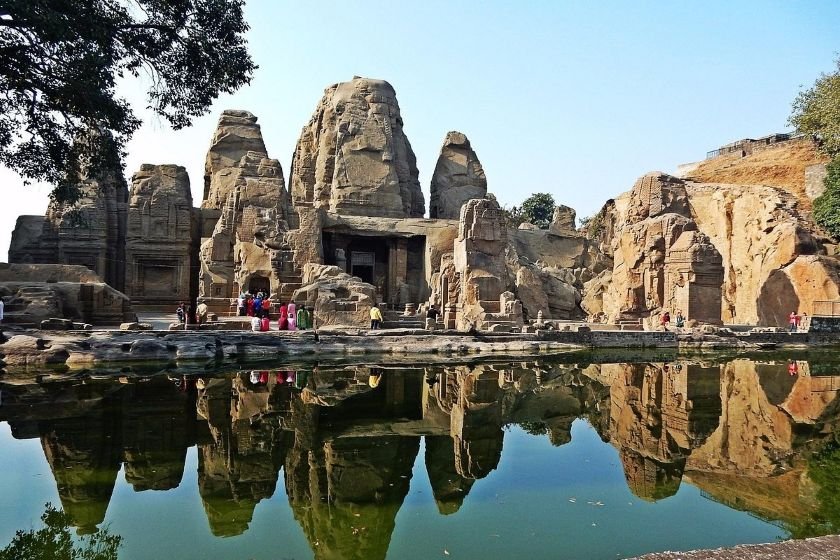
The Masroor complex is a monolithic rock-cut temple, carved directly into a hill, featuring:
- 15 rock-cut shrines arranged in a mandala-like square grid
- A central temple with a shikhara (spire) surrounded by smaller shrines
- Three entrances (northeast, southeast, northwest), with a fourth incomplete
- A sacred water tank in front of the temple, reflecting the spires like a mirror
- Reliefs and friezes depicting scenes from the Ramayana, Mahabharata, and Hindu cosmology
The temple faces northeast, aligned with the Dhauladhar range, symbolizing the temple-mountain concept—a cosmic axis connecting earth and heaven.
📜 Historical & Cultural Significance
- Built during the early 8th century, possibly under the Katyuri or early Karkota dynasty
- First brought to scholarly attention in 1913 by Henry Shuttleworth, and later surveyed by Harold Hargreaves of the ASI in 1915
- The temple was damaged by earthquakes, especially the 1905 Kangra quake, but its core structure remains intact
- It is one of the few surviving examples of North Indian rock-cut architecture, making it culturally and archaeologically invaluable
🎉 Festivals & Experience
While no major festivals are held here today, the site is visited by:
- Pilgrims seeking blessings from the ancient deities
- Historians and architects studying its unique construction
- Photographers and trekkers drawn by its mystical aura and panoramic views
🏞️ Nearby Attractions
- Kangra Fort: A historic stronghold with panoramic views
- Brajeshwari Devi Temple: A Shaktipeeth in Kangra town
- Chamunda Devi Temple: A riverside shrine of fierce grace
- Dharamshala & McLeod Ganj: Cultural hubs of Tibetan Buddhism
🙏 Spiritual Experience
The Masroor Rock Cut Temple is not just a monument—it is a stone hymn, a place where the chisel met the cosmos, and faith was carved into permanence. As you stand before its weathered spires, with the Dhauladhars rising behind and the sacred pool reflecting the sky, you feel the presence of a civilization that dreamed in stone. It is a temple where architecture becomes prayer, and the **soul finds its echo in the silence of rock.