Overview:
Commissioned in 2007, the Larji HEP is a 126 MW run-of-the-river project developed by the Himachal Pradesh State Electricity Board (HPSEB). It harnesses the flow of the Beas River through a short but powerful system of tunnels and turbines. The project is known for its underground powerhouse, compact design, and strategic location at the confluence of the Sainj and Tirthan valleys.
📍 Location & Key Details
| Attribute | Details |
|---|---|
| Coordinates | 31.7196°N, 77.2120°E |
| District | Kullu |
| River | Beas |
| Installed Capacity | 126 MW (3 × 42 MW Francis turbines) |
| Commissioned | 2007 |
| Operator | HPSEB |
| Project Type | Run-of-the-river |
| Powerhouse Type | Underground |
| Net Head | ~56.84 meters |
🏗️ Engineering Highlights
- Diversion Dam:
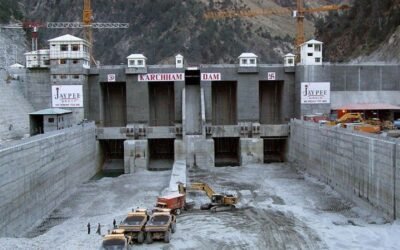
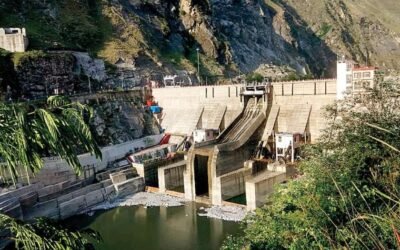
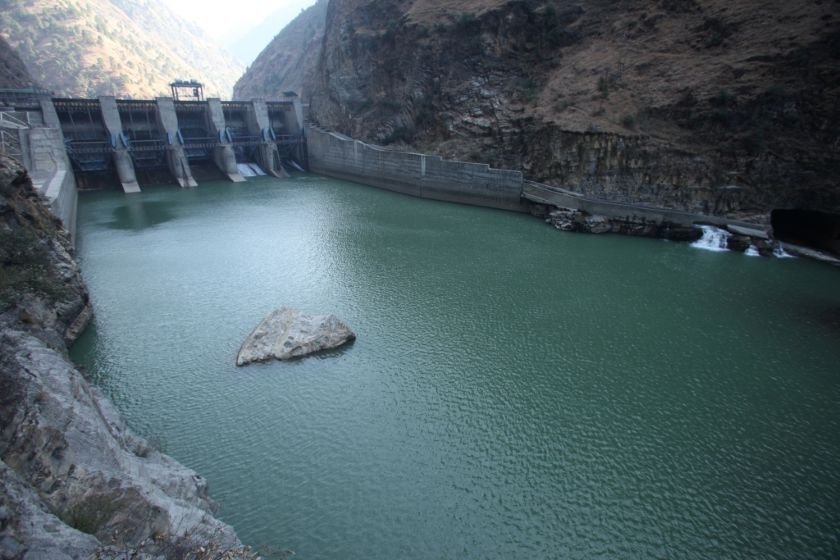
A concrete gravity dam diverts water into a 4.4 km headrace tunnel leading to the underground powerhouse. - De-silting Chambers:
Four massive chambers (200 × 16 × 27 m) remove abrasive silt from the Beas before it reaches the turbines. - Penstocks:
Three steel-lined penstocks (83.33 m long, 4.5 m diameter) feed the turbines with regulated flow. - Annual Generation:
Approximately 598.7 GWh, contributing significantly to the state’s power supply.
🌄 Scenic & Strategic Context
- Location Advantage:
Situated near Aut, the project lies at the gateway to Tirthan and Sainj Valleys, making it visible to tourists en route to the Great Himalayan National Park. - Tourist Interest:
While the powerhouse is not open to the public, the dam and surrounding gorge offer dramatic views—especially during monsoon when the Beas is in full flow. - Nearby Attractions:
- Sainj HEP (upstream)
- Tirthan Valley – trout fishing, eco-tourism
- Jibhi & Banjar – forest trails and homestays
⚠️ Flood Damage & Restoration (2023–2025)
- In July 2023, catastrophic floods in the Beas River caused extensive damage to the Larji project, depositing muck deep inside the turbine units.
- Restoration was completed in less than two years, with all three units fully operational by January 2025.
- The state government allocated over ₹245 crore for rehabilitation, including slope stabilization, rockfall barriers, and flood-proofing tunnels.
🧭 Accessibility
- By Road:
Located on NH-3, about 40 km from Mandi and 60 km from Kullu. - By Train:
Nearest railhead: Joginder Nagar (narrow gauge) or Chandigarh (broad gauge) - By Air:
Bhuntar Airport (Kullu) – ~45 km away