
Temple & sacred site
Aadi Brahma Temple, Khokhan
Four Roofs Above a Living Himalayan Tradition
At a glance
- Location
- Historic Aadi Brahma Temple, Khokhan, Kullu district
- How to reach
- Road via Bhuntar; confirm the intended temple and current worship location
Four tiers of carved wood give Khokhan’s Aadi Brahma Temple its distinctive form, while festivals and village relationships keep its heritage active.
Aadi Brahma Temple at Khokhan combines two reasons to visit: a memorable historic building and the continuing religious life of the Kullu Valley. Its roofline draws the eye, but the shrine’s meaning also lies in the deity’s relationships with villages, other devtas, and ceremonial occasions.
Give both aspects time. An architectural visit may involve looking closely at the exterior, while attending worship depends on current local arrangements. The two should be planned together without assuming they always happen at the same location or hour.
🌄 Location and how to reach it
The historic temple stands in Khokhan village near Bhuntar, Kullu district. The official Kullu Dussehra directory lists the approach as Kullu–Bhuntar–Khokhan and gives an approximate distance of 12 km from Kullu.
Google Maps: Find Aadi Brahma Temple, Khokhan
- From Kullu: Arrange the journey through Bhuntar and ask for the historic Khokhan temple.
- From Bhuntar: Confirm the village road, suitable drop-off point, and any remaining walk.
- By public transport: Check the current service and return connection rather than assuming a direct vehicle to the entrance.
- After a flight: Allow separately for the road connection from Bhuntar Airport.
Route estimates vary with the starting point. Visitors concerned about steps or uneven village paths should ask about the final approach in advance.
🌸 Best time to visit
Spring to early summer and autumn are sensible periods for combining Khokhan with other lower-valley stops. Daylight helps when looking at the roof structure and carved details.
During the monsoon, check the roads and leave extra travel time. In winter, prepare for the weather along the whole journey rather than relying on the conditions at your accommodation.
If worship or a festival is your main interest, begin by confirming the relevant location and date. A suitable day for sightseeing may not coincide with the deity’s ceremonial presence at the historic building.
🕉️ Aadi Brahma in the valley’s devta tradition
The official directory names the deity as Shri Devta Aadi Brahma, also called Brahma Ji, and records a relationship with Devta Veer Nathji. It also lists participation in Kullu Dussehra.
Brahma’s wider association with creation provides a starting point, but the shrine belongs to a specific local religious world. Its customs and ceremonial relationships should be understood through the people responsible for the deity’s worship.
Ask about what is taking place during your visit rather than applying a generic description of Hindu ritual. Village devta traditions can carry details that a broad guide does not capture.
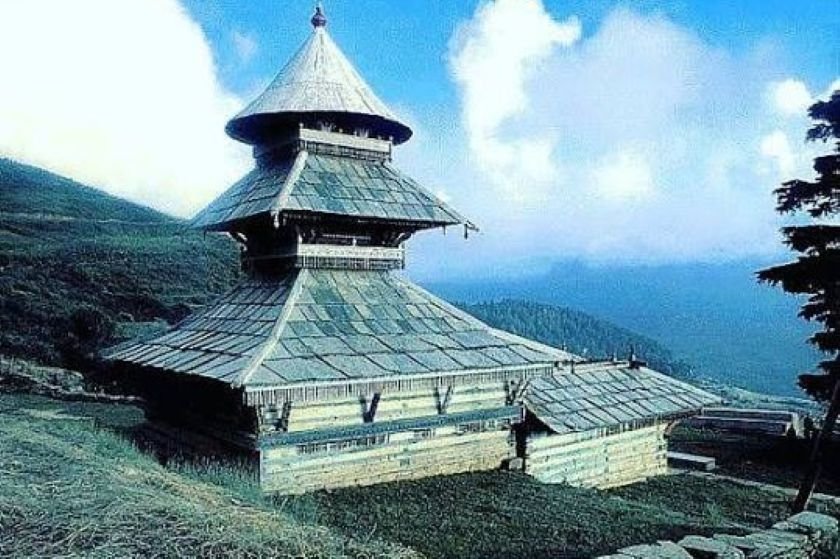
🏛️ The four-tiered wooden temple
The building is recognised for its four-tiered pagoda-style form. A state heritage inventory describes richly ornamented supporting brackets, bells at the roof ends, and a small pent-and-gable form at the summit.
Begin at a respectful distance where the whole silhouette is visible. The relationship between each projecting roof gives the structure its shape; the closer view then reveals the work in the supports and decorative elements.
Look without handling the woodwork or moving barriers. A carving can be appreciated without touching it, and a good vantage point should not obstruct the entrance or the movement of worshippers.
The temple is one of several Brahma shrines in the region. Descriptions claiming that it is India’s only Brahma temple should be avoided.
📜 Understanding the temple’s age
The heritage inventory gives different dates for different parts of the shrine: older sculptural material, a later medieval structure, and an eighteenth-century repair. Its account associates a recorded repair in 1747 with Raja Tedhi Singh.
Those layers are more informative than a single construction year. A sculpture may have been preserved through rebuilding, while the structure around it has changed. A repair records another chapter in the life of the shrine rather than erasing what came before it.
For visitors, the important point is that Khokhan preserves a historic wooden temple whose fabric and objects have their own chronology. Avoid assigning the age of the oldest object to everything now visible.
🔗 The Aadi Purkha connection
Mandi district’s account of Aadi Purkha Temple at Tihri records a traditional connection with Khokhan. It describes a shared worship relationship and the establishment of a separate shrine after a territorial division between Mandi and Kullu.
This is a recorded local tradition, and it helps place Khokhan within a wider network of communities. Religious relationships can continue through stories, images, and architectural references even as political boundaries change.
Keep the two sites distinct when planning a journey. A connection in religious history does not make the temples neighbouring stops on a short outing.
🎉 Festivals and Kullu Dussehra
The official directory lists Panchmi, Sadiyala, Baishakhi, and Dussehra among the deity’s associated occasions. These references show the importance of the ceremonial calendar to Aadi Brahma’s community role.
Confirm the current dates, procession arrangements, and visitor expectations locally. The deity’s movements may determine where worship is taking place, and a listing in a directory does not promise an event at a particular building on every visit.
During a procession, give ceremonial equipment and participants space. Ask where visitors may stand and whether photographs are appropriate.
🙏 Confirming the current worship location
A November 2025 report describes the consecration of a new Aadi Brahma temple at Rohalgi. This is a reason to ask which location suits the purpose of your visit.
It does not by itself establish that the historic Khokhan temple has closed or that every ritual has moved. Make the distinction clear when arranging transport: are you hoping to see the old wooden building, attend darshan, or join a particular ceremony?
No dependable current daily timetable is established here. Local custodians are the appropriate source for access and worship arrangements.
📷 Etiquette and care for the building
- Follow footwear and entry instructions.
- Ask before approaching the inner shrine or photographing sacred images.
- Leave carvings, ritual objects, and ceremonial equipment untouched.
- Keep village paths and doorways clear.
- Avoid leaning bags or equipment against old woodwork.
- Give worship and processions priority over a sightseeing photograph.
Leave time to view the accessible exterior without rushing, and add travel and any wait for access separately. The pace of the visit should follow the site’s arrangements.
🏞️ Places to combine with Khokhan
- Bhuntar: A convenient transport connection.
- Bajaura: A possible additional stop on a wider temple itinerary.
- Kullu town: A base for exploring the valley’s religious life.
- Raghunath Temple: Another important place for understanding Kullu’s ceremonial traditions.
Check each stop’s access arrangements before putting several shrines into one day. A short journey between sites is not always enough to make a rushed itinerary worthwhile.
❓ Quick questions travellers ask
Where is the historic temple?
In Khokhan village near Bhuntar, Kullu district.
What makes the building distinctive?
Its four-tiered wooden roof arrangement and richly decorated supports.
Is it the only Brahma temple in India?
No. Other Brahma shrines exist, including in the wider Himalayan region.
Does the deity participate in Kullu Dussehra?
Yes, according to the official directory.
Should I confirm where darshan takes place?
Yes. Ask specifically about the intended worship location and the historic Khokhan building.
A final thought
Khokhan’s temple rewards close looking, but its heritage also continues through relationships beyond the building. The roofs and carvings, the festival calendar, and the care of local custodians belong to the same continuing story.
Sources and references
- Himachal Pradesh Department of Language and Culture: heritage inventory — architectural features and recorded phases.
- Official Kullu Dussehra directory: Shri Devta Aadi Brahma — route, deity relationships, and annual occasions.
- District Mandi: Aadi Purkha Temple, Tihri — the traditional connection with Khokhan.
- Amar Ujala, November 2025: new Aadi Brahma temple at Rohalgi — dated reporting relevant to checking the present worship location.