
Temple & sacred site
Surya Narayan Temple, Nirath
A Sun Shrine Beside the Sutlej
At a glance
- Location
- Nirath village near Rampur Bushahr, Shimla district
- How to reach
- Road along the Shimla–Rampur corridor; confirm parking and village access
A stone tower beside the Sutlej preserves Nirath’s Sun-worship tradition and a history shaped by more than one period of building.
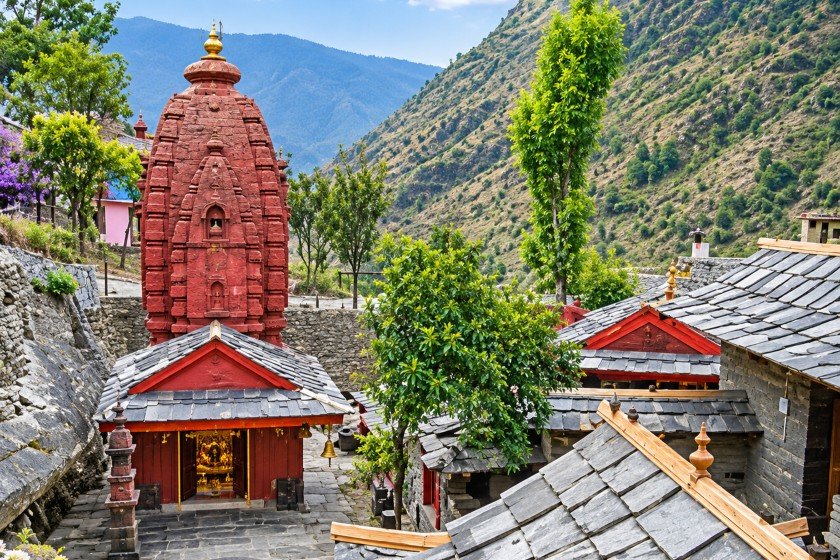
Surya Narayan Temple at Nirath gives a journey towards Rampur a reason to slow down. Dedicated to Surya, the Sun God, it offers a different architectural experience from the tiered wooden shrines often associated with the Himachal hills.
The temple’s appeal lies in that dedication, its rising stone form, and the details that become visible when a visitor stops to look. Its age also deserves careful explanation. An old religious tradition and a standing building altered over time should not be reduced to one confident founding date.
🌄 Location and how to reach it
Nirath is near Rampur Bushahr in Shimla district, on the Sutlej Valley corridor. Architectural literature places the village approximately 18 km from Rampur, though an actual journey depends on the chosen starting point and road route.
Google Maps: Find Surya Narayan Temple, Nirath
- From Rampur: Confirm the approach to Nirath and the final route through the village.
- From Shimla or Narkanda: Consider the stop as part of the onward valley journey, allowing time for access and worship.
- By public transport: Ask whether the service stops at Nirath and how to continue after the visit.
- By private vehicle: Find a suitable parking place locally rather than assuming the vehicle can reach the entrance.
Check walking surfaces, steps, and the nearest drop-off point if visiting with someone who has limited mobility.
🌸 Best time to visit
Spring to early summer and autumn are sensible periods for a wider Sutlej Valley outing. Plan around daylight if the exterior sculpture and architectural form are a main interest.
The valley can feel quite different from a higher overnight base. Carry what you need for the conditions at the temple as well as the weather along the journey. During rain or winter conditions, check the whole route rather than relying on how the weather looks at departure.
Confirm access separately if your purpose is to enter the shrine for worship. A convenient sightseeing hour is not necessarily the time a custodian can admit visitors.
☀️ Surya Narayan and the temple’s dedication
Surya is associated in Hindu tradition with the sun, light, and the ordering of time. At Nirath, this wider devotional tradition takes a particular local form in a village shrine.
Architectural accounts record a stone image of Surya. For a devotee it is a focus of worship; for someone interested in sacred art, it provides a reason to consider the relationship between the image and the building around it.
Let the custodians explain the offerings and practices followed here. A general description of Sun worship should not be used to assume a ritual programme for this particular temple.
📜 How old is the temple?
The National Mission on Monuments and Antiquities records competing chronological information. Its historical account mentions scholarly proposals of an eighth–ninth-century origin and substantial later reconstruction, while its date field uses a later period.
A recent architectural study lists Nirath’s Sun temple as twelfth century. These references do not provide a single settled date for every element of the site. They point instead towards a shrine whose origins, surviving fabric, and repairs need to be distinguished.
The clearest account for a visitor is that Nirath preserves an old Sun-worship tradition in a building with a layered history. Neither an early proposed origin nor a later reconstruction date should be made to explain every stone without further evidence.
🏛️ Stone architecture and the shikhara
The heritage record describes a Nagara-style shrine with a shikhara, a sanctum, and an assembly space. Its stone construction gives the temple a recognisable vertical form.
Stand back first to see the outline. Then, where access allows, move closer to examine the visible carving. Ronald M. Bernier’s architectural account draws attention to a dancing Ganesha relief on the rear exterior.
This is a useful place to compare different ways of building in the Himalayan region. The tower supplies a different silhouette from a shrine organised around successive projecting roofs. The comparison is best made through what is actually visible, without assuming that all temples in one valley follow a single style.
📖 The Pandava tradition
Local accounts associate the shrine with the Pandavas and their period of concealment, or Agyaatvaas. That belongs to religious memory, rather than an independently established account of construction.
The legend and the architectural evidence answer different questions. One describes the place a community gives the shrine within sacred storytelling; the other examines its materials, images, and changes over time.
A visitor can listen to the tradition respectfully without turning it into a measured historical date. Where tellings differ, allow the person explaining the shrine to use their own words.
🌊 Making Nirath part of a valley journey
A temple stop needs room in the itinerary. Leave time to park without obstructing the village, find the appropriate entrance, and ask about access if the shrine is closed.
A short visit to the visible exterior may suit one traveller, while someone coming for worship or an explanation will need longer. Treat any suggested duration as an allowance to adapt, rather than a requirement to finish within a fixed number of minutes.
For drivers continuing towards Kinnaur, decide on the day’s main destination before adding further stops. Giving Nirath proper attention is more useful than visiting it hurriedly between several distant landmarks.
🎉 Worship and festival visits
A dependable current temple-specific festival calendar has not been established for this guide. Occasions associated with Surya worship more generally should not automatically be presented as confirmed events at Nirath.
If a particular ceremony is the purpose of your journey, ask the temple’s custodians about the date, start time, and participation arrangements. Religious calendars and local practices need to be checked for the visit being planned.
🙏 Opening arrangements and etiquette
Confirm the current daily timetable and entry arrangements locally before travelling especially for worship. No unverified temple telephone number or booking service is included here.
- Remove footwear wherever instructed.
- Ask before photographing the deity, sanctum, or a ritual.
- Keep clear of worshippers and preparations for prayer.
- Leave carved surfaces untouched; avoid rubbing, marking, or leaning objects against them.
- Ask about offerings and donations rather than assuming a procedure.
- Keep the surroundings clean and respect village entrances and paths.
Exterior visibility and access to an inner worship space are separate matters. Follow the guidance given for each part of the shrine.
🏞️ Places to combine with Nirath
- Rampur Bushahr: A practical connection for exploring this stretch of the Sutlej Valley.
- Narkanda: A possible earlier or later stop on the Shimla approach.
- Sarahan and Bhimakali Temple: A separate detour for a broader itinerary, requiring adequate travel time.
- Kinnaur: An onward journey whose driving distance should be planned independently of the temple visit.
Choose a route that gives each stop time, rather than treating all regional destinations as immediately nearby.
❓ Quick questions travellers ask
Which deity is worshipped at Nirath?
Surya Narayan, the Sun God.
Is a single construction year certain?
No. Published heritage and architectural accounts offer different dates and describe later changes.
Did the Pandavas build the temple?
That is a local religious tradition, rather than a verified construction history.
Is it the only Sun temple in North India?
No. That frequently repeated superlative should not be used as fact.
Are daily darshan hours confirmed?
No dependable current official timetable has been established here; ask locally before making a special journey.
A final thought
Nirath rewards close attention to a building that can easily be passed on a long drive. Its solar dedication, stone form, and layered history give the valley journey another dimension, while worship keeps the shrine part of village life.
Sources and references
- National Mission on Monuments and Antiquities: Surya Narayan Temple, Nirath — architectural description and differing chronological fields; the catalogue’s administrative fields should not be treated as a current visitor address.
- Ronald M. Bernier: Himalayan Towers — architectural and sculptural observations.
- Indian Journal of Traditional Knowledge: Himachal temple architecture study — comparative classification and dating.
- District Shimla: Patwar Circles — administrative context for Nirath.