
Temple & sacred site
Masroor Rock Cut Temple, Kangra
The Unfinished Miracle Carved From a Single Mountain
At a glance
- Location
- Masroor / Masrur rock-cut temple complex, Kangra district
- How to reach
- Road to Masroor village, followed by the protected monument visitor route
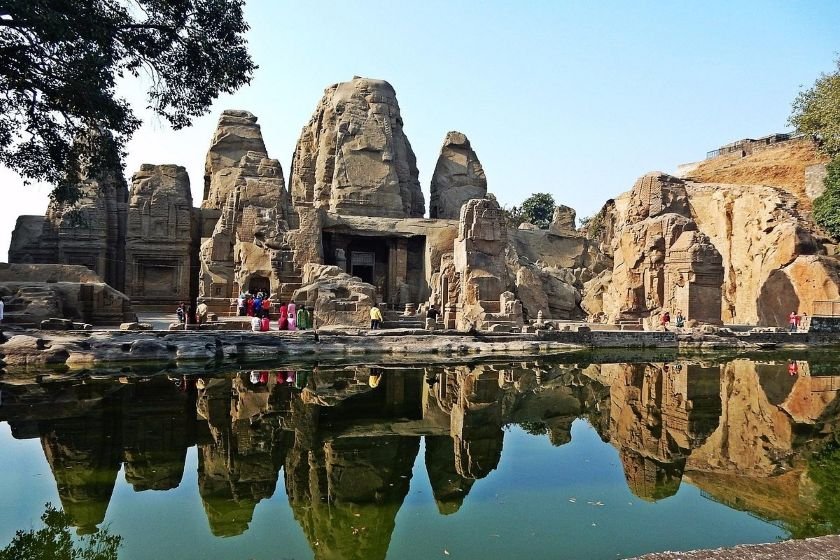
Masroor turns a rock outcrop into temple architecture. Towers, doorways and carved figures emerge from the stone beside a reflecting tank, leaving visitors to consider both the ambition of its makers and the parts of their plan that remained unfinished.
At most temples, individual stones are assembled into a building. Here, much of the architecture was cut from the rock itself. That distinction changes how you look: a doorway, a pillar and the mass behind them are parts of an excavated design rather than simply a stack of separate building materials.
Walk slowly enough to notice the transitions between shaped surfaces, sculpture and remaining rock. The site rewards observation more than a quick photograph from across the water. Its damaged and unfinished areas are part of the architectural story, not empty spaces to ignore.
🌄 Location and how to reach it
The temples are at Masroor, also written Masrur, in Kangra district.
Google Maps: Find Masroor Rock Cut Temple Kangra
- By road: They require a deliberate road journey rather than a short walk from central Dharamshala.
- Parking and entrance: Confirm the village route, parking and visitor entrance before leaving, and arrange a return vehicle if you are not driving yourself.
🌸 Best Time to Visit
A clear, dry day gives you more time to study the exposed carvings and makes the stone approach easier underfoot. Allow a flexible window if you want to see the rock face and tank in different light. Confirm the monument’s current entry arrangements before travelling.
📜 The Early Medieval Temple and Its Dating
The district administration places the complex in the early eighth century and describes its architecture as a rock-cut interpretation of the North Indian Nagara tradition. Its sculpture draws on several Hindu traditions, rather than allowing the entire monument to be reduced to a single modern label.
The exact patron and complete building sequence remain questions for scholarship. A current Austrian Science Fund research project treats Masrur as an important monolithic Shiva temple and is studying its architecture and iconography. An attribution to a particular ruler should therefore be presented with its evidence, not repeated as a settled founding record.
The district account records Henry Shuttleworth bringing the complex to archaeological attention in 1913 and Harold Hargreaves surveying it for the Archaeological Survey of India in 1915. Those dates trace the study of the monument in modern times. The building itself is generally dated by comparing its plan and carvings with other early medieval temples.
🏛️ The Unfinished Entrances
The official district description notes incomplete entrances and a more ambitious intended scheme. This is different from saying that everything missing was destroyed later. At a rock-cut monument, abandoned work and subsequent damage can exist together, and the surviving structure needs to be read with both possibilities in mind.
The northeast, southeast and northwest approaches help make sense of the plan. Two entrances are incomplete, and the district description notes traces of work toward a possible fourth. Where the visitor path gives a view of an unfinished opening, compare the less worked rock with the shaped edges of a finished doorway.
📖 The Pandavas and the Stairway to Heaven
A local story associates the work with the Pandavas and a stairway towards heaven. In a familiar telling, a false announcement of dawn interrupts their labour. It is a memorable explanation of unfinished work within sacred storytelling, rather than an archaeological account of who carved the monument or why construction ended.
🔎 How to Read the Rock-Cut Complex
Look for the relationship between the towers, the carved entrances and the main mass of stone. Step back to see how the whole composition works before concentrating on individual reliefs. The tank gives another view of the architecture, although reflections depend on water, light and weather.
Also remember that the complex has a worshipping identity. The presence of Rama, Sita and Lakshmana in the main shrine should not be taken as proof that all surviving carvings or the original architectural programme belong to that same phase.
From the tank, look for the central shrine and the smaller towers gathered around it. The plan is easier to understand from a distance before you move close enough to see individual figures and carved frames. The towers use a form familiar from built Nagara temples, here shaped from rock already in place.
🙏 Visiting Information and Etiquette
Masroor is an Archaeological Survey of India monument. Check the current opening arrangement, admission charge and any photography restrictions before travelling; an old claim of free entry should not determine your plans. Stay on permitted routes and respect areas closed for protection or repair.
- Do not climb towers, carved surfaces or barriers to obtain a photograph.
- Watch your footing on uneven stone, particularly after rain.
- Keep children away from the tank edge and treat the water as part of the site, not a swimming facility.
- Ask about steps and the accessible visitor route if anyone has limited mobility.
- Carry water and allow time to explore without a hurried departure.
🏞️ Places to Combine with the Visit
A dry day makes it easier to study the exterior stonework. In wet weather, adjust the visit to the condition of the surfaces and follow local instructions. If adding the Pong reservoir area, check road distances and permitted access separately; a map showing nearby water does not establish a safe shoreline route.
❓ Quick Questions Travellers Ask
Is Masroor made from one whole mountain? It is a rock-cut complex formed from an outcrop; that does not mean an entire mountain was carved into the temple.
Who built it? It is generally dated to the eighth century, while the precise patron remains uncertain.
Did the Pandavas leave it unfinished? That is a local legend, distinct from archaeological interpretation.
Is entry always free? Confirm the current ASI visitor arrangements instead of relying on an older listing.
A Final Thought
Spend part of the visit looking across the tank, then compare that broad view with the carved openings along the permitted route. The site reveals different parts of its design at each distance.
Sources and Further Reading
- Kangra district administration: Masroor Temple — dating, architecture and incomplete work.
- Austrian Science Fund: The rock-cut Temple of Masrur — current architectural and iconographic research.
- Ministry of Tourism: Pong Dam area master plan — Masroor’s status as an ASI monument.