
Temple & sacred site
Narvadeshwar Temple, Sujanpur Tira
Where a Queen Painted Her Devotion Onto Stone
At a glance
- Location
- Narvadeshwar Temple, Sujanpur Tira, Hamirpur district
- How to reach
- Road to Sujanpur Tira, followed by the local temple approach
At Narvadeshwar in Sujanpur Tira, Shiva worship shares its setting with painted stories, floral detail and the artistic legacy of the Katoch court.
Narvadeshwar Temple is one of the most rewarding places in Hamirpur district for visitors interested in sacred art. The murals give the shrine a distinctive place within the wider tradition of painting associated with Kangra and Sujanpur.
Allow time to look closely. A temple known for paintings still functions as a religious space, so the best visit balances attention to the art with consideration for worship and the care of fragile surfaces.
🌄 Location and how to reach it
The temple is in Sujanpur Tira, Hamirpur district.
Google Maps: Find Narvadeshwar Temple in Sujanpur Tira
- By road: Road connections reach the town from the Hamirpur, Nadaun and wider Kangra sides. Arrange the local approach according to the entrance receiving visitors.
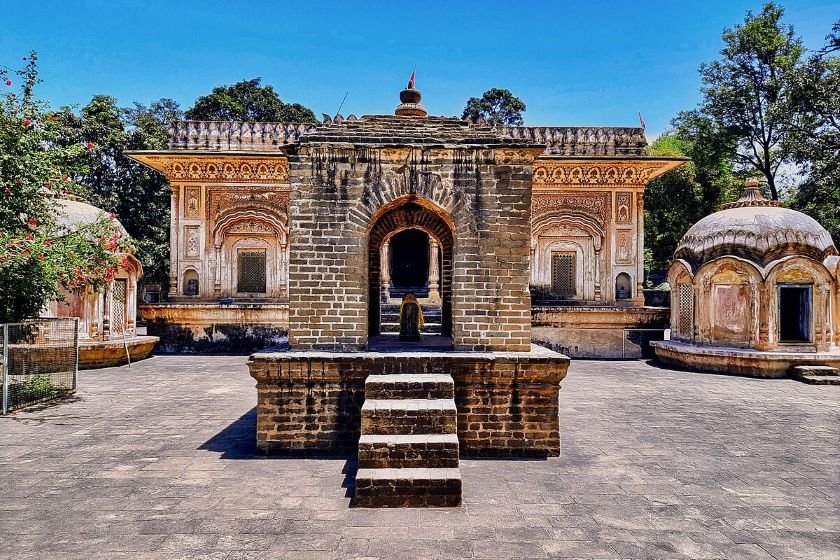
- At the temple: The archaeological inventory describes the temple on a raised platform approached by steps. Do not assume the route is flat or step-free because it is within a town. Ask about assistance and the specific spaces accessible to someone with limited mobility.
- Parking and drop-off: Confirm parking and the last stretch on foot before entering the lanes.
🌸 Best Time to Visit
Spring and autumn are comfortable choices for a visit that includes walking around Sujanpur. Summer days can be hot. During rain, allow for wet steps; in winter, carry a layer for time spent looking slowly at the paintings.
Ask about current opening arrangements, admission and any restrictions on interior access. A normal sightseeing visit and a visit during a major town festival can require different amounts of time.
📜 A Queen’s Patronage
National Culture Fund material identifies Maharani Prasanni Devi, queen of Maharaja Sansar Chand, as the patron and gives 1802 as the building date. That attribution places the temple within Sujanpur’s Katoch royal and artistic world.
An older archaeological inventory gives the broader dating of approximately the eighteenth century. The sources therefore differ in precision and chronology; the 1802 attribution is identified here with its source rather than treated as a date shared by every record.
The title’s reference to a queen’s devotion concerns patronage. It should not be read as a claim that the queen personally painted the walls.
🙏 Shiva and the Temple Compound
Narvadeshwar is a Shiva temple. Its sanctuary, courtyard and subsidiary shrines create a setting for worship as well as artistic detail. The archaeological record explicitly includes the paintings and the shrines within the compound in its description of the monument.
Begin by understanding which spaces are open. If worship is taking place, leave the sanctuary approach clear and observe from where you are directed. The artwork can be studied without interrupting prayer.
🎨 Reading the Murals
The archaeological inventory identifies painted scenes from the Bhagavata and the Ramayana, including work around the mandapa and ambulatory doorway. Other accounts describe a wider range of epic and decorative imagery.
Look first at one panel. Notice the relationship between figures, framing and the architectural surface carrying the scene. Floral details and painted borders can help organise a composition, much as a frame or page layout guides the eye.
Then step back, where space allows, to see how individual scenes belong to the room. A mural is encountered in relation to doors, passages and the movement of worshippers. That setting distinguishes the experience from looking at a painting displayed on a museum wall.
If a knowledgeable guide is available, ask about a particular scene rather than expecting every faded figure to be immediately identifiable. Weathering and repairs can make interpretation less certain.
🏛️ Architecture Supporting the Art
The heritage description records an enclosed courtyard, the raised temple platform and associated spaces within the boundary. These give the murals their physical setting and help explain why the whole compound deserves attention.
The broader Sujanpur tradition brings together forms associated with north Indian temples and courtly architectural influences. Look for the relationship between the shrine, openings and painted surfaces without assuming that a single stylistic label explains every part.
The useful comparison is with other buildings in the town: different structures show how royal patronage could support worship, residence and art in the same cultural centre.
🛕 Caring for the Paintings
The temple is recorded under archaeological protection. Its paintings are historic surfaces, not places to lean, touch or use as a backdrop for close-contact photographs.
Follow current instructions on photography, flash and entry to particular rooms. Keep bags away from painted walls and avoid crowding narrow passages. Do not apply offerings to decorated surfaces unless directed to an appropriate place by those responsible.
Reports discuss fading and damage, but no fixed percentage of surviving original work is asserted here. The condition of individual areas and current conservation restrictions should be learned at the site.
🪔 Worship and Sujanpur’s Festivals
The temple’s Shiva identity makes its worship as important as its art. For Shivratri or another ceremony, ask about the actual local programme and visitor access.
Sujanpur is also associated with a major Holi celebration. Confirm the year’s dates, venues and transport arrangements before planning around it. A town-wide festival does not imply that every temple room is open or that ceremonies follow a fixed timetable.
🏞️ Other Places in Sujanpur Tira
- Murli Manohar Temple: another important local temple, useful for comparing devotional and artistic traditions.
- The Chougan: a central part of the town’s public and festival life.
- The Tira palace and fort area: plan its uphill approach and permitted access separately; do not assume a flat walk from the temple.
- Nadaun and Bil-Kaleshwar: possible additions to a wider regional itinerary, with their own road connections.
❓ Questions Before You Go
Who is associated with the temple’s foundation? National Culture Fund material credits Maharani Prasanni Devi and gives the date 1802; an older inventory uses a broader eighteenth-century dating.
Did the queen paint the murals? The evidence concerns her patronage, not personal authorship of the paintings.
Is the approach step-free? The recorded platform has steps. Ask about the actual access available for your needs.
Can I photograph the paintings? Follow the site’s current rules, including any restrictions on flash or particular rooms.
A Last Word
Narvadeshwar rewards the visitor who slows down. Give one painted scene careful attention, then look at how it belongs to the temple around it. The art and the worship together explain why this shrine deserves time in Sujanpur.
Sources and Further Reading
- National Culture Fund: Shimla Circle monuments — the 1802 attribution to Maharani Prasanni Devi.
- Archaeological inventory: Narbadeshwar Temple, entry 98 — platform, murals, religious use and protection.
- Incredible India: Sujanpur Tira — the town’s artistic and royal setting.
- The Tribune: Kangra’s wall paintings — conservation context and Narvadeshwar’s murals.