A fortified market town once stood here with seven watchtowers guarding it — today only the temple remains, and even its carved faces bear the scars of a war nobody remembers fighting.
Most of what made Bajaura important a thousand years ago is simply gone. The fort that once controlled this stretch of the Beas has crumbled into a private estate. The bustling trade route that gave the town its name — bazaar, worn down over centuries into “Bajaura” — has been replaced by a national highway that most people drive straight through without stopping. What’s left, standing quietly 200 metres off that highway, is a single stone temple: older than almost anything else standing in the Kullu valley, carved with a density of detail rarely attempted at this altitude, and marked, if you look closely, with the deliberate damage of a much later war that had nothing to do with religion at all.
🌄 Location & How to Reach It
The temple sits on the right bank of the Beas River in Bajaura village, Kullu district, just off National Highway 3 — about 4 km from Bhuntar and roughly 15 km south of Kullu town. A short, quiet 200-metre walk down a narrow path from the main road brings you to the temple grounds.
Google Maps: Get Directions
GPS Coordinates: not independently pinned in this note; the temple’s own well-documented location — roughly 500 metres from Bajaura bus stop, on the Mandi–Kullu highway — serves as a reliable practical reference.
Elevation: Bajaura sits at a modest valley elevation typical of the lower Kullu valley, considerably lower and gentler than the high-altitude shrines further up toward Manali or Lahaul.
- By road: Easily reached by taxi or bus from Kullu or Bhuntar; the temple lies directly on the Mandi–Kullu highway corridor, making it one of the more convenient historic temples in the valley to combine with other travel.
- By rail: The nearest railhead is Joginder Nagar, about 91 km away; Chandigarh, at roughly 222 km, offers better onward connections.
- By air: Bhuntar (Kullu-Manali) Airport is just 4 km away — genuinely walkable-adjacent by Himachal standards, making this one of the easiest ancient temples in the state to reach straight off a flight.
There’s no trek and no permit required here — this is a flat, short walk off a functioning highway, a stark contrast to how remote the temple’s era of origin can feel once you’re standing in front of it.
🌸 Best Time to Visit
October through May is generally considered the most comfortable window, avoiding the heaviest monsoon rains that can make the valley’s roads slower going. The temple sees its biggest crowds during Dussehra, when the greater Kullu valley celebrations draw large numbers of devotees and travellers to temples across the district, and again around Navratri and Mahashivratri. Outside festival season, this is a genuinely quiet site — visitors often have the carved exterior largely to themselves.
🕉️ Built in a Day, or Built Over Centuries
Local legend credits the temple’s construction to the Pandavas, who are said to have built it in a single day during their period of exile — a common motif attached to many ancient stone structures across Himachal, where scale and craftsmanship that seem to defy ordinary human effort get folded into Mahabharata mythology. It’s a good story, and worth telling as exactly that: a story. The archaeological record tells a different, though no less remarkable, one. Scholars who’ve studied the temple’s carving style — comparing it to dated works like the bronze Mahishasuramardini image from Hatkoti — place its construction around the mid-to-late 9th century CE, under the patronage of the Gurjara-Pratihara dynasty, quite possibly during the reign of Nagabhatta II or Mihira Bhoja. One historical account suggests that after the decline of an earlier royal court’s patronage elsewhere in North India, the artisans who had trained under it found new employment with the Pratiharas — and it’s their skill, carried this far into the hills, that likely produced Bajaura’s temple.
📜 A Kingdom That Chose Its Gods
There’s a second, quieter story embedded in this temple’s existence — not a myth, but a documented pattern of religious politics. Writing in the mid-20th century, the English travel writer Penelope Chetwode observed that Kullu’s rulers had strategically promoted structured Shiva and Vishnu worship over the valley’s older tribal deities and local rites, animal sacrifice included. Basheshar Mahadev, on this reading, wasn’t simply a beautiful shrine built for its own sake — it was part of a deliberate cultural transformation, a stone anchor for a new, more centralised form of devotion replacing older, more localised practice. Whether or not one agrees with this framing entirely, it’s a useful reminder that temples in this region often carried political weight alongside spiritual purpose, especially ones built with this much resource and skill invested in a single structure.
🙏 What the Temple Is Known For
The presiding deity is worshipped as Basheshar — a local corruption of the Sanskrit Vishveshvara, “Lord of the Universe” — enshrined as a yoni-lingam at the heart of the sanctum. Devotees come seeking the standard blessings associated with Shiva worship in the hills: protection, marital and family harmony, and relief from hardship, with larger crowds during the major Shaivite festivals of the year. According to research into the temple’s construction, its design follows guidance laid out in the Vishnudharmottara Purana, embodying a concept sometimes called panchabrahmana — five aspects or forms of ultimate reality gathered into a single structure, expressed here through the niches and sub-shrines built into the temple’s outer walls alongside the central lingam.
🏛️ The Temple Itself
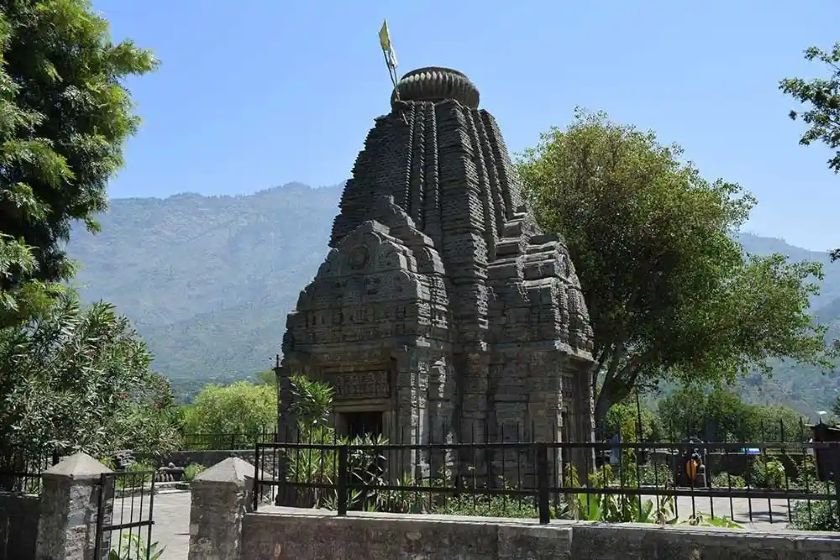
This is, by most measures, the largest and oldest stone temple in the Kullu valley, and its scale is immediately apparent in its unusually thick, tapering shikhara — a tower far heavier and more substantial than most Himalayan temple spires, built in a Nagara style more commonly associated with the plains than the hills. The structure follows what scholars describe as a pseudo-sarvatobhadra plan: a square sanctum with projections on all four sides, though only the eastern one actually opens into the garbhagriha — the other three are false doors, each concealing a small sub-shrine in its own niche. Inside those niches sit finely carved images of Ganesha (seated on a lotus, flanked by lions), a four-armed Vishnu holding chakra, lotus, mace, and conch, and an eight-armed Durga shown slaying a demon, her multiple hands gripping a trident, thunderbolt, arrow, and sword simultaneously.
The exterior carving is dense and specific rather than merely decorative: a repeating band of pot-and-foliage motifs runs along the outer walls, small corner towers show three carved faces of Shiva as creator, protector, and destroyer, and the stonework includes entwined naga couples with interlaced serpent tails, kinnaras in close embrace, and figures of birds and elephants worked into the surface with real precision. Two feminine figures on the front porch personify the rivers Ganga and Yamuna. Inside, the ceiling above the sanctum is built in a “lantern” style — two rotated squares capped with a flat slab bearing a carved lotus at its centre.
Not every mark on the stone was left by its original builders, though. When the British traveller William Moorcroft passed through Bajaura in 1820 — one of the first Western visitors to document the temple — he noted that many of its sculpted faces had been deliberately defaced, their noses cut away. He attributed the damage to soldiers under the command of an ancestor of the Kangra ruler Sansar Chand, during an earlier military campaign against Kullu. It’s a detail easy to miss on a casual visit, but worth looking for: proof that this temple has survived not only the ordinary wear of a thousand years, but at least one act of deliberate violence carried out for reasons that had nothing to do with the god it honours.
📜 The Town That Disappeared Around It
Bajaura’s name itself comes from “bazaar” — a signal of what this place once was. Sitting on an old trade route linking the Punjab plains with Tibet and Central Asia, and later serving as a key crossing point over the Dulchi Pass into the Kullu valley, the town supported a fortified structure with seven watchtowers, described by 19th-century travellers as a substantial square fort of hewn stone reinforced with fir beams. That fort is gone now — its ruins were still visible at the end of the 1800s, but the site eventually passed into private hands, bought by an Englishman in the early 20th century and later sold on to a local family, who are said to have used surviving stones from the fort in their own construction. Today, the temple is essentially the only substantial trace left of a settlement that was once significant enough to warrant seven towers of defence. It survived the 1905 Kangra earthquake that damaged temples across the region, and the Archaeological Survey of India has since designated it a monument of national importance, which is now responsible for its upkeep.
🎉 Festivals and Devotion
- Mahashivratri: the temple’s most significant Shaivite observance, marked with night-long prayer and devotional gatherings
- Dussehra: observed alongside the broader, famously large Kullu valley Dussehra celebrations, which draw devotees to temples across the district
- Navratri: additional worship and community gathering tied to the wider festival calendar
- Daily worship: ongoing rituals continue quietly outside festival season, in keeping with the site’s role as a living ASI-protected shrine rather than a museum piece
🏞️ While You’re in the Area
- Bhuntar and Kullu-Manali Airport: just 4 km away, making this an easy first or last stop on a Kullu valley trip
- Kullu town: roughly 15 km north, home to the Raghunath Temple and the valley’s famous Dussehra festivities
- Naggar Castle and Tripura Sundari Temple: about 36 km away, for more of the valley’s architectural heritage
- Manali: roughly 55 km further up the valley, for the region’s better-known temples and hill-station attractions
🙏 Getting in Touch
There’s no formal booking system or dedicated visitor helpline for the temple; as an ASI-protected monument that remains an active place of worship, it follows general daily visiting patterns rather than a fixed appointment structure. Local guides and taxi drivers in Bajaura or Bhuntar are generally well informed about current access and timings if you need specifics for a particular day.
❓ Quick Questions Travellers Ask
How old is the Basheshar Mahadev Temple, really? Most scholarly estimates place its construction in the mid-to-late 9th century CE, though a folk tradition credits its origin to the Pandavas building it in a single day — the two accounts shouldn’t be confused, and the archaeological dating is far better supported.
Is this the largest stone temple in Kullu? Yes — it’s widely cited as the largest and among the oldest stone temples in the Kullu valley, out of roughly twenty such stone temples in the district.
Why do some of the carved faces look damaged? Several sculptures had their noses deliberately cut away, first documented by a British traveller in 1820, who attributed it to a military campaign by soldiers connected to a rival Kangra ruler rather than to natural weathering.
Is there an entry fee? No fee is documented; as an ASI-protected site it follows standard public access norms typical of other national monuments in the state.
Can this be combined easily with an airport arrival or departure? Yes — at just 4 km from Bhuntar Airport, it’s one of the most convenient historic temples in Himachal to fit into a short layover or the start/end of a Kullu-Manali trip.
A Last Word
It’s worth sitting with the asymmetry here: an entire fortified town, with towers and a marketplace substantial enough to lend its name to the village, has essentially vanished — swallowed by time, colonial-era land deals, and the simple attrition of centuries. And yet the temple, built from stone rather than the fort’s timber-reinforced walls, is still standing, still carved with the same density of detail it had a thousand years ago, still drawing worshippers on Mahashivratri night. Even its scars — the defaced faces, cut away by soldiers fighting a war neither god nor stone had anything to do with — have simply become part of what it is now. Not every ruin in these hills gets to keep its purpose. This one, somehow, still has.
Fact-check note: Cross-checked across an academic heritage study (IJFMR, 2025–26), a detailed art-historical account drawing on primary sources (Vogel’s 1909–10 ASI report, Harcourt’s 1869–71 survey, Moorcroft and Trebeck’s 1820 travel account, Hermann Goetz, Penelope Chetwode, and Dr. Laxman Thakur’s published research), and several independent travel and heritage sites. The 9th-century Gurjara-Pratihara dating is the best-supported account and is presented as more reliable than the “Pandavas built it in a day” folk legend, which is stated clearly as legend rather than history. Some sources round the temple’s likely construction window slightly differently (8th–9th century vs. 9th–11th century); the range is given rather than a single arbitrary date. The existing site article on this temple was not used as a source, given a consistent pattern of mismatched boilerplate content (including an unrelated “three pindis” passage) found on other articles across the same site — this piece was built independently from primary and academic sources instead. No independently verified GPS pin, priest contact, or formal visiting hours could be confirmed, so those gaps are stated plainly rather than invented.