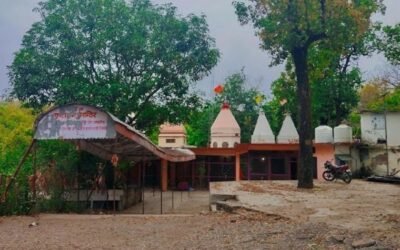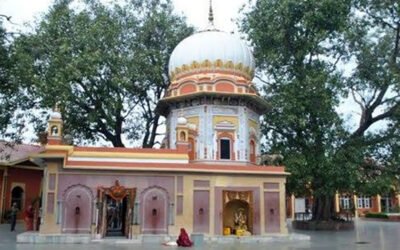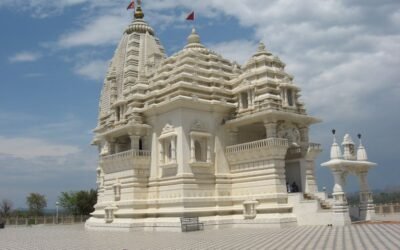
High above the Kullu Valley, a Shiva lingam has been shattered and reborn for generations — and locals will tell you it’s happening on purpose
There are temples you visit, and there are temples you earn. Bijli Mahadev belongs firmly to the second kind. Perched at roughly 2,460 metres on a ridge above Kullu town, with the Kullu Valley falling away on one side and the Parvati Valley opening up on the other, this is a temple you only reach after a genuine trek through pine and deodar forest — and that effort turns out to be exactly the point.
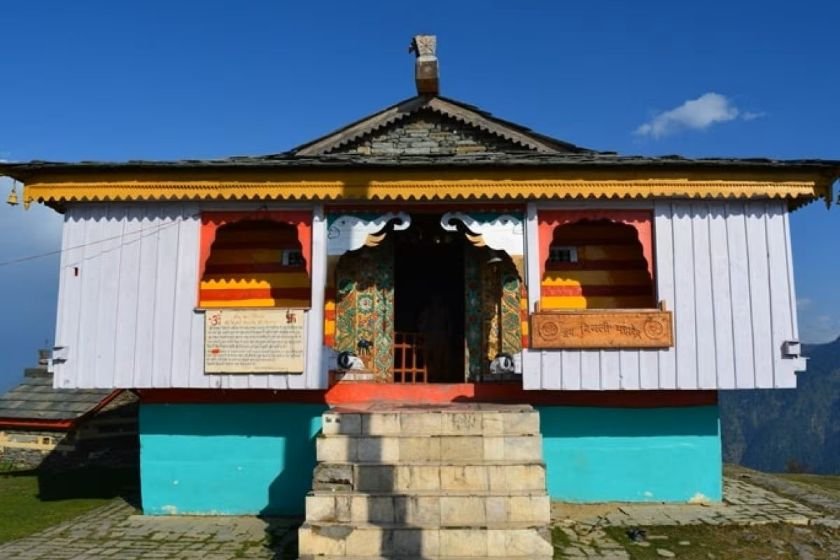
What waits at the top isn’t a grand structure. It’s a modest, weathered wooden shrine, dwarfed by a single, extraordinary object standing beside it: a 60-foot wooden pole, cut from a single deodar tree, rising into the sky like a lightning rod aimed straight at the heavens. Because that, according to everyone in this valley, is more or less exactly what it is.
🌄 Location & How to Reach It
- Location: Kashawri village, above Kullu town, Himachal Pradesh – 175101
- GPS Coordinates: 31.9233° N, 77.1504° E
- Google Maps: Get Directions
- Altitude: Approximately 2,460 metres
- Distance: About 22 km from Kullu town; ~25 km from Bhuntar Airport; ~40 km from Manali
There are three main ways up, and which one suits you depends on where you’re starting from:
Route 1 – From Kullu via Chansari (most popular): Drive or take a taxi/bus from Kullu to Chansari village, about 24 km and roughly an hour by road. From there, a 3 km trek climbs steadily through pine forest — reckon on 45 minutes to 1.5 hours depending on your pace and fitness. This is the shortest and most straightforward route.
Route 2 – From Naggar: A longer, more scenic 12 km trek that passes through the Kais Wildlife Sanctuary, with sweeping views over both the Kullu and Parvati valleys along the way. This route is popular with trekkers who want the journey to be as much a part of the experience as the temple itself.
Route 3 – From Parvati Valley via Bhrain village: The shortest option if you’re already based in the Parvati Valley — under an hour’s trek from Bhrain.
Whichever route you take, expect a genuine uphill climb — not a casual stroll. Several visitors mention roughly a thousand steps on the Chansari route alone, through forest that thins out into open meadow as you near the top, where two small ponds and a final stretch of grassland lead you to the shrine.
Getting to Kullu first: Bhuntar (Kullu-Manali) Airport is about 25 km away. The nearest railway station is Joginder Nagar, roughly 95 km distant. Regular buses and taxis connect Kullu to Delhi, Chandigarh, and Manali.
🌸 Best Time to Visit
April to June and September to November are consistently recommended as the two best windows — mild temperatures, clear skies, and forest trails that are firm underfoot rather than slick with rain or buried in snow. March and early April bring a colder trek but reward you with the valley in bloom. Winter visits are best avoided entirely; the mountain gets buried in snow, the trail becomes genuinely hazardous, and the temple is effectively cut off. If you’re a Shiva devotee specifically, Shravan (July–August) and Maha Shivratri draw the largest and most devotional crowds, with a dedicated fair held during Shravan — though be prepared to share the trail with a lot of fellow pilgrims.
Temple timings: Generally open daily from around 6:00 AM to 7:00 PM, though given the altitude and trek involved, most visitors aim to reach the summit well before early afternoon, both for safety on the descent and for the clearest mountain views.
🕉️ Inside the Shrine
At the heart of Bijli Mahadev is a Shiva lingam, housed in a simple sanctum built in the traditional wood-and-stone style of the valley. It’s an unusually large lingam by most accounts, and it’s also, quite literally, the centre of the temple’s entire identity — because this is a shrine defined less by ritual grandeur than by an extraordinary, recurring event.
According to widespread local belief, lightning periodically strikes the great wooden pole beside the temple and travels down into the lingam itself, shattering it into fragments. How often this happens is genuinely disputed even among locals — some describe it as roughly every 12 years, others say it happens more like annually, particularly during the monsoon months when electrical storms are common at this altitude. What everyone agrees on is what happens next: the temple priest gathers the broken pieces and painstakingly reassembles the lingam using a paste of butter and sattu (roasted barley and gram flour), accompanied by prayers and chanting. Within a day, by most accounts, the lingam is whole again.
Devotees read this not as damage but as devotion in action — Shiva absorbing the raw power of the storm to protect the valley below, breaking apart and reforming as a kind of eternal cycle of sacrifice and renewal. It’s one of the more genuinely striking pieces of living ritual anywhere in Himachal Pradesh, precisely because it isn’t symbolic theatre — villagers really do bring butter and sattu to the temple for this purpose, and the tradition of restoration has reportedly continued for generations.
A note on the “72 Jyotirlingas” claim: you may come across some articles describing Bijli Mahadev as one of “72 Jyotirlingas” of Shiva. This isn’t accurate — Hindu tradition recognises 12 Jyotirlingas across India, and Bijli Mahadev isn’t traditionally counted among them. Its significance rests on its own remarkable legend and local devotion, which frankly need no embellishment.
📜 The Legend of Kulant
The mythology behind Bijli Mahadev ties directly into the origin story of the Kullu Valley itself. The most widely told version centres on a demon named Kulant (also rendered Kulanta or Jalandhara in some accounts), who took the form of a giant serpent and attempted to dam the Beas River, threatening to flood the entire valley and everyone living in it.
Lord Shiva confronted Kulant at a spot called Ghogar Dhar, where the demon had stretched his enormous body across the river. As the story goes, Shiva tricked Kulant into believing his own tail was ablaze — and when the demon twisted around to check, Shiva struck him down. Kulant’s massive body is said to have then transformed into the mountains surrounding the valley, with his head coming to rest at Mathan hill — the very hill where Bijli Mahadev now stands. Some local historians even suggest that “Kullu” itself is a linguistic descendant of “Kulant’s” name, tying the valley’s identity directly to this myth.
Having defeated the demon and secured the valley, Shiva is said to have chosen to remain here permanently as its protector — and the lightning strikes on the temple are understood as the ongoing physical expression of that guardianship, with Indra sending the bolts and Shiva absorbing them on behalf of the people below.
Interestingly, some scholars researching Kullu’s temple culture have pointed to older layers beneath this Shaivite story — noting that a serpent-demon narrative and a sacred lightning-pole share strong echoes with Buddhist symbolism once prevalent throughout the valley centuries ago, before the region’s religious identity settled firmly into the Shiva devotion seen today. Whether you take that as historical layering or simply an interesting theory, it’s a reminder of how many centuries of belief this single hilltop has absorbed.
🏛️ Architecture Built to Survive the Sky
Bijli Mahadev’s structure is deliberately modest — a simple, pent-roofed shrine built in the traditional Kath-Kuni style common across the Kullu Valley, using timber and stone construction designed to withstand harsh mountain weather, heavy snow, and monsoon rain. There’s little of the elaborate carving you’d find at temples like Hidimba Devi; the architecture here isn’t the attraction. Stone-carved figures of a bull (Nandi) and a lingam mark the entrance, firmly establishing the site’s Shaivite character.
The genuine architectural marvel is that 60-foot deodar pole standing beside the shrine — locally referred to in older colonial-era travel writing as the “Dhuj.” Cut from the tallest deodar in the surrounding forest and replaced periodically, it’s visible from a considerable distance below in Sultanpur and across the valley, and it’s this pole, more than the shrine itself, that’s believed to draw the lightning down toward the temple. British surveyor A.F.P. Hamilton documented this staff and its lightning association as far back as 1933, suggesting the belief is at minimum a century old, and very likely considerably older still.
🏞️ At the Summit
What visitors consistently mention isn’t just the temple but the meadow surrounding it — a stretch of open grassland at the summit dotted with two small ponds, framed by a 360-degree panorama that takes in both the Kullu and Parvati valleys, with the Beas and Parvati rivers visible converging far below and the Pir Panjal and Dhauladhar ranges rising in the distance. It’s the kind of view that regularly gets described as one of the best in the entire valley, and given how few casual tourists make the climb, you’ll often have long stretches of it to yourself.
🎉 Festivals and Devotion
- Maha Shivratri: The temple’s most important day, drawing devotees from across the region for prayer and celebration.
- Shravan (July–August): A dedicated fair is held during this sacred month for Shiva devotees, combining ritual with the wider cultural life of the valley.
- Following a lightning strike: Whenever the lingam is struck and shattered, the community restoration ritual itself becomes a kind of spontaneous local festival — villagers gathering with butter and sattu, prayers, and, by some accounts, drums and folk music accompanying the process.
🏞️ While You’re in the Area
- Naggar: The old capital of Kullu, with its castle, temples, and the Roerich Art Gallery, reachable via one of the trekking routes to Bijli Mahadev.
- Kais Wildlife Sanctuary: Crossed en route if you take the Naggar approach to the temple.
- Manali: About 40 km away, home to Hidimba Devi Temple, Solang Valley, and Rohtang Pass, easily combined into a longer Kullu-Manali itinerary.
- Kullu town: Base for the Chansari route, with its own temples, the Dussehra grounds, and the Beas riverfront worth an afternoon.
🙏 Getting in Touch
Unlike many of the more remote hill temples in this valley, Bijli Mahadev’s Google listing does show a publicly available contact number: +91 70183 11296 — worth calling ahead if you want to check trail conditions, confirm timings around a festival, or ask about the road up to Chansari before you set out, particularly outside peak season. As always with mountain treks, it’s worth checking recent weather and trail conditions locally in Kullu before committing to the climb, since conditions can change quickly at this altitude.
❓ Quick Questions Travellers Ask
How difficult is the trek? Moderate. The Chansari route is the shortest at about 3 km, but it’s a genuine, sustained uphill climb — reckon on 1 to 2 hours depending on fitness and pace. It’s manageable for most reasonably fit visitors but not recommended for young children, anyone with mobility issues, or those unaccustomed to altitude.
Is there a shorter or easier way up? Not currently by road — no vehicle reaches the temple directly on any of the three routes. A ropeway to Bijli Mahadev has reportedly been under development, which would significantly change accessibility in future; it’s worth checking current status locally or with Himachal Tourism before you go.
When does the lightning actually strike? There’s no predictable schedule, and accounts genuinely vary — some say roughly every 12 years, others describe it as a more frequent, even near-annual occurrence, especially during monsoon storms. It isn’t something you can plan a visit around, and that unpredictability is very much part of the temple’s mystique.
What should I bring for the trek? Comfortable, broken-in walking shoes, water, and some light snacks — there’s little available once you’re on the trail itself. Starting early in the morning is recommended, both to avoid the heat and to allow enough daylight for the return descent.
Is the temple open to all visitors, or Hindus only? The temple and trek are open to all visitors regardless of faith; this is very much a working pilgrimage site, but non-Hindu trekkers and tourists are common and welcome.
A Last Word
There’s something almost defiant about a temple that keeps rebuilding itself. Most sacred sites are valued for their permanence — stone that doesn’t move, idols that don’t change. Bijli Mahadev inverts that entirely: its holiness is bound up in the fact that it breaks, again and again, and is put back together by hand, with butter and prayer, by people who’ve been doing exactly this for as long as anyone can remember. Stand at that summit with the wind moving across the meadow, the great deodar pole catching the light above you, and the whole Kullu Valley spread out below — and the legend stops feeling like folklore. It starts feeling like something that’s simply, quietly, still happening.
Fact-check notes: This article was written and verified using multiple independent sources (Wikipedia, IndiaHikes’ documented field research including the 1933 Hamilton account, and current Google Places data), cross-checked for consistency. I corrected a claim found on several lower-quality sites describing Bijli Mahadev as one of “72 Jyotirlingas” — Hindu tradition recognises 12 Jyotirlingas, and this temple isn’t traditionally counted among them, so that claim was left out rather than repeated. Sources genuinely disagree on how frequently the lightning strikes occur (accounts range from roughly every 12 years to near-annually) — this is presented honestly as disputed rather than stated as settled fact. Verified GPS coordinates and a publicly listed contact number were pulled directly from live location data.