A sadhu once caught one of three mysterious bathers by the hand — and where the boy vanished, a five-foot lingam rose up in his place, the largest of its kind in the district
Three sons, one meditating sage, and a secret midnight ritual he wasn’t supposed to witness — that’s the story behind not one temple but three, scattered across Chamba district, each honouring a different figure from the same strange legend. Chandrashekhar Mahadev, standing on a quiet plateau above the Sal River in Saho village, is the least visited of the three, and in some ways the most atmospheric: a thousand-year-old shrine surrounded on three sides by hills, still drawing devotees the way it has for over a millennium.
🌄 Location & How to Reach It
- Location: Saho village, on the right bank of the Sal River, Chamba Tehsil, Chamba District, Himachal Pradesh – 176307
- GPS Coordinates: 32.5955° N, 76.2251° E
- Google Maps: Get Directions
- Distance: About 15–18 km east of Chamba town, on the Chamba–Bharmour road
Saho is reachable by regular bus from Chamba town, with the temple itself roughly a kilometre from the Saho bus stop. Worth knowing before you set out: the temple cannot be reached directly by vehicle, since it sits within the small village itself — plan to park outside Saho and walk the final stretch up to the temple grounds. The route from Chamba runs along the Dalhousie–Bharmour road, making this an easy stop if you’re already travelling that direction.
Getting to the wider area: The nearest domestic airport is Gaggal, near Kangra (~135 km), with Amritsar serving as the nearest international airport (~220 km). The nearest railhead is Pathankot Junction, roughly 116–120 km away. This remains solidly road-trip territory, typical of most of inner Chamba district.
🌸 Best Time to Visit
March to June brings golden wheat fields across the Saho plateau, while September to November turns the same fields lush green with paddy — either season offers a genuinely beautiful backdrop to the temple visit, and the choice mostly comes down to which agricultural rhythm you’d rather see. The temple’s biggest crowds gather around Shivratri and during the Manimahesh Yatra season (roughly August–September), when the shrine becomes considerably busier than its usual quiet self — worth planning around, whether you want to join that energy or avoid it.
Temple timings: Visitor reports specifically note the temple closes between 12 PM and 3 PM, reopening in the afternoon — worth building into your schedule, since arriving during that window means waiting around rather than getting straight in.
🕉️ The Legend of Three Vanishing Children
Here’s the story that gives this temple its real depth, and it’s one that most short write-ups of Saho skip past almost entirely. A sadhu, meditating in a cave near the Sal River, made a habit of ensuring no one bathed in the sacred spring before he did each morning. One day, he noticed signs that someone had bathed there ahead of him regardless. Determined to solve the mystery, he hid himself behind a boulder one night to watch — and at first light, three children, all bearing a striking resemblance to one another, emerged and began bathing far earlier than he ever had.
The sadhu ran to catch them. He managed to grab hold of just one, while the other two fled. Pressed for an explanation, the child he’d caught began to answer — and then simply vanished from his grasp, reappearing an instant later in the form of a Shivalinga at the exact spot where the Chandrashekhar temple now stands. That lingam, roughly five feet tall, is said to be the largest of its kind anywhere in the district.
The three children, it’s said, were named Mahesh, Chandragupta, and Chandrashekhar. Mahesh made it to Bharmour, where he’s worshipped today as Manimahesh. Chandragupta reached Chamba town, worshipped there as Chandragupta Mahadev. And Chandrashekhar — the one the sadhu actually caught — remained here in Saho, giving this temple its name. All three sites still stand today as shikhara-style Shiva temples, three separate shrines quietly telling the same shared origin story across the district.
A second, more historically grounded account exists alongside this legend, and it’s worth knowing both rather than picking one. According to an inscription discovered in Saho village and now preserved in the Bhuri Singh Museum in Chamba, the temple was built in the 10th century CE by King Satyaki, son of Bagota — a ruler said to have married Somprabha, daughter of the Kishkindha royal family (a name drawn from the Ramayana’s monkey-kingdom setting, here referring to the Himgiri pargana region). Satyaki reportedly built the temple specifically to cement lasting friendship between his wife and Parvati, “the mountain’s daughter.” Some regional sources suggest the temple may in fact predate this — potentially reaching back even earlier than the 10th-century shift of the Chamba capital from Bharmour to Chamba town, making Chandrashekhar Mahadev possibly older still than its most commonly cited founding date.
🏛️ A Temple Rebuilt After Disaster
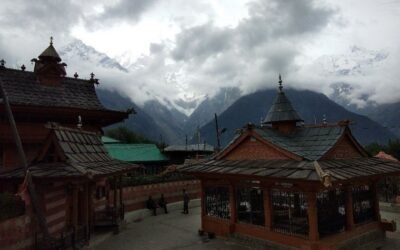
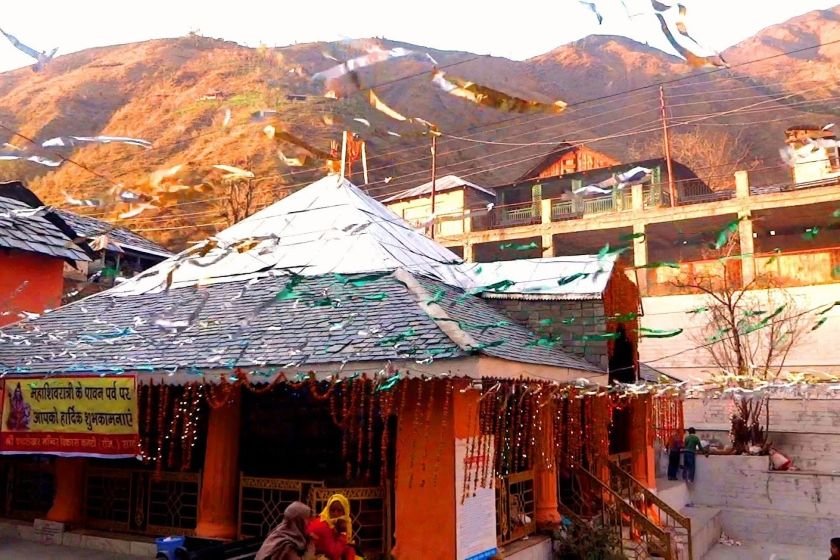
The structure standing today isn’t entirely original — it was rebuilt following devastating floods in 1900, which affected much of the wider region. What survives is a striking example of shikhara-style architecture with a slate roof, situated on a plateau bordered by hills on three sides, with the Sal River running through the valley below.
The temple entrance features two distinct depictions of Shiva worth looking for specifically: one showing him in a fierce, three-headed form standing atop a corpse, wearing a garland of skulls, and a second, gentler form holding a flower, rosary, trident, and water pot in his four arms — a deliberate pairing of Shiva’s destructive and benevolent aspects framing the approach to the sanctum. Inside, the presiding Shivalinga sits within a square yonipitha, and outside the sanctum stands a stone-carved Nandi bull of genuine craftsmanship — and here’s a detail worth correcting from some casual accounts: it’s specifically the Nandi’s throat, not the deity’s, that produces a distinct bell-like sound when tapped, an acoustic quirk in the stone that several visitors describe as a small, delightful mystery in its own right. Some visitors also mention a large Hanuman statue within the temple grounds, alongside natural springs behind the temple believed locally to carry medicinal properties.
🎉 Festivals and Village Life
- Shivratri: The temple’s most significant occasion, drawing large crowds for prayer, aarti, and celebration.
- Baisakh Fair (April): Celebrated with genuine festivity at the temple site, drawing villagers and visitors from the wider Saho area.
- August–September Mela: Coinciding with the Manimahesh Yatra season, this fair reportedly includes traditional Bhasmasur dance performances alongside music and communal ritual.
- Morning Aarti: Several visitors specifically recommend timing a visit around the morning ritual, describing it as a genuinely luminous, memorable moment.
🏞️ While You’re in the Area
- Bhalei Mata Temple: A notable regional shrine, commonly combined with a Saho visit.
- Chamera Lake: A scenic reservoir en route back toward Chamba.
- Bhuri Singh Museum, Chamba: Home to the very inscription documenting this temple’s founding, alongside a rich collection of Chamba’s Pahari painting tradition and historical artefacts.
- Manimahesh Lake and Chandragupta Mahadev Temple: The two companion sites from this same three-brothers legend, in Bharmour and Chamba town respectively — a genuinely interesting trio to visit across a longer Chamba itinerary.
- Chhakund Lake: A scenic high-altitude lake reachable via routes from Saho village.
🙏 Getting in Touch
There’s no independent phone number or formal booking contact listed for this temple — it functions as an active village shrine rather than a managed tourist site. Given the specific midday closure (roughly 12 PM–3 PM) reported by visitors, it’s worth planning your arrival time around the morning or late afternoon rather than assuming continuous access throughout the day.
❓ Quick Questions Travellers Ask
Can I drive right up to the temple? No — the temple sits within Saho village itself and isn’t reachable directly by vehicle. Plan to park outside the village and walk the final stretch.
Is the temple open all day? No, several recent visitor accounts note a midday closure, roughly 12 PM to 3 PM. Time your visit for the morning or afternoon accordingly.
How does this temple relate to Manimahesh? They share an origin legend — local tradition holds that Manimahesh (Bharmour), Chandragupta Mahadev (Chamba town), and Chandrashekhar Mahadev (Saho) represent three brothers who each transformed into a Shivalinga at the place they eventually reached, after a sadhu’s failed attempt to catch all three of them bathing.
Is there an entry fee? No, it operates as a free, active community temple.
What’s the best time of year to combine a visit with the scenery? March to June for golden wheat fields, or September to November for lush green paddy — both are described by regular visitors as particularly beautiful backdrops to the temple itself.
A Last Word
There’s something quietly satisfying about a legend that resists a single tidy telling — three brothers, one sadhu’s failed grasp, and three separate temples now standing in three separate towns, each one insisting, in its own way, that it holds the true site of the transformation. Whether you take the story as literal myth or as an old, poetic way of explaining why three related Shiva shrines happen to sit scattered across the same district, standing on that quiet plateau above the Sal River, hills rising on three sides and a thousand years of devotion settled into the stone underfoot, it’s easy to believe you’re standing at the one that actually mattered most to the story — even knowing two other villages would tell you exactly the same thing about their own.
Fact-check notes: The earlier version of this content, published on the site under “Saho Village,” attributed a bell-like acoustic effect to the deity itself; multiple independent sources specifically describe this phenomenon as belonging to the stone-carved Nandi bull outside the temple, not the Shivalinga, and this has been corrected. It also named the temple’s founder as “King Saryaki” — the name documented on the inscription preserved in the Bhuri Singh Museum, and used consistently across independent sources, is Satyaki, son of Bagota; this has been corrected as well. This rewrite adds the temple’s fuller founding legend — the three vanishing children connecting Chandrashekhar Mahadev to Manimahesh and Chandragupta Mahadev — which was omitted from the earlier village-focused piece entirely. Verified GPS coordinates and current visitor-reported timings were pulled from live location data. No independent contact number exists for this temple, and none has been invented.