
Temple & sacred site
Christ Church, Shimla
The Gothic Landmark That Defines the Ridge
At a glance
- Location
- The Ridge, central Shimla
- How to reach
- Use the central pedestrian routes and confirm the nearest permitted drop-off point
Christ Church gives the Ridge its familiar silhouette, while its stained glass, memorials, and continuing worship tell a fuller story of Shimla.
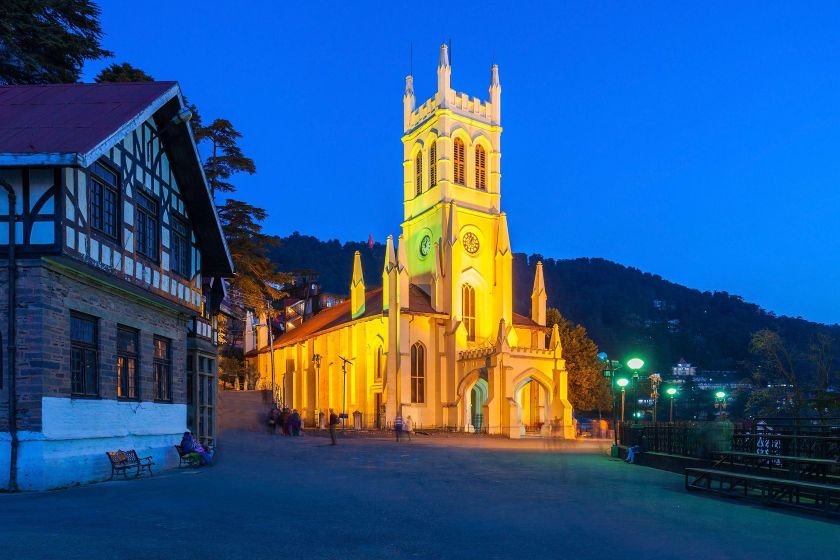
Christ Church, Shimla is easy to recognise and worth more time than a photograph alone. The pale exterior, pointed windows, and clock tower stand beside one of the town’s busiest public spaces. Behind that familiar view is a nineteenth-century church that still has a religious purpose.
A rewarding visit considers the building in three ways: as a place of Christian worship, an example of neo-Gothic design, and a surviving part of Shimla’s colonial history. Each perspective reveals something the others do not.
🌄 Location and how to reach it
The church stands on the Ridge in central Shimla, below Jakhoo Hill. It can be included in a walking route through the Ridge and Mall Road area.
Google Maps: Find Christ Church, Shimla
- From the central town: Use the pedestrian routes leading to the Ridge.
- By vehicle: Establish a suitable parking or permitted drop-off point and allow for the remaining walk.
- From the railway station: Plan the connection up to the central area according to your walking needs and available transport.
- With limited mobility: Check the approach, gradients, and interior access before setting out.
Do not assume door-to-door private-vehicle access. A comfortable plan accounts for the approach as well as the time spent at the church.
🌸 Best time to visit
Spring to early summer and autumn are sensible periods for walking around central Shimla. Daylight is useful for appreciating architectural detail and, when the interior is open, the effect of light through coloured glass.
Winter can change the setting considerably, but snow should never be promised as part of a visit. Check conditions on the roads and pedestrian routes. Rain and ice can make an otherwise straightforward walk more demanding.
If you wish to attend worship, choose the time according to the church’s current schedule. For a heritage visit, be prepared to see the exterior if the interior is closed or in use.
📜 From a hill-station congregation to a landmark
Himachal Pradesh Tourism records the foundation stone on 9 September 1844 and the consecration on 10 January 1857. It credits Colonel J. T. Boileau with the design.
Those dates place the church within the growth of British-era Shimla. It served a congregation in a town developing into an important administrative and residential centre.
Its present significance includes that past without ending there. The building has continued through changes in the town and the people who use it. Worshippers, residents, and visitors now encounter the same landmark for different reasons.
🏛️ Reading the neo-Gothic design
The church’s neo-Gothic character can be seen in its pointed openings and vertical emphasis. The tower makes a strong outline against the hill, while the windows and entrance reward a closer look.
The tourism department describes stone and brick construction with lime mortar and a layout including a nave, chancel, and tower. The nave is the main congregational space; the chancel is the area towards the altar.
Start with the whole form from a place where you do not obstruct the entrance. If interior access is allowed, notice how the arrangement of aisles and pews directs attention towards worship rather than simply towards decoration.
🪟 Stained glass and the changing interior light
Stained glass is one of the church’s principal artistic features. Coloured windows combine religious imagery with light, giving the interior a different character from the pale exterior.
Published accounts associate the windows with Christian virtues such as faith, hope, and charity. The state tourism description records stained glass above the altar among the additions of 1860.
Look at what is visible without moving into a reserved area for a clearer photograph. The effect changes with daylight, so an image seen online need not match the room during your visit.
🕰️ The clock, the organ, and later chapters
The clock is another familiar part of the church’s public face. Tourism information places its installation in 1860, after consecration. The building’s history therefore includes additions as well as its original design.
Official visitor descriptions also identify a historic pipe organ. Its presence is part of the church’s musical heritage; it should not be taken as a promise of a demonstration or regular performance during tourist hours.
The state account records damage from heavy snowfall in 1961 and subsequent repair. A heritage building can retain its character while carrying evidence of maintenance and change.
📖 Memorials and the colonial setting
The memorials and furnishings invite visitors to think about the people for whom the church was built. Names, inscriptions, and commemorative objects belong to the social history of the congregation and the wider colonial town.
Read what can be seen from an allowed position. Do not move furniture or handle objects to inspect an inscription. A specific memorial can be a useful starting point for a historical enquiry, provided its wording is distinguished from a complete account of the person or period.
The church can be appreciated as architecture while its colonial context is also examined thoughtfully.
⛪ A continuing place of Christian worship
The building’s religious use should guide a visit. Prayer, readings, hymns, and services are different from a heritage tour, and those attending worship need space and quiet.
Ask about access if a service is taking place. Being able to stand on the Ridge does not automatically mean the interior is open for sightseeing.
Visitors wishing to attend a service should confirm the current arrangements through the church’s own representatives. Dress and behave respectfully, and follow instructions about seating and movement.
🎄 Christmas and other services
Christmas is a significant occasion for the congregation and a busy period in Shimla’s tourist calendar. The religious service and the activity in the public square have different purposes.
Confirm the actual programme before planning attendance. Give priority to worshippers entering or leaving, and avoid photographing a service without permission.
The same principle applies to other observances and Sunday worship: a historic church’s place in a general Christian calendar does not establish its current local service time.
🙏 Visitor information and photography
No dependable current official daily visitor timetable or admission arrangement has been established for this guide. Confirm interior access locally before making it the main reason for a journey.
- Keep voices low inside and do not interrupt prayer.
- Ask before photographing the altar, windows, memorials, or a service.
- Leave historic surfaces and furnishings untouched.
- Keep entrance routes clear and follow any temporary restrictions.
- Use a permitted viewpoint rather than stepping into a reserved area.
Leave time for the approach and the building rather than fixing the visit to an exact duration. A closed interior can still leave an interesting architectural stop, but a service visit needs its own plan.
🏞️ Places to combine with Christ Church
- The Ridge and Mall Road: The natural setting for a central walking itinerary.
- Gaiety Heritage Cultural Complex: A separate stop for cultural and architectural history.
- Scandal Point and Kali Bari: Possible connections through the central town.
- Jakhoo Temple: A separate uphill excursion with its own time and effort.
More distant places such as the Viceregal Lodge and State Museum should be planned with their travel and visitor arrangements in mind, rather than treated as part of one level stroll.
❓ Quick questions travellers ask
When was the church consecrated?
On 10 January 1857, according to Himachal Pradesh Tourism.
What architectural style does it represent?
Neo-Gothic, visible particularly in the pointed openings and tower.
Can I always enter the interior?
No. Access depends on current opening and worship arrangements.
Will I hear the historic organ?
Do not assume a performance or demonstration; enquire about any scheduled programme.
Can I drive to the church door?
Plan for the central pedestrian area and check the nearest permitted drop-off point.
A final thought
Christ Church is familiar from the outside, but its fuller story emerges through patient attention to the glass, the furnishings, and its continuing worship. Giving those details time turns a landmark photograph into a more meaningful encounter with Shimla’s heritage.
Sources and references
- Himachal Pradesh Tourism: Churches — foundation, consecration, design, later additions, and repairs.
- Incredible India: Shimla travel guide — location and principal heritage features; historical superlatives in short travel listings require care.
- Incredible India: Christ Church and St Michael’s Church — the building’s architectural and colonial context.