In the pine hills above Amb, a saint’s family made a mistake at his funeral pyre — and the shrine that grew from that mistake is now where people bring their most fragile relatives every Holi.
Most saints are remembered for what they did while alive. A smaller number are remembered for what happened at the moment they were supposed to have died — and fewer still are remembered because that moment turned out to be a misunderstanding. Dera Baba Bharbhag Singh, tucked into the hills of Una district in Himachal Pradesh, belongs to this rarer category. Its central story isn’t really about a miracle performed on command; it’s about a household that grieved too soon, a body that burned before anyone realized the soul hadn’t finished its errand, and a promise made afterward that still shapes what happens here every year. Long before any of that, though, the man at the center of it had already made his name by doing something else entirely: wrestling a spirit into submission and putting it to work.
🌄 Location & How to Reach It
The dera sits in Mairi village, a few kilometres off the Una–Amb–Nadaun–Hamirpur road in the Amb tehsil of Una district, close to the smaller village of Nehri. It’s a quiet, pine- and eucalyptus-covered stretch of the Shivalik foothills — not dramatic mountain country, but the kind of gently rising terrain where Una district eases into the hills of Kangra and Hoshiarpur beyond it.
Google Maps: Get Directions
Elevation: roughly 600 metres, though this isn’t independently confirmed and should be treated as approximate.
- By road: Regular buses and taxis run from Una town, about 24 to 40 kilometres away depending on the route taken (sources disagree on the exact figure); the road is a standard hill-district route, in decent condition but with the usual winding stretches once you leave the main highway.
- By rail: The nearest railhead is either Amb Andaura, roughly 15 km away, or Una Himachal station, cited elsewhere as around 45 km — the two figures don’t line up, so it’s worth confirming locally which one is actually closer to Mairi.
- By air: Gaggal Airport near Kangra/Dharamshala (roughly 75–100 km) is the commonly cited option, though a few sources point instead to Chandigarh, which is farther but has more flight connections.
Compared to the high-altitude treks that some Himachal shrines demand, this is an easy stop — a half-day detour off the Una–Hamirpur road, not an expedition.
🌸 Best Time to Visit
There’s no published daily timing for the dera, so the honest answer is: it’s open through the day, every day, and most visitors simply arrive whenever suits them. What actually shapes a visit is the calendar, not the clock. The Hola Mohalla fair, held over the full moon in the Vikrami month of Phalgun (roughly February–March), is when the dera transforms — for about ten days, the grounds fill with pilgrims from across Punjab, Haryana, Delhi and beyond. Outside the mela, this is a modest, largely local pilgrimage spot, pleasant enough to visit any time of year given the moderate hill-district climate.
🕉️ The Guru Who Tamed a Ghost
The man devotees know as Baba Bharbhag Singh — sometimes recorded as Vadbhag Singh or Gurbarbhag Singh, depending on the source — was born in Kartarpur, Punjab, in either 1715 or 1716, into a family that carried real weight in Sikh history: he was a descendant of Dhir Mal, first cousin to Guru Gobind Singh, and he inherited the hereditary religious seat, or gaddi, of the Sodhis of Kartarpur. As a child, the story goes, his tangled hair once drew a taunt from a playmate, who said he looked like a bhoot — a ghost. A passing astrologer supposedly corrected the boy: he wasn’t a ghost, he said, but would one day become a guru of ghosts. It’s the kind of origin story that only makes sense in hindsight, and it’s told here precisely because of what came next.
Political upheaval eventually pushed him out of Punjab — later accounts tie his move to the turmoil of Ahmad Shah Abdali’s invasions — and he settled in the hills near Mairi. The land, according to legend, was already occupied: by a powerful, shape-shifting spirit named Nahar Singh (also written as Nar Singh), who had been tormenting the region. Rather than flee the confrontation, Bharbhag Singh met it. Through meditation and what devotees describe as sheer spiritual force, he subdued the spirit and is said to have caged it — not to destroy it, but to put it to work protecting and healing people instead of harming them. It’s a tidy, almost administrative resolution to a ghost story, and it’s the detail that gives the dera its enduring reputation: a shrine less about warding off evil than about redirecting it.
📜 The Body That Burned Too Soon
The second story here is stranger, and it’s the one that actually explains why people keep returning. As Bharbhag Singh’s reputation grew, so did the number of followers who called on him from a distance. One account holds that a group of his disciples ran into serious trouble somewhere far from Mairi, and he sensed it. He retreated to a room, told his family not to disturb him, lay down, and bolted the door from inside — his body staying put while, as the story is told, some part of him went to help. He was gone longer than expected. His family, worried, eventually broke the door down, found what looked like a lifeless body, and — believing him dead — cremated him near an old ber tree, on the very spot where the dera’s shrine now stands.
What happened next is the part that turns a tragedy into a founding myth: as the pyre burned, his spirit is said to have returned to reclaim a body that no longer existed to receive it. Too late to undo what grief and haste had done, his family and followers begged him not to abandon them entirely. He agreed to remain — not as a living man, but as a continuing presence at that same spot, still available to those who came looking for him. It’s a striking piece of local memory, equal parts consolation and warning about mistaking absence for death, and it deserves to be told as the story it is rather than as settled biography; no contemporary record confirms any of it, and it survives purely as oral tradition passed down through generations of visitors and caretakers.
🙏 What People Come Here Seeking
What actually draws people to Dera Baba Bharbhag Singh is less abstract than the legends suggest: relief from what’s often described locally as possession, “evil influence,” or serious mental and emotional distress. This isn’t a shrine built around prosperity, marriage, or exam results, the way many better-known temples are. It’s built around crisis — and it has functioned, for generations, as one of the few places in the region where families bring relatives suffering from conditions that rural communities may not otherwise have language or resources for. That’s worth stating plainly rather than romantically: the dera occupies a role that, elsewhere, might belong to a clinic. Whether one reads that as folk healing, community care, or something else, the devotion here is sincere and the need it responds to is real.
Rituals at the dera lean on standard Sikh devotional practice rather than elaborate exorcism theatre — Gurbani recitation, Ardas, sprinkling of consecrated water, and the tying of red threads and flags as markers of protection. The caretakers who lead these sessions are traditionally known as Masands. Compared to the grand Shakti shrines elsewhere in the district, this is a quieter, more intimate kind of devotion — less spectacle, more vigil.
🏛️ The Dera Itself
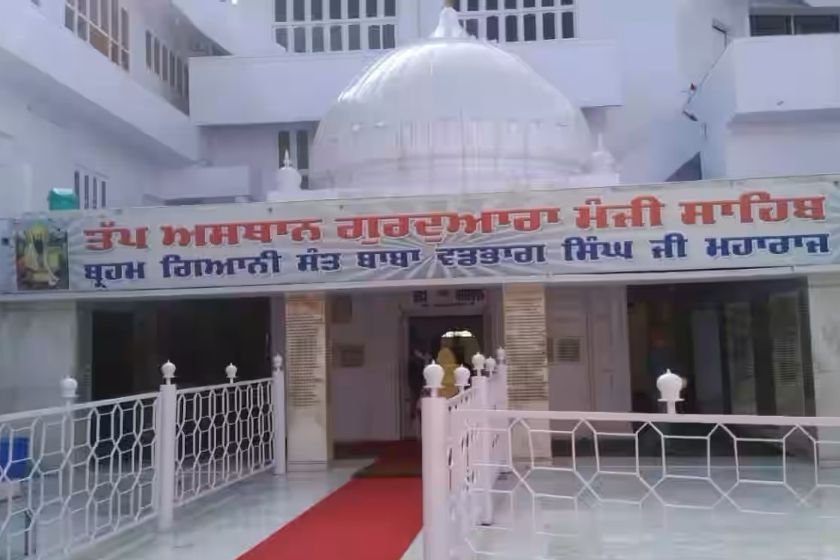
The complex is modest rather than monumental: a whitewashed shrine building housing Bharbhag Singh’s memorial, set among eucalyptus trees on rising ground, with a courtyard where healing rituals and communal prayer take place. The old ber tree — the one under which the founding legend places both the taming of Nahar Singh and, later, the mistaken cremation — still stands near the main shrine, along with a tall Jhanda Sahib (Sikh standard) that devotees consider especially sacred; pieces of its old cloth, along with cowrie shells, betel nuts, and coins tied to it over the years, are treasured by pilgrims as a kind of blessing. Nearby is the sepulchre of Bibi Bhani, the saint’s sister, and a small domed gurdwara called Manji Sahib. About a kilometre and a half away is a waterfall known as Dhauli Dhar, said to be where Bharbhag Singh bathed daily — it’s regarded as sacred in its own right and is a peaceful short walk from the main complex. There’s nothing ornate about any of this; the atmosphere comes less from carved stone than from the sound of drums, chanting, and the wind moving through the eucalyptus canopy.
🎉 Festivals and Devotion
- Hola Mohalla / Baba Bharbhag Singh Mela — the dera’s main event, held around Holi in Phalgun (Feb–March), running roughly ten days. This is when the healing rituals are at their most intense, with large numbers of families bringing relatives believed to be suffering from possession or mental illness.
- Jhanda Sahib renewal — every third year, a young pine, often 70–80 feet tall, is selected and erected as the new pole for the Jhanda Sahib, an event with its own quiet ceremony.
- Daily devotion — outside the mela, worship continues at a smaller scale: Gurbani recitation, individual Ardas, and the steady, unhurried presence of pilgrims tying threads and flags.
🏞️ While You’re in the Area
- Chintpurni Temple — one of Himachal’s Shakti Peethas, dedicated to Chinnamastika Devi, and one of the district’s most visited shrines.
- Kaleshwar Mahadev Temple, Amb — a riverside Shiva shrine with its own local mythology, an easy add-on given Amb’s proximity to Mairi.
- Shiv Bari Temple, Gagret — a Shiva shrine connected in local tradition to figures from the Mahabharata.
- Gobind Sagar Lake — for a change of pace, this reservoir near Una offers boating and watersports, a very different register from the dera’s stillness.
🙏 Getting in Touch
There’s no formal booking process, ticketing system, or publicly listed contact number for the dera — this is a community-run shrine, not a managed tourist site. If you’re planning a visit around the mela dates or want current details on accommodation, the practical move is to ask locally in Una or Amb, where bus operators, taxi drivers, and nearby gurdwaras are used to fielding these questions from pilgrims. Basic overnight stay has historically been available through a PWD rest house and a Gurdwara sarai near the dera, though it’s worth confirming availability before relying on either.
❓ Quick Questions Travellers Ask
Is there an entry fee? No — like most gurdwaras and deras in the region, entry is free, though donations toward the langar and upkeep are welcomed.
Can non-Sikh visitors go? Yes. The dera draws Hindu and Sikh pilgrims alike, and general gurdwara etiquette applies: cover your head, remove your shoes, and dress modestly.
How crowded does it get during Hola Mohalla? Very — this is the dera’s busiest period by far, with pilgrims arriving from Punjab, Haryana, Delhi, and beyond, so expect limited parking and stretched accommodation.
Is this the same place as “Dera Baba Vadbhag Singh”? Yes — Bharbhag Singh, Barbhag Singh, Gurbarbhag Singh, and Vadbhag Singh all refer to the same saint and the same shrine in Mairi; the spelling varies by source rather than referring to different places.
Is there food available on-site? Yes — like most gurdwaras, a langar (community kitchen) operates here, especially during the mela.
A note on sources: the saint’s birth year is given as both 1715 and 1716 across different accounts, and distances to Una town, the nearest railway station, and the nearest airport vary meaningfully between sources — these have been presented as ranges or flagged rather than stated as single confirmed figures. No independently verified GPS coordinates or elevation reading were found, so elevation above is given as an approximate figure only, and coordinates have been omitted in favor of the village name and access route. There is also no confirmed formal timing, contact number, or booking process for the dera, which is reflected in the “Getting in Touch” section above. One recurring error was specifically checked for and removed: a boilerplate passage describing “three pindis representing Maha Kali, Maha Lakshmi, and Maha Saraswati” appears on at least one existing published account of this exact dera — but Bharbhag Singh is a male Sikh saint, not a goddess worshipped in triple pindi form, and nothing in the historical or devotional record for this site supports that claim. It has been deliberately excluded here.