
Temple & sacred site
Dhakpo Shedrupling Monastery, Kais
A Living Centre of Buddhist Learning in Kullu
At a glance
- Location
- Kais village, Kullu district
- How to reach
- Arrange the road connection on the Kullu–Naggar side of the valley
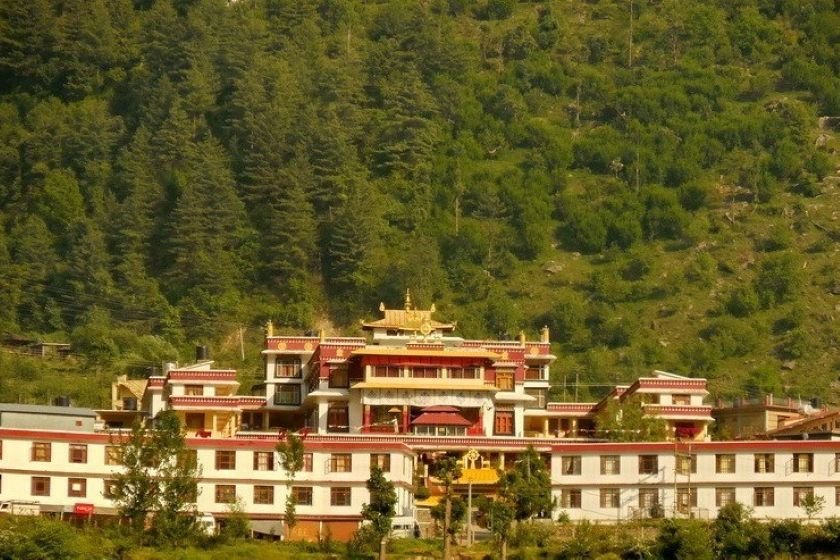
At Kais, a modern monastery continues an older Tibetan tradition through Buddhist study, prayer, and the work of education.
Dhakpo Shedrupling Monastery, commonly called Kais Monastery, adds another dimension to a journey through the Kullu Valley. Its buildings are relatively recent, but the community’s religious and educational inheritance reaches back to Tibet.
The distinction matters. Visitors arrive at a Himalayan complex inaugurated in 2005, while the institution understands itself through a much longer history of learning and practice. Looking at the site as a working monastery helps explain its purpose beyond the valley views.
🌄 Location and how to reach it
The monastery is in Kais village, Kullu district, on the Kullu–Naggar side of the valley. Use its full name or the village name when arranging transport.
Google Maps: Find Dhakpo Shedrupling Monastery
- From Kullu: Arrange a road journey to Kais and confirm the final approach.
- From Naggar: Consider the visit as part of the journey through this side of the valley, with time reserved for the monastery itself.
- From Manali: Check the chosen valley road and realistic travel time.
- By local transport: Establish the service, drop-off point, remaining walk, and return connection before departure.
Published distance estimates depend on starting points. If steps or gradients are a concern, ask the monastery or your host about access rather than relying on a general description of the grounds.
🌸 Best time to visit
Spring to early summer and autumn are sensible periods for combining Kais with other Kullu Valley visits. Weather and road conditions should still be checked for the day itself.
During rain, allow more time for the approach and walking surfaces. In winter, carry clothing suited to the local conditions. The most suitable arrival time also depends on the monastery’s activities: the prayer hall may be in use even when the weather is ideal for an outing.
Contact the monastery before making a special journey for a teaching, assembly, or group visit. A sightseeing plan should fit around its working arrangements.
📜 The tradition before Kais
The Dagpo Fund traces the institution’s origins to a community founded in southeastern Tibet in the mid-fifteenth century by Je Lodrö Tenpa, associated with the teachings of Je Tsongkhapa.
The monastery belongs to the Gelug tradition and has a particular connection with Lamrim, the stages of the path to enlightenment. Study and practice developed together within this institutional history.
For a visitor, this provides context for what happens in the complex today. The monastery’s purpose is not exhausted by a building or a statue; it includes the continued teaching of texts, the training of students, and a community’s daily religious life.
🏔️ Rebuilding a home in the Himalayas
The monastery’s own history describes displacement from Tibet and resettlement in India. It records difficulties at the earlier Mainpat base and the search for a more suitable Himalayan location under Dagpo Lama Rinpoche’s guidance.
The official account places the blessing of the Kais site in 1999, road work in 2001, and the inauguration by the 14th Dalai Lama on 11 May 2005.
These dates describe the development of the present complex, not the beginning of the lineage. Keeping those histories distinct gives the site a clearer story: an older institution establishing a new physical home while carrying its learning forward.
🏛️ The prayer hall and monastery setting
The prayer hall and its sacred imagery are a focus for many visits. Approach them as spaces arranged for worship and assembly, with their own instructions about entrance, seating, movement, and photography.
If access is permitted, take time to notice how images and furnishings relate to the room’s use. A quiet explanation can make a visit more rewarding, but it should be requested at an appropriate moment rather than expected during an ongoing practice.
Do not sit in a place reserved for monks or set belongings on religious furniture without guidance. The fact that travellers are welcomed to some areas does not make every room a public space.
📚 Study and Dhakpo Thoesamling School
Education is central to the monastery’s identity. Alongside monastic learning, it runs Dhakpo Thoesamling School, described on its website as a charitable institution. The official account records the school’s opening on 22 April 2004.
This work is an important part of the monastery’s place in the valley. It connects the preservation of a religious tradition with the care and education of a younger generation.
Classrooms and residential spaces should remain private unless staff invite visitors. Ask before photographing students, and respect the arrangements made for children’s learning rather than treating a school as an additional sightseeing room.
🪷 Teachings and religious events
The monastery has hosted gatherings associated with Dagpo Rinpoche’s teachings. A Tibet Museum report documents an exhibition held here during a teaching gathering in 2014.
Such records illustrate the institution’s role in learning and cultural exchange. They do not establish the programme for the current year or promise that a teaching will be available during an ordinary visit.
Ask directly about dates, registration if required, the language of an event, and whether visitors may attend. Joining a teaching can involve a different commitment of time and conduct from quietly seeing the monastery’s accessible areas.
🙏 Visiting information and etiquette
- Dress respectfully, speak quietly, and follow entrance instructions.
- Remove footwear where requested.
- Ask before entering a prayer assembly or taking a seat.
- Keep hands and belongings away from scriptures, instruments, and sacred images.
- Obtain permission for photographs of interiors, residents, or students.
- Leave residential and school areas undisturbed unless invited.
No dependable current daily visitor timetable has been established for this guide. Confirm prayer-hall access and any group arrangements directly. Leave enough time to adapt if a space is in use, and plan the return transport separately.
☎️ Published contact details
The monastery’s official contact page publishes:
- Address: Dhakpo Shedrupling Monastery, Village and P.O. Kais, District Kullu, Himachal Pradesh 175101.
- Telephone: +91 1902 230573.
- Email: dhakposociety@gmail.com.
These are published institutional details, rather than a confirmation that a call or message will receive an immediate response. Ask about the specific purpose and date of your proposed visit.
🏞️ Places to combine with Kais
- Kullu: A practical connection for transport and wider valley exploration.
- Naggar: A possible heritage outing before or after Kais.
- Raison: A valley stop to consider according to your route.
- Manali: A base for a longer journey through the upper valley.
Choose a few compatible stops instead of making the monastery a hurried pause between several distant attractions. Time for prayer-hall access, an explanation, or simply the setting can make a shorter itinerary more worthwhile.
❓ Quick questions travellers ask
Are Kais Monastery and Dhakpo Shedrupling the same place?
Yes. Kais Monastery is the commonly used name based on its village location.
Is the present complex ancient?
No. The Kais complex was inaugurated in 2005; the institution’s lineage is much older.
Which Buddhist tradition does it follow?
The Gelug tradition, with a strong Lamrim connection.
Can visitors attend teachings?
Ask the monastery about the current programme and participation arrangements.
Can visitors enter the school?
Only by arrangement and with staff permission. Its teaching and residential spaces are not ordinary sightseeing areas.
A final thought
Kais is a place where a continuing tradition has found a newer home. Its story becomes clearer when the buildings are seen alongside the work of study, worship, and education that gives them a purpose.
Sources and references
- Dhakpo Shedrupling Monastery: About Us — resettlement, Kais development, inauguration, and school opening.
- The Dagpo Fund: History — Tibetan origins and the Lamrim tradition.
- Dhakpo Thoesamling School — the institution’s educational work.
- Official monastery contact page — published contact details.
- Tibet Museum: exhibition at Dhakpo Shedrubling Monastery — the documented 2014 gathering.