
Temple & sacred site
Kyanlu Devta Ji Temple, Mandal Jubbal
The Forest Shrine of Gupt Maheshwar
At a glance
- Location
- Mandal–Jubbal area, Shimla district
- How to reach
- Confirm the forest-shrine location and final approach with local residents
In the Mandal–Jubbal hills, a forest-shrine tradition connects Kyanlu Devta Ji with closed-door worship, a hidden Shivling, and the name Gupt Maheshwar.
Kyanlu Devta Ji Temple is remembered locally through a story of sacred boundaries. The account associated with the forest shrine describes an inner chamber kept from ordinary view, worship conducted without looking directly into its deepest space, and a naag offering milk to a hidden Shivling.
These traditions give the shrine its distinctive identity. They also shape how it should be approached: with local guidance, respect for the deity’s boundaries, and an understanding that the story of an inner chamber is not a promise of something visitors will see.
🌄 Location and how to reach it
The shrine described here is associated with the Mandal–Jubbal area of Shimla district, Himachal Pradesh. Mandal, Rohtan, Sawra, and Jubbal are useful local reference points when asking about Kyanlu Devta Ji. Names may appear in English as Kyanlu, Kayanlu, or Kayalu, while regional reports use Hindi forms including क्यांलू.
Before following the final approach, explain that you are asking about the forest shrine associated with the closed-door tradition. Confirm the destination with a knowledgeable local person rather than relying on the name alone.
Google Maps: Find Kyanlu Devta Ji location reference
- By road: Plan your arrival through the Jubbal, Hatkoti, Sawra, or Mandal side according to your starting point. Ask locally which motorable approach is currently suitable.
- The final approach: Confirm whether walking is required, where the path begins, and whether a local guide or prior permission is needed. A verified walking distance and difficulty grade are not available.
- From a railway station or airport: Allow for the onward road journey into the Jubbal region. Arrange the last connection and return transport before setting out.
Do not enter an unfamiliar forest path simply because it appears to lead towards a map pin. Local directions are particularly important when several places share a deity’s name.
🌸 Best time to visit
For a wider journey through the Jubbal hills, spring to early summer and the clearer autumn period are reasonable starting points for planning. This is regional travel guidance, rather than a confirmed opening season for the shrine.
Choose daylight and check the road, weather, and final path locally. Heavy rain can make walking surfaces difficult, while winter frost or snow may affect parts of the journey. Access permission matters in every season: favourable weather does not mean that a restricted shrine is open.
If your purpose is worship on a particular occasion, confirm the date and arrangements with people responsible for the shrine instead of relying on a general festival calendar.
🕉️ Kyanlu Devta Ji and the name Gupt Maheshwar
In the local account preserved for this shrine, Kyanlu Devta Ji is connected with Shiva through an unseen Shivling. The name Gupt Maheshwar expresses that association: gupt means hidden, while Maheshwar is a name of Shiva.
The expression helps explain the story without settling every question about the deity’s history. It describes a devotional understanding of the shrine, rather than a verified inscription, official alternative name, or proof of a particular founding date.
For someone approaching the place through local faith, the hidden form is significant in itself. Worship need not depend on making the innermost object visible to a visitor. That is the central idea running through the traditions associated with Kyanlu.
🚪 The closed-door tradition
The forest-shrine account describes several doors separating the outer space from the deepest chamber. Worship is said to be performed only as far as the permitted door, with the pujari avoiding a direct view into the innermost space.
The distinction between the outer place of worship and its protected inner space matters. A tradition of restricted inner worship should not be read as a claim that all religious activity takes place behind locked doors.
The useful word here is maryada: the rules and boundaries through which a sacred place is respected. For a visitor, recognising that boundary matters more than trying to discover what lies beyond it. A closed door is not an invitation to ask for an exception.
If local instructions allow only an outside visit, accept that as the extent of access. Seeing less does not make a visit incomplete when restraint is part of the shrine’s religious character.
🐍 The naag, the Shivling, and the milk-to-water story
One of the shrine’s most distinctive traditions describes a naag above the hidden Shivling. According to the account, the naag offers milk to the Shivling inside the chamber; when the liquid emerges outside, it is said to appear as water.
The story joins several devotional images: Shiva, the serpent, an offering, and water flowing beyond a place that remains unseen. Within the telling, the outward flow allows people to recognise an act of worship without entering the chamber themselves.
This is local religious tradition, rather than an independently documented account of a physical transformation. Its devotional meaning lies in worship continuing beyond ordinary sight, with water as its outward sign.
When listening to such stories, allow for differences in wording or detail between narrators. Avoid treating a resident’s account as something they must perform, demonstrate, or prove for a visitor.
📜 What is documented, and what remains uncertain?
A 12 May 2023 report in Him Shimla Live places a Kyanlu Devta Maharaj temple consecration in Rohtan village, Mandal panchayat, in the Jubbal subdivision. This provides a dated reference for worship in the area, rather than a construction date for the forest shrine described here.
Amar Ujala also reported a newly built Kyanlu temple at Rohtan in May 2023, a Shiva Mahapuran programme there in August 2024, and a gathering involving Kyanlu Maharaj and other devtas in August 2025.
Those reports establish an active public devotional life. The relationship between the reported Rohtan temple and the forest shrine described here remains unconfirmed. The reports do not verify the inner-chamber traditions. A founding date or builder for the forest shrine has also not been established.
🏛️ The forest setting and what visitors may see
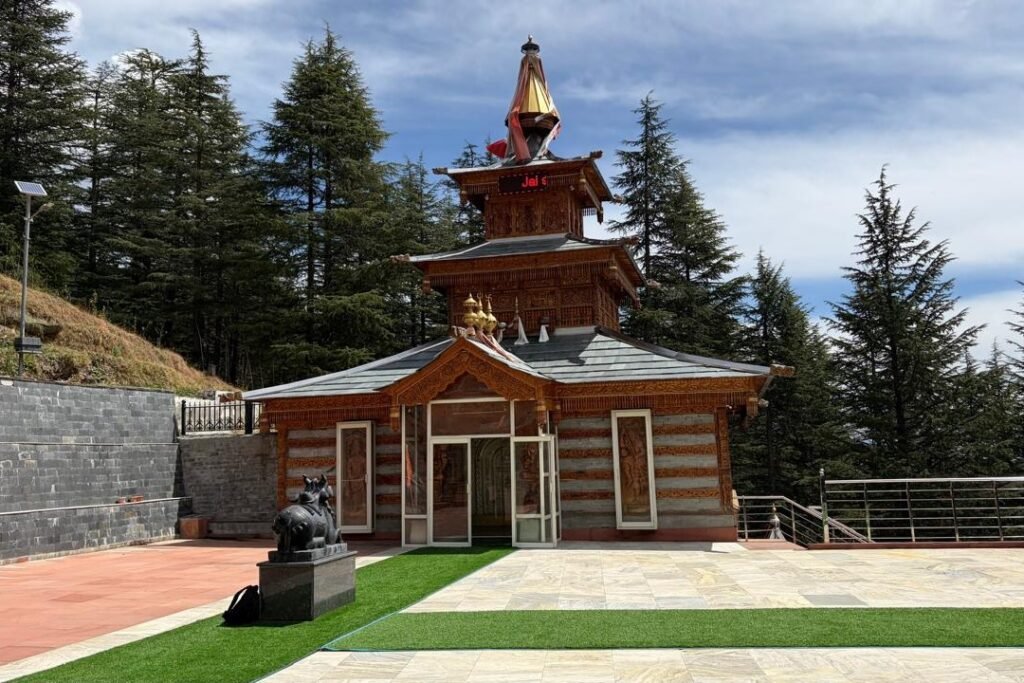
The existing local account places the shrine in wooded surroundings and gives particular importance to its outer building and successive doors. A reliable measured architectural description is not available, so the site should not be assigned a specific ancient building style or age without further evidence.
If an outside visit is permitted, let the visible structure and local explanations guide your understanding. Ask which areas may be approached and which should be left undisturbed. Do not assume that a path, courtyard, doorway, or forest space is open merely because it has no barrier.
🎉 Worship, ceremonies, and visiting occasions
The Rohtan reports show Kyanlu Maharaj participating in a wider community of worship through consecration ceremonies, religious recitation, and meetings of devtas. These dated events provide context for the area’s religious life.
Ask locally about the current calendar. A ceremony reported in one year does not establish an annual date for a future visit.
For a visit connected with a ritual, ask the local pujari, temple representatives, or knowledgeable residents which shrine is involved and whether outsiders may attend.
🙏 Visiting information and etiquette
Current public opening hours, entry charges, a direct temple contact, and routine visitor access have not been established for the forest shrine. Confirm these before making a special journey.
- Ask which shrine you are being directed to and whether permission is required.
- Follow instructions about footwear, offerings, and the limits of access.
- Leave closed doors and ritual objects untouched.
- Ask before photographing the building, ceremonies, or people at prayer.
- Avoid noise and litter, and keep to the permitted approach.
- Arrange the return journey and allow enough daylight for it.
Visitors accompanying elderly relatives or anyone with limited mobility should establish the walking distance, surface, and steps in advance. No accessible route or fixed visit duration is promised here.
🏞️ Places to combine with the journey
Jubbal, Hatkoti, and Rohru provide possible connections for a wider valley itinerary, depending on your approach and available time. Hatkoti’s Hateshwari Mata Temple offers a separate sacred-site visit; it should not be treated as an extension of Kyanlu’s own traditions.
Begin with a realistic route and confirmed access to Kyanlu. Add other stops only after allowing for the final approach and return journey. More distant mountain excursions need their own planning.
❓ Quick questions travellers ask
Where is the shrine described in this guide?
It is associated with the Mandal–Jubbal area of Shimla district. Ask specifically about the forest shrine and the closed-door tradition when confirming directions.
Is it definitely the same as the Kyanlu temple at Rohtan?
That relationship has not been established. The dated Rohtan reports should not be used as proof of the forest shrine’s layout or access rules.
What does Gupt Maheshwar refer to?
In the local account, it expresses the shrine’s association with a hidden Shivling and Shiva.
Is the naag offering milk a documented event?
It is a devotional story retained as local tradition, rather than an independently verified physical event.
Can visitors enter the inner chamber?
Do not expect or seek inner access. Follow the restrictions explained by those responsible for the shrine.
Are daily darshan timings available?
No dependable current public timetable has been established. Confirm access locally before travelling.
A final thought
The heart of Kyanlu’s forest-shrine tradition is the relationship between presence and restraint. The hidden Shivling, the naag’s offering, and the successive doors give that relationship a memorable form. A visitor can appreciate the story while accepting that the deepest space belongs to worship, not to public curiosity.
Begin with local directions and listen to the people who care for the shrine. Their guidance gives the journey its context and helps preserve the maryada that makes the place meaningful.
Sources and references
- Kyanlu Devta Ji map reference — the location reference retained from the local shrine account.
- Him Shimla Live, 12 May 2023: Kyanlu Devta Maharaj temple consecration — identifies the reported village ceremony at Rohtan in Mandal panchayat.
- Amar Ujala, 11 May 2023: Consecration of a newly built Kyanlu temple at Rohtan — dated reporting on the village temple.
- Amar Ujala, 4 August 2024: Shiva Mahapuran programme at Rohtan — public worship in the area.
- Amar Ujala, 10 August 2025: Devta gathering at Rohtan — regional devotional context.
The closed-door worship, hidden Shivling, Gupt Maheshwar name, and naag-and-milk narrative come from the local account preserved for this shrine. Their attribution remains distinct from the dated reports of public ceremonies.