Near the movement of Bilaspur’s bus stand and market roads, Laxmi Narayan Mandir keeps a quieter rhythm — one where Lord Vishnu and Goddess Lakshmi offer balance inside a town reshaped by water, roads, and memory.
Bilaspur is not a hill town that can be understood only through one temple or one view. Its old story was broken and remade by the creation of Bhakra Dam and Gobind Sagar Lake, when Old Bilaspur was submerged and the town had to live again on new ground. In such a place, temples are not only religious buildings. They become anchors.
Laxmi Narayan Mandir in Bilaspur is one such anchor. Located near the Bilaspur Bus Stand / ISBT side, it is a living town temple dedicated to Lord Vishnu and Goddess Lakshmi. It is not remote, difficult, or hidden in a forest. Its importance comes from being close to everyday life — buses arriving, people passing, families stopping for darshan, and the old Vaishnavite idea of preservation standing quietly inside a town that has known change.
🌄 Location & How to Reach It
Laxmi Narayan Mandir is located in Bilaspur town, Himachal Pradesh, close to the Bilaspur Bus Stand / ISBT area. This makes it one of the easiest temples to include in a local Bilaspur visit. Unlike high hill shrines or remote pilgrimage routes, this temple belongs to the town’s daily movement and can be reached without a trek.
Google Maps: Get Directions
Elevation: A precise temple-specific elevation is not consistently published in reliable public sources. Bilaspur town lies in the lower hill region of Himachal Pradesh near the Gobind Sagar landscape.
- By road: Bilaspur is well connected by road with Shimla, Mandi, Hamirpur, Ghumarwin, Swarghat, Kiratpur Sahib, and Chandigarh. Since the temple is close to the bus stand area, it is easy to reach by local taxi, auto, or on foot from nearby parts of town.
- By rail: The nearest practical broad-gauge railway access is generally through Kiratpur Sahib, Chandigarh, or other Punjab-side stations, followed by road travel to Bilaspur.
- By air: The nearest commonly used airports are Chandigarh Airport and Kullu-Manali Airport at Bhuntar, followed by road travel. For most visitors, road access is the most practical option.
This is an easy town temple, suitable for a short darshan visit or a calmer pause during a Bilaspur town itinerary.
🌸 Best Time to Visit
Laxmi Narayan Mandir can be visited through most of the year because it is located inside Bilaspur town. The most comfortable months are generally October to March, when the lower hills are cooler, and March to June if visiting in the morning or evening.
Bilaspur can become quite warm in summer compared with higher hill stations, so early morning and evening visits are more comfortable. Monsoon months bring rain, humidity, and occasional road delays in the wider region, but the temple itself remains accessible as a town shrine.
The temple is especially meaningful during Diwali, because of the worship of Goddess Lakshmi, and during Vaishnavite observances connected with Lord Vishnu, Lord Krishna, and Lord Rama. Janmashtami and Ram Navami are spiritually relevant, though visitors should confirm local arrangements before planning around exact festival activity.
There is no need to expect a tourist-style visiting system. This is a living temple. Visit during daylight or normal prayer hours, remove shoes where required, and ask before photographing inner sacred areas.
🕉️ Vishnu and Lakshmi in a Town That Had to Begin Again
The main deities of the temple are Lord Vishnu and Goddess Lakshmi. Vishnu is worshipped as the preserver, the one who maintains cosmic order, while Lakshmi represents prosperity, auspiciousness, grace, and well-being. Together, Laxmi Narayan is a form of stability.
That meaning feels especially relevant in Bilaspur. The town’s modern identity is inseparable from the story of Gobind Sagar Lake and the submergence of Old Bilaspur after the Bhakra Dam project. Many families, temples, memories, and public spaces had to relocate or be rebuilt in new form.
In that context, a Laxmi Narayan temple near the town’s daily movement carries more than routine devotion. It stands for continuity. Vishnu preserves. Lakshmi blesses. A town changes, but worship finds a way to remain.
This is not a temple whose power comes from difficulty of access. Its power comes from nearness — the fact that people can come easily, pray simply, and return to ordinary life with a little more steadiness.
🏛️ The Temple Near the Bus Stand
Many famous temples are remembered by their mountains, rivers, caves, or legends. Laxmi Narayan Mandir in Bilaspur is remembered partly by its location near the bus stand. That may sound ordinary, but it tells us something important.
A temple near a bus stand serves a different spiritual function from a remote shrine. It becomes part of movement. Travellers may stop before a journey. Families may visit while passing through town. Local residents may come in the morning or evening. Shopkeepers, students, office workers, drivers, and visitors all share the same sacred space.
The temple therefore belongs to everyday Bilaspur. It is not cut off from the town’s noise. It gives that noise a centre.
The presence of a temple in such a location also reflects an older Indian pattern: sacred spaces are not always isolated from public life. They often stand exactly where people gather, trade, travel, and wait. Laxmi Narayan Mandir works in that way. It offers darshan within the flow of town life.
🙏 What Laxmi Narayan Mandir Is Known For
Laxmi Narayan Mandir is known first as a shrine of Lord Vishnu and Goddess Lakshmi. Devotees visit for blessings related to peace, prosperity, family well-being, stability, and protection.
The temple is also known as a local multi-shrine compound. Tourism references mention other deities present in the temple area, including Lord Shiva, Maa Durga, Shani, Rangnath, and Baba Bangali, though the exact list varies by source and local arrangement. This gives the temple a broader devotional character than its name alone suggests.
Such temple compounds are common in Himachal’s towns. A main shrine may be dedicated to Vishnu and Lakshmi, but devotees may also bow before Shiva, Durga, Hanuman, Shani, or other local forms. This makes the place useful for families, because different members may approach different deities while sharing one temple visit.
The temple is also valued for its calm atmosphere. Even with the bus stand and town movement nearby, visitors often describe the compound as peaceful, with space to sit and pray.
🏛️ Shikhara Style, Marble, and a Local Compound
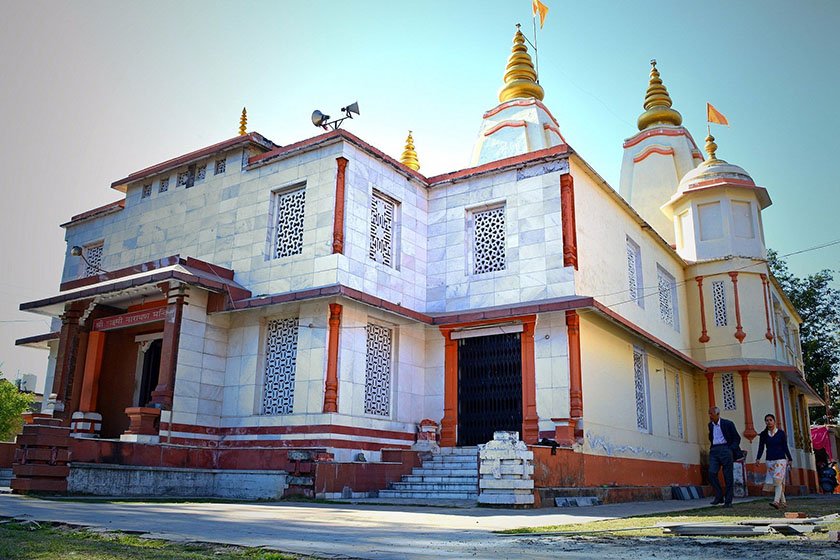
Available tourism references describe Laxmi Narayan Mandir as built in Shikhara / Shikhar Shaily architecture. The shikhara is the rising tower form associated with North Indian temples, visually drawing the eye upward from the sanctum toward the divine.
Some descriptions also speak of white marble and wooden pillars, giving the temple a bright, clean, and devotional appearance. Unlike older medieval stone temples, this temple’s visual character appears more modern and town-facing, shaped for regular worship rather than archaeological display.
This difference is important. Not every temple has to be ancient to be meaningful. A newer or rebuilt temple can carry real sacred value if it holds living devotion. Laxmi Narayan Mandir’s architecture should therefore be read as part of Bilaspur’s modern religious landscape — accessible, clean, compound-based, and welcoming to local worshippers.
The temple’s beauty lies in its usability. It offers space for darshan, prayer, and sitting. It serves the town directly.
📜 Old Bilaspur, Gobind Sagar, and the Memory of Relocation
One of the most interesting traditions connected with this temple is the memory that an older Laxmi Narayan shrine existed in Old Bilaspur before the town was affected by the creation of Gobind Sagar Lake. Some local accounts say the present temple preserves that devotional legacy, and that the idol of Lord Ranganath was moved here from the submerged old shrine.
This point should be handled carefully because detailed official documentation is not easily available in public sources. But the tradition itself is important. Bilaspur’s modern sacred geography cannot be separated from submergence, relocation, and rebuilding.
When a town is displaced, temples often become containers of memory. Idols are moved. Rituals continue. New buildings are raised. People bring old devotion into new neighbourhoods. Even when stone and streets are lost under water, worship can survive through relocation.
Laxmi Narayan Mandir therefore may be understood not only as a temple near the bus stand, but as part of Bilaspur’s effort to preserve sacred continuity after enormous landscape change.
🕉️ Rangnath, Shiva, Durga, and the Wider Devotional Space
Although the temple’s name centres on Laxmi Narayan, references to other deities in the compound give it a fuller devotional identity. Lord Shiva, Maa Durga, Shani, Rangnath, and Baba Bangali are among the names mentioned in available sources.
The mention of Rangnath is especially interesting. Rangnath is a form of Lord Vishnu, usually associated with Vishnu reclining on the serpent Ananta / Sheshnag. If the local tradition of a relocated Rangnath idol is accepted as part of the temple’s memory, it adds another Vaishnavite layer to the shrine.
Shiva and Durga add balance. A town temple often serves many devotional needs at once. A visitor may come for Vishnu, a family member may light a lamp for Durga, someone else may pray to Shani, and another may remember a local saintly figure. This is not disorder. It is the normal grammar of local Hindu worship.
The compound becomes a small sacred map of Bilaspur’s faith.
🎉 Festivals and Devotion
- Diwali: As a temple of Goddess Lakshmi and Lord Vishnu, Diwali is spiritually meaningful. Local arrangements should be confirmed before planning around special worship.
- Janmashtami: Connected with Lord Krishna, an avatar of Vishnu, Janmashtami is a relevant Vaishnavite festival for devotees.
- Ram Navami: Worship of Lord Rama, another avatar of Vishnu, gives this festival devotional importance for Vaishnavite visitors.
- Daily worship: The temple functions as a living town shrine, with devotees visiting for regular prayer, family blessings, and peace.
- Multi-deity devotion: Because other deities are also associated with the temple compound, visitors may experience a broader worship space beyond the main Laxmi Narayan shrine.
🏞️ While You’re in the Area
- Baba Nahar Singh Temple, Dholra: One of Bilaspur’s important local sacred sites, associated with Baba Nahar Singh Ji and the devotional identity of Dholra.
- Maa Santoshi Temple, Dholra: A local shrine dedicated to Maa Santoshi, especially meaningful for Friday vrat devotees.
- Vyas Cave: A sacred site associated with Sage Vyasa and one of Bilaspur’s older mythological memories.
- Gobind Sagar Lake: The large reservoir created by Bhakra Dam, central to modern Bilaspur’s landscape and memory.
- Bhakra Dam: A major engineering landmark of North India, often connected with Bilaspur travel where access and permissions allow.
- Naina Devi Temple: One of Himachal’s major Shakti shrines, located in Bilaspur district and often visited as part of a larger pilgrimage route.
- Rukmani Kund: A sacred water site in Bilaspur district, linked with local legend and often included in regional religious travel.
🙏 Getting in Touch
There is no widely verified official temple website, booking system, or formal public contact number available for Laxmi Narayan Mandir, Bilaspur in accessible public sources. For current darshan access, aarti timings, festival arrangements, and photography rules, ask locally near the Bilaspur Bus Stand / ISBT or in the surrounding town area.
Since the temple is close to the main town movement, access is usually simple. Still, if you are planning around Diwali, Janmashtami, Ram Navami, or a special family ritual, confirm the timing locally before visiting.
As with all living shrines, remove shoes where required, keep the compound clean, avoid loud behaviour, and ask before photographing inner sanctums or deities.
❓ Quick Questions Travellers Ask
Where is Laxmi Narayan Mandir located?
Laxmi Narayan Mandir is located in Bilaspur town, Himachal Pradesh, close to the Bilaspur Bus Stand / ISBT area.
Which deities are worshipped here?
The main deities are Lord Vishnu and Goddess Lakshmi in the form of Laxmi Narayan.
Is this the same as Laxmi Narayan Temple in Chamba?
No. This is Laxmi Narayan Mandir, Bilaspur, a separate temple from the famous Laxmi Narayan Temple complex of Chamba.
What is the temple known for?
It is known as a peaceful town temple dedicated to Vishnu and Lakshmi, with other shrines or deities also present in the compound.
What is the architectural style?
Available references describe the temple in Shikhara / Shikhar Shaily style.
Is the temple connected with Old Bilaspur?
Local accounts connect the temple with the devotional legacy of Old Bilaspur and mention the relocation of a Rangnath idol, but detailed public documentation is limited.
Is there a trek to reach the temple?
No. It is a town temple near the bus stand and is easy to reach by road or on foot from nearby areas.
What is the best time to visit?
Morning and evening are best, especially during the warmer months. The cooler season from October to March is comfortable for Bilaspur town visits.
Can it be visited with other Bilaspur temples?
Yes. It can be combined with Baba Nahar Singh Temple, Maa Santoshi Temple, Vyas Cave, and other Bilaspur sacred sites.
Are photos allowed inside?
Photography rules may depend on temple custom. Ask before photographing inner sanctums, deities, or ritual areas.
A Last Word
Laxmi Narayan Mandir, Bilaspur is not a temple of distance. Its strength is nearness. It stands close to the bus stand, close to the town, close to the ordinary movements of people who may have only a few minutes for prayer.
That makes its devotion practical and human. Lord Vishnu, the preserver, and Goddess Lakshmi, the giver of auspiciousness, sit at the centre of a town that knows what it means to lose, rebuild, and continue.
Bilaspur’s landscape changed under the waters of Gobind Sagar, but faith found new ground. In Laxmi Narayan Mandir, that continuity remains visible — not as a grand declaration, but as daily darshan, small offerings, and the quiet belief that preservation is also a form of grace.
Fact-check note: Laxmi Narayan Mandir, Bilaspur is consistently identified in available tourism references as a temple near the Bilaspur Bus Stand / ISBT, dedicated to Lord Vishnu and Goddess Lakshmi. Several sources describe it in Shikhara / Shikhar Shaily style and mention additional deities or shrines in the compound, including Lord Shiva, Maa Durga, Shani, Rangnath, and Baba Bangali, though the exact list varies. Local accounts also connect the present temple with the devotional memory of Old Bilaspur and the relocation of a Rangnath idol after the creation of Gobind Sagar Lake, but detailed official documentation for that claim is limited in accessible public sources. This article therefore treats the relocation memory cautiously and avoids forcing unverified construction dates, daily timings, contact numbers, or temple-specific elevation figures.