
Temple & sacred site
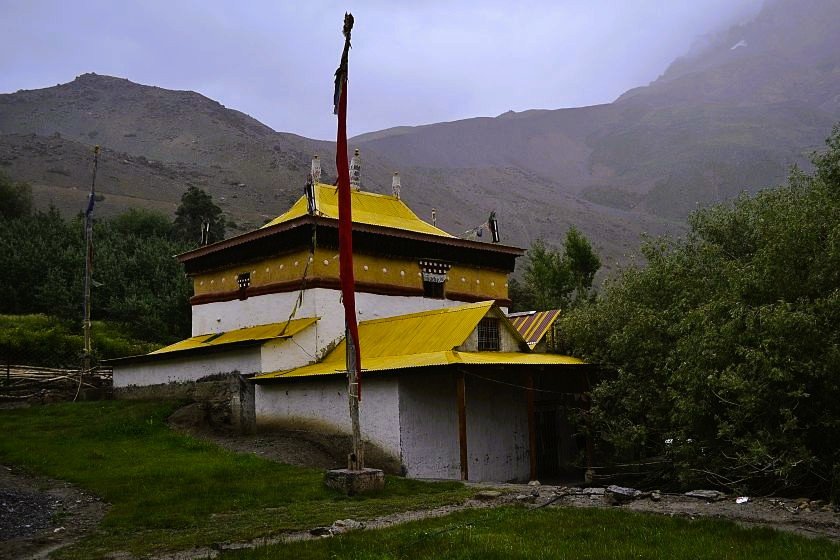
Lhalung Monastery, Spiti
The Sacred Art of the Serkhang Golden Temple
At a glance
- Location
- Lhalung village, Lingti Valley, Lahaul and Spiti district
- How to reach
- Arrange the Lingti Valley road connection and ask for the historic Serkhang
A small shrine above Lhalung village preserves an expansive artistic world in clay sculpture, painted surfaces, and the memory of a larger monastery.
Lhalung Monastery, also written as Lalung, belongs on an itinerary for travellers who want to look closely at Spiti’s Buddhist art. Its best-known historic shrine is the Serkhang, or Golden Temple. The scale of the building gives little warning of the densely arranged figures inside.
The visit is most rewarding when approached as an encounter with fragile, living heritage. The village, the surviving chapels, and the care of their custodians are all part of the experience. A small interior can deserve as much attention as a much larger monastery.
🌄 Location and how to reach it
Lhalung stands in the Lingti Valley of Spiti, in Lahaul and Spiti district. It is reached on a side journey from the main Spiti route, often planned from Kaza or alongside a visit to Dhankar.
Google Maps: Find Lhalung Monastery
- From Kaza: Arrange transport to Lhalung and confirm the connecting roads before leaving.
- From Dhankar or Tabo: Allow for the separate valley approach instead of assuming the monastery lies directly on the main road.
- In the village: Ask for the old Serkhang or Golden Temple, and find out which historic spaces are open.
Published distance estimates depend on starting points and routes. Use them for orientation rather than a firm arrival time. If walking surfaces or steps are a concern, ask about the final approach before travelling.
🌸 Best time to visit
Summer and early autumn are practical periods for a wider Spiti visit. June to September provides a useful planning window, but the choice of route and the year’s road conditions remain important.
Winter travel brings severe cold and fewer services. A clear day in one part of the valley does not establish conditions along the whole journey. Keep plans flexible and arrange an arrival that leaves enough daylight for the onward drive.
Allow time to settle into the region’s elevation before fitting several village and monastery visits into one day. A slower itinerary also makes it easier to wait for a custodian without rushing the rest of the journey.
📜 History, dating, and the translator tradition
Lhalung is traditionally associated with Rinchen Zangpo, whose name is linked with Buddhist learning and temple foundations across the western Himalayas. The surviving buildings and artworks require a more specific historical reading.
Art historian Christian Luczanits places the Serkhang close to the Alchi group of monuments and proposes the second half of the twelfth century. Other architectural research discusses the site within a broader eleventh–twelfth-century setting.
The association with a celebrated teacher should therefore be distinguished from a proven construction year. A religious foundation, its surviving sculpture, and later alterations can represent different stages in the life of a shrine.
🏛️ A surviving part of a larger monastery
Research describes an earlier monastic establishment on the hill above the village. Two historic elements receive particular attention: the Serkhang and the nearby Vairocana Chapel.
This helps explain the site’s modest appearance today. What survives is part of a larger history, rather than evidence that the monastery was always a small pair of rooms. Look at the relationship between the hill, village, and accessible buildings before concentrating on a single shrine.
Let local custodians explain the visitor route. Modern rooms, private areas, and historic chapels may stand near one another without sharing the same access arrangements.
✨ Inside the Serkhang Golden Temple
The Serkhang is noted for clay sculptures arranged across three interior walls. The room presents a connected religious composition, with figures and their settings shaping the experience of the whole space.
Luczanits distinguishes older sculpture from later repainting. The colour visible on a figure should not automatically be treated as the same age as the sculpted form beneath it.
Look patiently at the relationships between figures rather than trying to identify every one at once. A knowledgeable explanation can draw attention to details that are easy to miss in a quick visit. The name Golden Temple refers to the Serkhang; it should not create an expectation of a gold-covered exterior.
🪷 The Vairocana Chapel
The nearby chapel is associated with a fourfold Vairocana image: figures seated with their backs towards one another around a common arrangement. Its original architectural setting is not securely established.
The image is part of Lhalung’s importance for the study of early Buddhist art. Its relationship with comparable imagery elsewhere in the region is a subject for scholarship, rather than a detail that needs to be simplified into an unsupported certainty for visitors.
Ask whether the chapel can be visited and follow the guidance given. A reference in a guidebook does not mean a particular room will be open on the day.
🎨 Caring for the artwork during a visit
Historic clay sculpture and painted surfaces are vulnerable. Their preservation depends partly on ordinary visitor behaviour in a confined space.
- Keep hands, bags, and clothing clear of walls and images.
- Do not lean against decorated surfaces or place equipment beside sculpture.
- Ask before taking any interior photograph.
- Follow restrictions on flash, lighting, and the number of people inside.
- Allow others room to move without crowding the artwork.
Photographs published elsewhere describe a previous visit, not permission for photography today. The custodian’s instructions should determine what you do.
🙏 Visiting information and local arrangements
No dependable current official opening timetable, admission charge, or visitor-office contact has been established for this guide. Ask a host in Kaza or Lhalung to help confirm access before making a special journey.
Some historic spaces may depend on a local custodian being available. If a door is closed, ask respectfully rather than entering another part of the compound in search of access.
Allow enough time to see the accessible rooms without rushing, and add the walking and travel time separately. A visit to observe the art is different from attending prayers or a ceremony; participation in those activities requires its own arrangements.
🏡 Spending time in Lhalung village
The settlement is a home for residents as well as a destination for travellers. A village walk can give context to the monastery when it respects private courtyards, houses, and daily work.
Ask before photographing people or entering an enclosed space. If staying locally, confirm meals, bedding, heating, and arrival arrangements in advance. Facilities available in a larger Spiti town should not be assumed to exist in every village.
Leave room in the day simply to appreciate the setting. Adding more stops does not necessarily make an itinerary more rewarding.
🏞️ Places to combine with Lhalung
- Dhankar: A separate monastery visit with a very different landscape setting.
- Tabo: A valuable comparison for travellers interested in early Buddhist art.
- Kaza: A possible base for transport and accommodation.
- The Lingti Valley: An option for slower village exploration with local advice.
Choose combinations according to the roads, daylight, and your interest in the sites themselves. Leave enough time to notice how each monastery differs.
❓ Quick questions travellers ask
Are Lhalung and Lalung the same place?
Yes. Both spellings are used for this village and monastery.
What is the Serkhang?
The historic shrine also called the Golden Temple, especially known for its sculpted interior.
Is all the visible painting as old as the sculpture?
No. Research distinguishes older sculpture from later repainting.
Can visitors see the Vairocana Chapel?
Ask locally about current access rather than assuming it is open.
Is interior photography permitted?
Only where the custodian allows it, following the instructions for each space.
A final thought
Lhalung shows how a small surviving space can carry a substantial history. Give its images time, ask questions where an explanation is available, and accept the care that fragile interiors require.
Sources and references
- Christian Luczanits: Lalung — sculpture, repainting, the Vairocana Chapel, and proposed chronology.
- Architectural research: Measure for Measure — the surviving buildings and their documentation.
- Research progress report on Lhalung — village and regional context.