On the high ridge of Haripurdhar, where Sirmaur looks towards Churdhar and the old frontier hills, Maa Bhangayani is worshipped as the fierce sister-power who helped a mountain deity return home.
Haripurdhar is not a place one reaches by accident. The road climbs through the Sirmaur hills, bends through forests and villages, and slowly opens towards a high ridge where the air feels sharper and the horizon wider. At this height stands Maa Bhangayani Temple, one of the most revered goddess shrines of Sirmaur.
The temple is closely connected with the local deity tradition of Shirgul Mahadev, also known as Chureshwar Maharaj, the great hill deity associated with Churdhar. Maa Bhangayani is often remembered as his divine sister or helper — the goddess who stood with him in a difficult moment and became one of the most powerful Devi presences in this part of Himachal.
This is not a temple whose story can be separated from the land around it. Haripurdhar carries memories of old Sirmour State, frontier watchfulness, Churdhar devotion, local goddess power, and the faith of people from Sirmaur, Shimla, Solan, and nearby regions. Maa Bhangayani’s shrine gathers all of that into one hilltop darbar.
🌄 Location & How to Reach It
Maa Bhangayani Temple is located at Haripurdhar / Haripur Dhar in Sirmaur district, Himachal Pradesh. Haripurdhar is a high ridge settlement in the lesser Himalayan / Shivalik belt and is closely associated with the Churdhar–Shirgul devotional landscape. District Sirmaur’s official site includes Maa Bhangayani Temple, Haripurdhar in its Sirmaur gallery and describes Haripur Dhar as an old frontier hill where a fort was once built by the rulers of the former Sirmour State to guard the boundary with Jubbal State.
Google Maps: Get Directions
Elevation: Public sources commonly place Haripurdhar around 2,400–2,500 m / about 8,000 ft, though exact figures vary. It is safest to understand the temple as a high-ridge shrine rather than a lowland temple.
- By road: Haripurdhar is connected by road with Nahan, Solan, Rajgarh, Nohradhar, Sangrah, and nearby Sirmaur routes. The road journey is scenic but involves hill driving, so travel during daylight is better.
- From Shimla / Solan side: Travellers often approach through Solan–Rajgarh–Nohradhar / Haripurdhar routes, depending on road condition.
- From Nahan side: Haripurdhar can also be approached from Nahan through the interior Sirmaur road network.
- By rail: The nearest practical railway access is usually Kalka or Chandigarh, followed by road travel through Solan, Nahan, or other chosen routes.
- By air: The nearest major airport is Chandigarh Airport, followed by road travel. Shimla Airport may be closer on the map for some routes, but flight availability and road practicality should be checked.
This is not a trek-based shrine, but the approach is a proper hill-road journey. Weather, fog, snow, and road repair can affect travel, especially in winter and monsoon.
🌸 Best Time to Visit
Maa Bhangayani Temple can generally be visited through the year, but the most comfortable months are April to June and September to November. These months usually offer better road conditions, clearer skies, and a more comfortable experience for travellers coming from lower regions.
Winter can be beautiful at Haripurdhar, but cold, fog, frost, and occasional snow can make road conditions uncertain. If travelling in winter, confirm the road status locally before starting. Monsoon brings greenery, but also mist, slippery roads, and possible landslide-related delays.
Morning is the best time for darshan and views. The ridge is quieter, the air is clearer, and the temple atmosphere feels less hurried. During local fairs, Navratri, or special Devi days, the shrine may become much busier.
Because public sources do not provide a single official festival calendar for Maa Bhangayani Temple, visitors should confirm important local dates in Haripurdhar before planning a festival-specific journey.
🕉️ The Goddess of Haripurdhar
Maa Bhangayani is worshipped as one of the most powerful goddess figures in the Sirmaur hills. For local devotees, she is not simply a form of Devi placed in a temple; she is a living protective presence connected with Haripurdhar and the wider Shirgul–Churdhar sacred region.
Her shrine stands in a part of Himachal where local devta traditions are strong. Deities here are not treated only as mythological figures from distant scriptures. They belong to villages, ridges, fairs, routes, families, and oral memory. They travel in palanquins, receive offerings, settle disputes, protect communities, and remain part of everyday life.
Maa Bhangayani belongs to that living world. She is approached as Maa, the mother, but also as a force with authority. Her devotees come for protection, fulfilment of vows, family well-being, relief from trouble, and blessings before important decisions.
The temple’s hilltop setting suits her. She is not hidden in a town lane. She stands where the ridge opens, where old Sirmaur’s hills meet sky and wind.
🕉️ Shirgul Maharaj and the Sister-Power of Bhangayani
The most important devotional relationship connected with Maa Bhangayani is her association with Shirgul Mahadev, also called Chureshwar Maharaj. District Sirmaur’s Churdhar Trek page describes the Churdhar temple as dedicated to Shiva / Chooreshwar Mahadev and named after Shri Shrigul Maharaj or Chureshwar Maharaj, a deity worshipped in the area. For locals of Sirmaur, Chaupal, and Solan, this deity holds deep importance.
Maa Bhangayani is widely remembered as Shirgul Maharaj’s divine sister or helper. Local legend says that when Shirgul was imprisoned by a Mughal ruler, Maa Bhangayani helped secure his freedom or helped him return from captivity. The details vary from telling to telling, but the emotional centre remains the same: the goddess stood beside the deity in a moment of crisis.
This relationship gives Maa Bhangayani Temple its special place. It is not only a Devi shrine. It is part of the larger sacred story of Shirgul Maharaj, Churdhar, and the hill communities that revere him.
The brother-sister relationship also gives the temple a deeply local feeling. In Himachali devta traditions, divine relationships are often described through family language. Deities have sisters, brothers, attendants, messengers, rivals, and allies. These relationships make the sacred world feel close, social, and alive.
🔥 The Legend of Captivity and Return
One of the widely told stories says that Shirgul Maharaj was once taken or imprisoned by a Mughal ruler. Some versions connect the event with Delhi and say that Shirgul had angered the authorities through his defence of people and dharma. In the legend, he is held in captivity, and Maa Bhangayani plays a key role in helping him regain freedom.
The story should be treated as sacred tradition, not as a court-certified historical record. But its meaning is important. It presents Shirgul as a protector deity and Maa Bhangayani as the force who supports him when power turns unjust.
In many mountain legends, deities travel beyond their home region and return with greater authority. Captivity, exile, testing, and return are common sacred themes. They show that a deity’s power is not confined to one village. It can move, suffer, fight, and come back stronger.
Maa Bhangayani’s role in this story is not secondary. She is not merely present in the background. She is remembered because she acts. She helps. She protects. She stands with Shirgul.
That is why devotees speak of her with such strength.
🙏 What Maa Bhangayani Temple Is Known For
Maa Bhangayani Temple is known first as a major Devi shrine of Haripurdhar and one of the most revered goddess seats in Sirmaur district. Devotees come here for blessings, protection, fulfilment of vows, peace in family life, success in work, and relief from obstacles.
The temple is also known for its connection with Shirgul Mahadev / Chureshwar Maharaj. Many visitors who understand the Churdhar-Shirgul tradition see Maa Bhangayani and Shirgul Maharaj as part of the same sacred world.
The shrine is also valued for its high-ridge location. Haripurdhar gives wide views, cold air, and a sense of distance from the lower plains. This makes the temple feel like a true hill darbar.
For travellers, Maa Bhangayani Temple is often combined with Churdhar, Nohradhar, Sangrah, Renuka Ji, or other Sirmaur routes. But for local devotees, it is not merely a travel stop. It is the seat of the Mother.
🏛️ A Ridge-Top Temple With a Living Darbar
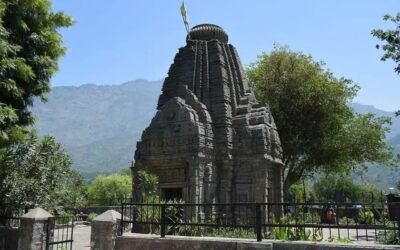
Maa Bhangayani Temple has the character of a living hill shrine rather than an ancient stone monument preserved only for architecture. Its importance lies in worship, community faith, local festivals, and the goddess’s continuing presence.
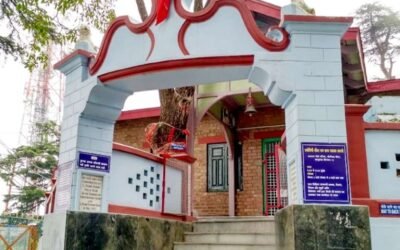
The temple complex is known for its active devotional atmosphere. Visitors may find prayer, offerings, bells, local movement, and the steady arrival of devotees from nearby villages and distant towns. On ordinary days, the shrine may feel calm and open; on special days, it becomes a centre of gathering.
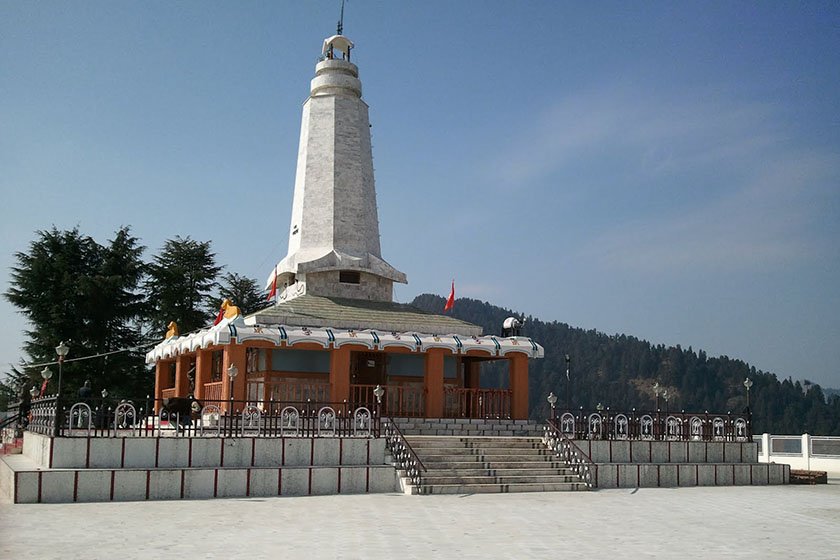
The ridge setting gives the temple its strongest visual identity. Around it are hills, forests, clouds, and the long road through Sirmaur. Weather changes quickly here. Mist may arrive suddenly. The temple can appear and disappear in cloud. On clear days, the horizon stretches widely.
A visitor should not look only at the temple building. The whole hilltop is part of the experience — the approach road, the ridge air, the sound of bells, the view, and the feeling of being high above ordinary movement.
📜 Haripurdhar: Fort, Frontier, and Devotion
Haripurdhar itself has an older political memory. District Sirmaur’s official places-of-interest page describes Haripur Dhar as a hill where a fort once stood like a silent sentinel, built by the rulers of the former Sirmour State. The fort was meant to guard the frontier with the neighbouring Jubbal State because of boundary disputes and encroachments.
This matters because it shows Haripurdhar as more than a temple village. It was once a frontier height — a place of watchfulness, defence, and boundary.
Over time, the military importance faded, but the sacred importance remained. Maa Bhangayani’s temple now gives Haripurdhar its strongest public identity. The old fort memory and the Devi temple together make the place feel layered: state frontier, ridge settlement, goddess seat, and gateway towards Churdhar devotion.
In the Himalayas, such layers are common. A hill may first be strategic, then sacred, or both at once. People choose heights because they see far from them. Deities also sit on heights because they watch.
🏔️ Haripurdhar and the Churdhar Sacred Landscape
Haripurdhar lies close to the wider Churdhar devotional region. Churdhar, also known as Chur Chandni, is one of the highest peaks in the Shivalik range and is deeply associated with Shirgul Maharaj / Chureshwar Mahadev. District Sirmaur describes Churdhar as a major sacred and trekking landscape, with the Churdhar temple dedicated to Shiva / Chooreshwar Mahadev and linked to Shri Shrigul Maharaj.
Maa Bhangayani’s temple should be understood in relation to this world. She is not physically the Churdhar summit temple, but her story and reverence are tied to Shirgul’s wider sacred authority.
For devotees, Haripurdhar and Churdhar can form part of a larger pilgrimage imagination. The goddess at Haripurdhar, the deity at Churdhar, the forest routes, the old frontier hills, and the surrounding villages all belong to one religious geography.
For travellers, this means Haripurdhar is a good place to understand Sirmaur beyond surface tourism. It is a gateway into the district’s devta traditions, not just a scenic stop.
🎉 Festivals and Devotion
- Local Devi worship: Maa Bhangayani is worshipped as a powerful goddess of the Haripurdhar and Sirmaur region. Devotees visit for protection, blessings, and fulfilment of vows.
- Navratri: As a Devi shrine, Navratri is naturally significant. Exact local arrangements should be confirmed in Haripurdhar before planning around festival days.
- Connection with Shirgul Maharaj: Devotees who revere Shirgul Mahadev / Chureshwar Maharaj often understand Maa Bhangayani as part of the same sacred family.
- Regional fairs and gatherings: Local fairs may be observed according to the traditional calendar, but a stable public festival calendar is not consistently available online. Confirm locally before travelling for a specific event.
- Darshan and offerings: Devotees may offer prasad, chunri, coconuts, flowers, or other items according to local custom.
- Respect for hill shrine customs: Follow local practice, avoid loud behaviour, and ask before photographing inner sacred areas.
🏞️ While You’re in the Area
- Churdhar / Chureshwar Mahadev: The great sacred peak associated with Shirgul Maharaj, important for both devotees and trekkers.
- Nohradhar: A key base for Churdhar routes and a useful stop for travellers exploring the higher Sirmaur region.
- Haripurdhar Fort / Killa: The old frontier fort site connected with the former Sirmour State’s boundary watch over the Jubbal side.
- Sangrah: A major local centre in this part of Sirmaur, useful for road connections and regional travel.
- Renuka Ji Lake: One of Sirmaur’s most famous sacred lakes, associated with Mata Renuka and Parshuram.
- Rajgarh: A beautiful hill town and orchard region, useful on routes connecting Solan, Nohradhar, and Haripurdhar.
- Nahan: The district headquarters of Sirmaur and a practical base for travellers entering the district from the plains.
🙏 Getting in Touch
There is no widely verified official temple website, booking system, or formal public contact number consistently available for Maa Bhangayani Temple in accessible public sources. For current darshan access, festival dates, accommodation options, local road conditions, priest availability, and weather updates, ask locally in Haripurdhar, Nohradhar, Sangrah, or Nahan.
Haripurdhar is a high-ridge settlement, so winter cold, fog, rain, or snow can affect travel. Do not rely only on maps during bad weather. Confirm road conditions with local drivers or residents before starting.
As with all living Devi shrines, remove shoes where required, keep the temple area clean, avoid loud music or casual behaviour, and ask before photographing inner sacred spaces.
❓ Quick Questions Travellers Ask
Where is Maa Bhangayani Temple located?
Maa Bhangayani Temple is located at Haripurdhar / Haripur Dhar in Sirmaur district, Himachal Pradesh.
Who is Maa Bhangayani?
Maa Bhangayani is a powerful local goddess of Sirmaur, closely associated with Shirgul Mahadev / Chureshwar Maharaj.
Is Maa Bhangayani connected with Shirgul Maharaj?
Yes. Local tradition remembers Maa Bhangayani as Shirgul Maharaj’s divine sister or helper, especially in the legend of his captivity and return.
What is Haripurdhar known for?
Haripurdhar is known for Maa Bhangayani Temple, its old frontier fort history, high-ridge setting, and connection with the Churdhar-Shirgul sacred landscape.
What is the altitude of Haripurdhar?
Public sources commonly place Haripurdhar around 2,400–2,500 m / about 8,000 ft, though exact figures vary.
Can Maa Bhangayani Temple be visited by road?
Yes. The temple is road-accessible through Sirmaur hill routes, but road condition should be checked during winter, monsoon, or bad weather.
What is the best time to visit?
April to June and September to November are generally the most comfortable months. Winter visits depend on weather and road conditions.
Can it be combined with Churdhar?
Yes, but Churdhar involves trekking and weather planning. Maa Bhangayani Temple at Haripurdhar can be part of a larger Churdhar-Sirmaur pilgrimage route.
Are there places to stay at Haripurdhar?
Basic accommodation is generally available in and around Haripurdhar, including small hotels or guesthouses, but availability should be confirmed before travel.
Are photos allowed inside the temple?
Photography rules may depend on local custom. Ask before photographing the sanctum, deity, or inner ritual spaces.
A Last Word
Maa Bhangayani Temple gives Haripurdhar its living heart. The ridge has old frontier memories, the road has forest and bends, and the wider hills carry the name of Shirgul Maharaj. But at the centre of it all stands the goddess.
Her story is one of strength beside strength. Shirgul is the great hill deity of Churdhar; Bhangayani is the sister-power who helps, protects, and remains present in the region’s devotion. Together, they show how Sirmaur understands the sacred not as isolated gods, but as a living family of powers spread across peaks, villages, and routes.
At Haripurdhar, Maa Bhangayani does not feel distant. She belongs to the ridge, the people, the weather, and the road that brings devotees to her. The hill watches outward, and the goddess watches within.
Fact-check note: District Sirmaur’s official website includes Maa Bhangayani Temple, Haripurdhar in its Sirmaur gallery and describes Haripur Dhar as an old frontier hill where the rulers of the former Sirmour State built a fort to guard the boundary with Jubbal State. The official Churdhar Trek page confirms the importance of Shirgul Maharaj / Chureshwar Mahadev in the region. Public sources consistently identify Maa Bhangayani as a highly revered goddess of Sirmaur and connect her with Shirgul Maharaj, especially through the legend of helping him during captivity or return. Exact historical chronology, elevation figures, annual festival dates, temple management contacts, and accommodation details vary or are not firmly verified in accessible public sources, so this article treats those points cautiously and advises local confirmation before travel.