Every Hindu temple honours a god. This one, unusually, honours the man who survived the flood that made room for them all
Ask ten people in Old Manali why their town is called Manali, and most will give you the same answer without pausing: Manu-Alaya, the abode of Manu. It’s one of those pieces of local knowledge that’s repeated so often it’s stopped sounding like legend and started sounding like fact. Up a steep tangle of lanes above the main village, past guesthouses and apple trees and the kind of cafés that serve both chai and shakshuka, sits the temple built around that claim — a modest wooden shrine dedicated to the sage said to have restarted human civilization from this exact spot, after the rest of the world had drowned.
It’s a genuinely unusual dedication. Walk through Himachal Pradesh and you’ll find hundreds of temples to Shiva, Krishna, and the valley’s countless local devtas. Manu Temple stands almost alone in Indian religious geography — widely described, though not something that can be verified with total certainty, as the only major temple in the country built specifically in honour of Manu, the primordial lawgiver rather than a conventional deity.
🌄 Location & How to Reach It
- Location: Manu Temple Road, Old Manali, Himachal Pradesh – 175131
- GPS Coordinates: 32.2570° N, 77.1761° E
- Google Maps: Get Directions
- Altitude: Roughly 2,050 metres
- Distance: About 2.5–3 km from Manali Mall Road
You reach it on foot, and honestly, that’s how it should be experienced. From Old Manali’s main lane, the path climbs steadily uphill through a warren of narrow, occasionally cobbled streets — past traditional wooden houses, small guesthouses, and the odd apple orchard, gaining height with every turn. Most people cover it in 30 to 45 minutes at a comfortable pace, though the final stretch is genuinely steep and not motorable, so don’t count on driving all the way up. A handful of locals do navigate the upper lanes in small hatchbacks, but it’s not something visitors should attempt or expect.
Taxis and autos can drop you near the base of the climb, saving some of the initial ascent, but the temple’s approach — narrow lanes, unexpected mountain views opening up between houses, the noise of the village fading as you climb — is arguably as much a part of the visit as the temple itself.
Getting to Manali first: Regular Volvo and HRTC buses connect Manali to Delhi, Chandigarh, and Shimla. The nearest airport is Bhuntar (Kullu-Manali Airport), around 50 km away, with the nearest railhead typically reached via Chandigarh.
🌸 Best Time to Visit
Manali’s high season, roughly March through June, is when the walk up feels easiest — mild days, clear skies, and the village lanes at their liveliest with cafés and shops running full swing. Come October through November and you’ll trade some of that liveliness for crisper air and quieter streets, arguably a better trade if what you actually want is calm at the temple itself. Monsoon (July–September) makes the stone lanes slick underfoot, so tread carefully if you visit then. Winter, particularly after snowfall, is when several visitors say the temple looks its most striking — a dark wooden structure against white slopes — though the climb turns properly cold, and warm, grippy footwear stops being optional.
Temple timings: Generally open daily, 6:00 AM to 5:00 PM.
🕉️ The Story Behind the Shrine
The legend at the centre of this temple comes from the Matsya Purana, and it’s one of Hindu mythology’s more vivid flood narratives. King Manu, the story goes, was washing his hands in a river when a small fish approached him, asking to be protected. Manu obliged, placing it in a water jar — only for the fish to keep growing, forcing him to move it into progressively larger vessels: a bowl, a well, a reservoir, eventually the river itself, and finally the ocean, as it kept outgrowing every container he offered. Once the fish had become vast beyond anything natural, it revealed itself as Lord Vishnu in his Matsya avatar, and delivered a warning: a catastrophic deluge was coming that would submerge the entire world.
Vishnu instructed Manu to build a great ark, load it with his family, the Saptarishi (the seven sages), and the seeds of every living thing, and prepare to ride out the flood. When the waters came, Vishnu — again in fish form — is said to have towed Manu’s ark to safety using the serpent Vasuki as a rope, guiding it to rest somewhere high in the Himalaya. Local tradition places that final mooring right here, in the valley that would eventually take Manu’s name.
What happened next is really the heart of why this temple matters as much as it does. Manu didn’t just survive; according to the legend, he meditated at this spot and set about rebuilding human civilization from nothing — codifying laws, social structures, and the framework for organized life that would later be recorded as the Manusmriti, one of the foundational (and today, admittedly, controversial) texts of Hindu law and social order. Whatever one makes of that text’s later history, its origin story, at least as told here, begins on this exact hillside.
🏛️ A Temple Rebuilt, Not Ruined
Don’t expect ancient stonework worn smooth by centuries. Several sources, Lonely Planet among them, note that the current structure was rebuilt around 1991–92, replacing an earlier chalet-style temple that had stood on the site — itself said to have been constructed after the discovery of several venerated idols, though no one can point to a firm date for when worship here actually began. This matters for setting expectations honestly: the temple’s significance is ancient, even if its physical fabric is considerably younger than many of Kullu’s older wooden shrines like Murlidhar or Tripura Sundari.
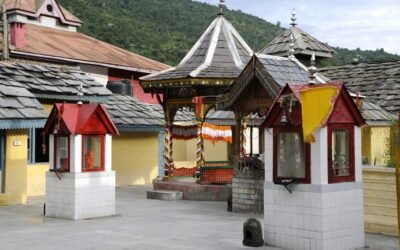
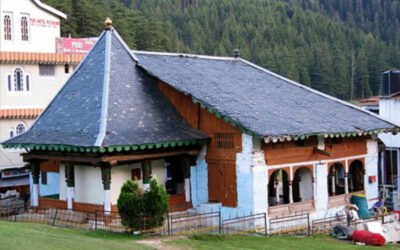
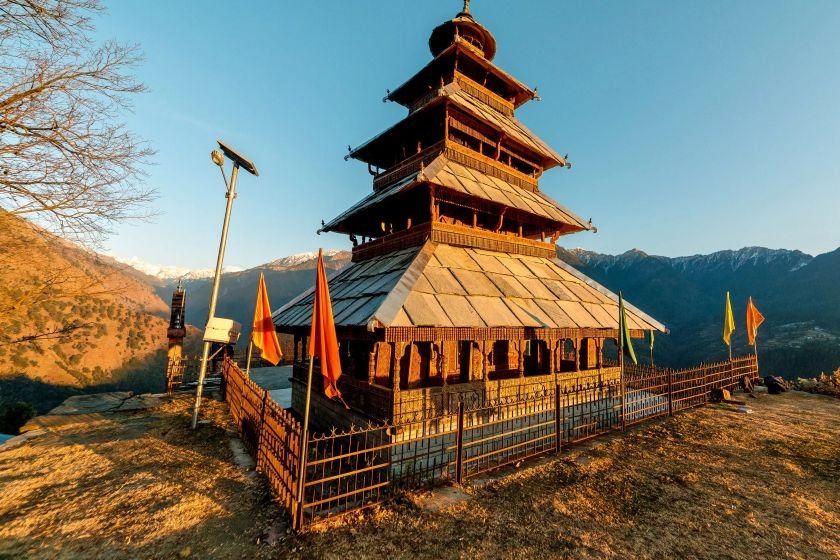
What you’ll find today is a stone-and-wood structure, built along broadly pagoda-style lines with a distinctive towered roofline that several visitors compare to architectural traditions further east in Nepal. Inside, the hall is spacious by the standards of small hill temples, with a wooden floor where devotees sit for extended periods of quiet meditation rather than passing through quickly — a detail worth knowing if you’re hoping for a calm moment inside rather than a brisk look around. A large bell hangs near the entrance, and the whole space carries a plainness that feels intentional rather than unfinished — fitting, perhaps, for a temple built around a figure associated with order and restraint rather than spectacle.
📜 A Second Local Legend: The Demon Tundi
Less commonly told than the flood story, but recorded in some older regional accounts, is a second legend tied to this same site: that the valley was once terrorised by a demon named Tundi, and that Manu, working with the sage Shandilya, freed the local people from his threat. This deliverance is said to be commemorated even today through a distinct local festival — a version of Diwali celebrated at a different time and for different reasons than the pan-Indian festival of the same name, alongside the spring festival of Faagli. It’s a good reminder that Manu’s story here isn’t confined to one single flood myth; the valley has woven multiple layers of his legend into its own festival calendar over time.
🎉 Festivals and Everyday Life at the Temple
- Local Diwali and Faagli: Tied to the Tundi legend above, these festivals mark deliverance and renewal in ways distinct from their more widely known namesakes elsewhere in India.
- Daily worship: Quiet, largely undemonstrative — incense, flowers, and long periods of meditation on the temple’s wooden floor rather than elaborate ritual.
- Peak season crowds: Worth knowing before you go — this is one of the more heavily visited spots in Old Manali during summer, so an early morning or late afternoon visit will get you considerably more of the calm the temple is known for.
🏞️ While You’re in the Area
- Old Manali village: The walk up and back takes you straight through its café culture, guesthouses, and riverside lanes — worth allowing extra time to wander.
- Manu Temple View Point: A short walk past the temple itself, offering a wider panorama over the Manali valley and surrounding peaks.
- Manalsu Nala: The stream running through Old Manali, with a small Himachal Tourism leisure area along its banks.
- Hidimba Devi Temple: A short taxi ride away in the Dhungri forest, if you want to pair two very different but equally significant Manali temples in one day.
🙏 Getting in Touch
There’s no publicly listed phone number or formal contact for Manu Temple — it’s managed as a community shrine rather than a bookable site, with regular, well-established opening hours (6 AM–5 PM) that don’t tend to shift unpredictably the way some remoter valley temples do. If you need current information on access or road conditions during winter, the Himachal Pradesh Tourism office in Manali is the most reliable point of contact.
❓ Quick Questions Travellers Ask
Is the temple actually thousands of years old? The legend behind it certainly is, but the physical structure standing today was rebuilt around 1991–92. Some online reviews describe the temple itself as “over 4,000 years old,” which conflates the age of the myth with the age of the building — worth knowing before you go in expecting ancient stonework.
Is this really the only Manu temple in India? It’s very widely described that way across guidebooks, tourism sites, and local accounts, and no other major Manu-dedicated temple is commonly cited anywhere else in the country. That said, this is a claim of relative obscurity rather than one that’s been formally, exhaustively verified — a small distinction, but worth being upfront about.
How strenuous is the walk? Moderate. It’s a steady 30–45 minute uphill walk through village lanes rather than open trail, manageable for most reasonably fit visitors, though the final stretch is steep enough that those with mobility concerns may find it tiring.
Is there parking near the temple? Not really — the lanes are narrow and largely unsuited to vehicles, and several visitors specifically flag parking and traffic as the most frustrating part of a visit if arriving by car. Walking from lower Old Manali is genuinely the easier option.
Can dogs or pets come along? Several visitor accounts mention the temple grounds as friendly toward the local dogs that tend to hang around Old Manali, though as with any place of worship, it’s worth using discretion and checking locally on the day.
A Last Word
There’s something quietly moving about a temple built not to a god who intervenes from above, but to a man who simply endured, then got to work rebuilding. No thunderbolts, no demons slain in cinematic combat — just a flood, a fish that kept growing, and a figure who, once the water receded, had to decide how humanity should live together again. Climb those steep lanes above Old Manali, step into that quiet wooden hall, and it’s hard not to think about how much of what we now call civilization is, in some symbolic sense, still being written from that same starting point.
Fact-check notes: This article was written and verified using multiple independent sources (Lonely Planet, Wikipedia-adjacent mythology references, Google Places live data, and regional travel documentation), cross-checked for consistency. The claim that this is “the only temple in India dedicated to Manu” is repeated extremely widely but is presented here as a commonly held claim rather than an independently audited fact, since no source offers a systematic survey confirming it. Sources disagree on the exact rebuild year (1991 vs. 1992) — both are noted rather than picking one arbitrarily. Also corrected: some online reviews describe the current temple structure itself as thousands of years old, which conflates the age of the Manu legend with the age of the physical building, documented as rebuilt around 1991–92. Verified GPS coordinates and current opening hours were pulled directly from live location data. No phone number or personal contact is publicly listed for this temple, and none has been invented.