In a quiet corner of the Kangra Valley, ancient artisans set out to carve an entire mountain into a temple complex rivalling Ellora — and then, for reasons nobody has ever fully explained, stopped.
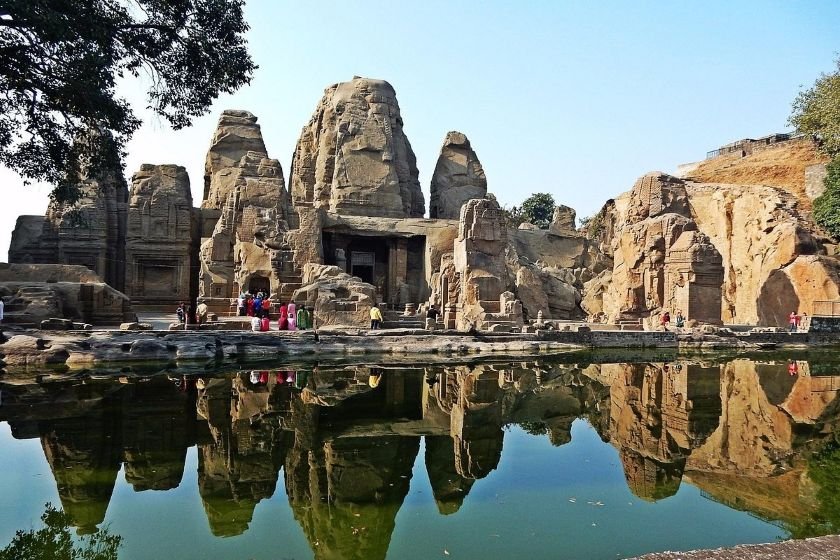
There’s something particularly haunting about ambition frozen mid-motion — a cathedral missing its second tower, a manuscript that ends mid-sentence. Masroor Rock Cut Temple is exactly that kind of unfinished monument, and it’s rarely talked about that way. Most descriptions lead with the finished parts: fifteen shrines carved from a single outcrop of rock, a shikhara rising from the stone like something that grew there rather than something built, reflections shimmering in a sacred pool cut into the same monolith. All of that is real and worth the journey on its own. But look closer and you’ll find a fourth entrance that was started and simply abandoned, a master plan that archaeologists now believe was far grander than what survives, and a question that has never been settled: why did the people who attempted one of India’s most extraordinary architectural feats walk away before finishing it?
🌄 Location & How to Reach It
Masrur Temple sits in Masrur village, in the Kangra Valley of the Beas River, Himachal Pradesh, on top of a naturally rocky hill roughly 2,500 feet above sea level, facing northeast toward the Dhauladhar range.
Google Maps: Get Directions
Distance figures for Masroor vary noticeably between sources — reported as anywhere from about 32 km to 45 km from Kangra town or Dharamshala/McLeodGanj depending on the route and source — so it’s worth checking a live map for your specific starting point rather than trusting a single number.
- By road: Best reached via the Nagrota Surian link road from Kangra; regular taxis and some bus services run from Kangra, Dharamshala, and McLeodGanj.
- By rail: Sources disagree on the practical answer here — Nagrota Surian is the geographically nearest station, but it’s a limited narrow-gauge line; for real long-distance rail connectivity, Pathankot Junction, roughly 85–100 km away, is the more realistic option.
- By air: Dharamshala (Gaggal) Airport is the nearest, with the closest major hub airports at Amritsar or Jammu.
Once you arrive, expect a fair amount of walking on uneven stone once you’re at the site itself — comfortable, sturdy footwear is more useful here than at temples with paved courtyards.
🌸 Best Time to Visit
September through March offers the most comfortable weather and the clearest views of the Dhauladhar backdrop; the monsoon months bring a real landslide risk on the approach roads and are best avoided. The complex is generally open daily, commonly cited as running from around 6 a.m. to 6 p.m., with free entry and no special permission required. Mahashivratri is the site’s standout occasion, when the Himachal Pradesh state government has organised evening light shows at the temple in recent years, drawing crowds and occasionally senior state officials.
🕉️ The Legend: A Staircase to Heaven, Interrupted by a Crow
Masroor’s most widely repeated legend, like so many ancient sites across North India, credits the Pandavas of the Mahabharata with its construction — built, the story goes, during their period of exile from the throne. One version of the tale adds a specific and rather charming twist: while building the complex, the Pandavas began work on a staircase intended to reach heaven itself, vowing to complete it by the following morning. Alarmed at the prospect of mortals gaining such easy access to the divine realm, Indra, lord of heaven and thunder, is said to have disguised himself as a crow and begun crowing loudly well before true dawn — tricking the Pandavas into believing morning had already broken, forcing them to abandon the staircase unfinished. A related version of the same broader legend holds that their hidden identity was exposed to the surrounding villagers during the work, forcing them to leave before the temple could be completed. Either way, the persistent local explanation for Masroor’s unfinished state is divine interruption rather than simple lack of resources or time.
A second tradition, further from folk legend and closer to formal art history, credits a King Yasovarman with the temple’s construction — and this version deserves to be taken more seriously than it might first appear. Independent architectural scholarship (notably the work of art historian Michael Meister) identifies Masroor’s Nagara style as directly derived from the temple-building tradition associated with King Yasovarman, a major art patron whose influence in the region is well documented through inscriptions and comparable temples elsewhere in North India. It’s a rare case where the “legendary” royal-builder story and the academic architectural analysis actually point toward the same historical figure, even if the precise details of his personal involvement remain unproven.
What’s genuinely unresolved, and worth stating plainly rather than papering over, is the temple’s exact date and dynasty. Wikipedia and specialist architectural historians place the complex in the early 8th century CE; some popular travel sources instead attribute it more loosely to the Gupta period (6th–8th century) or even the Pallava dynasty of South India, and at least one source credits the Katoch dynasty of Kangra directly. Historical records from the 6th to 12th centuries don’t document any major military conflict in this particular valley, which is part of why the temple’s precise chronology has proven so difficult to pin down with certainty — this was, and remains, a genuinely debated question rather than one with an agreed answer.
🙏 What Masroor Is Known For
Unlike most of the shrines in this series, Masroor isn’t built around a single deity’s devotional cult so much as a broader, layered vision of Hindu cosmology carved directly into stone. Scholars describe its surviving iconography as drawing on Shiva, Vishnu, Devi, and Saura (sun-worship) traditions together — a genuinely inclusive, multi-tradition temple rather than a shrine dedicated to one god at the exclusion of others, reflecting what art historians describe as a henotheistic religious framework common to the period.
A large, prominent figure of Shiva at the temple’s entrance has led many scholars and local traditions to believe the complex was originally conceived primarily as a Mahadeva (Shiva) shrine. Inside the main sanctum today, however, visitors find stone idols of Rama, Lakshmana, and Sita — and at least one source notes these particular figures appear stylistically newer than the surrounding stonework, suggesting they may have been installed considerably later, possibly as recently as the 20th century, rather than being part of the original 8th-century iconographic program. That’s a useful reminder that what you see enshrined in a temple today isn’t always identical to what its builders originally intended it to hold.
Modern visitors come here less for a specific ritual request and more for the site’s rare, dual identity as both an active pilgrimage destination — particularly around Mahashivratri — and a major archaeological and architectural landmark, drawing history enthusiasts and photographers as much as devotees.
🏛️ The Temple Itself
Masroor is, above all, a feat of subtraction rather than construction — the entire fifteen-shrine complex was carved downward and inward out of a single mass of living rock, rather than built up from separately quarried stone. The layout follows a strict, symmetrical grid: a central shikhara-topped sanctum surrounded by smaller shrines arranged in a mandala pattern, echoing the same multi-spire “temple mountain” concept found at far grander sites elsewhere in Asia — comparisons to Cambodia’s Angkor Wat and Maharashtra’s Kailasa temple at Ellora come up again and again in descriptions of Masroor, not as exaggeration but because the underlying architectural logic (a central peak ringed by lesser peaks, evoking Mount Meru’s mythic role as the axis of the cosmos) is genuinely shared across all three.
Three entrances currently exist; a planned fourth was left incomplete, a detail 20th-century archaeologists initially misread and which contributed to some early misunderstandings of the site’s history. Directly in front of the main temple sits a rectangular sacred pool, carved from the same rock and fed to reflect the shikhara above it on a still day — devotees traditionally believe a dip in these waters carries purifying, even healing, properties, and one local tradition specifically credits its excavation to the Pandavas, said to have built it for Draupadi’s private use. Surviving carvings and friezes narrate scenes from Hindu textual tradition, though centuries of exposure, earthquake damage — most severely from the catastrophic 1905 Kangra earthquake — and, in earlier centuries, some degree of looting, have left much of the original sculptural detail damaged or lost entirely. Ironically, the same remoteness that led to the site’s long obscurity is also credited by early ASI surveyors with protecting it from the kind of deliberate destruction that struck more accessible temples elsewhere in the region.
One further claim circulates in some sources: that unexplored underground chambers exist beneath the complex. This detail appears in only a single source consulted for this piece and hasn’t been independently corroborated, so it’s presented here as an intriguing but unverified claim rather than an established fact.
📜 Kangra’s Temple-Building Legacy
Masroor’s construction places it within a broader wave of Nagara-style temple building that swept across North India and the Himalayan foothills roughly from the 7th to 10th centuries, a period during which artisan guilds are believed to have moved fluidly between Central India, Kashmir, and hill states like Kangra, carrying stylistic influences with them. Comparable, though smaller, examples of this shared architectural language survive at Bajaura in the Kullu Valley and various sites in Uttarakhand and Nepal. Within Kangra district specifically, Masroor sits alongside a dense concentration of major religious sites — Kangra Fort’s ancient temples, the Shakti Peeth at Brajeshwari Devi, and the goddess shrines of Jwalamukhi and Chamunda Devi — making this valley, across many centuries and several distinct traditions, one of the most continuously significant temple-building regions in the Western Himalayas.
🎉 Festivals and Devotion
- Mahashivratri: The complex’s major organised occasion, marked in recent years by state-sponsored evening light shows and increased pilgrim and visitor traffic.
- General darshan: The temple functions year-round as an active site of worship alongside its status as a protected archaeological monument, with no fixed additional festival calendar independently confirmed beyond Shivratri.
🏞️ While You’re in the Area
- Pong Dam Wetland Sanctuary: The reservoir area lies close to Masroor and draws large numbers of migratory birds in winter, making it a natural pairing for a nature-focused extension of the visit.
- Kangra Fort: One of India’s oldest and largest forts, with its own ancient temples, further into the district.
- Baijnath Temple: A 13th-century Jyotirlinga shrine to Shiva in the Beas Valley, notable for its architecture and long pilgrimage history.
- Palampur: Known for its tea gardens and views of the Dhauladhar range, a relaxed contrast to Masroor’s dramatic stonework.
- Dharamshala and McLeodGanj: The region’s main hill-station hub, with Tibetan markets and the Dalai Lama’s residence, roughly 45–55 km away depending on route.
❓ Quick Questions Travellers Ask
How much walking is involved, and is it manageable for older visitors or young children? Expect uneven stone surfaces and some genuine walking around the complex; it’s manageable for most reasonably fit visitors but isn’t a fully flat, easy site, so plan accordingly.
Is photography allowed? Generally yes, though flash photography of the enshrined deity figures is typically discouraged; check current signage on arrival.
Is there an entry fee? Multiple sources describe entry as free with no special permits required, consistent with its status as a publicly accessible ASI-protected monument, though it’s worth confirming current policy locally as rules can change.
Is Masroor actively used for worship, or is it purely a historical site? Both — it functions as a protected archaeological monument and, particularly around Mahashivratri, an active pilgrimage destination.
Why does the temple face northeast instead of the more typical east? Sources don’t offer a fully agreed explanation; the northeast orientation toward the Dhauladhar range is well documented, but whether it reflects a specific astronomical, ritual, or purely site-driven decision by the original builders isn’t conclusively established.
A Last Word
Masroor doesn’t need its missing fourth entrance or its abandoned staircase-to-heaven to earn a place on any serious tour of Himachal’s temples — what survives is already one of the more extraordinary things carved by hand in the Western Himalayas. But it’s the incompleteness that lingers longest after you leave: a monument this ambitious, stopped short of its own vision, for reasons that folklore explains with a trickster crow and scholarship still can’t fully explain at all. Somewhere between the legend of Indra’s interruption and Michael Meister’s careful architectural dating sits the real, unresolved story of Masroor — a temple that became a masterpiece partly because of what it never finished becoming.
Fact-check note: Masroor’s early 8th-century dating (per specialist art-historical scholarship), its Nagara-style, monolithic, incomplete construction, its dedication spanning Shiva, Vishnu, Devi, and Saura traditions, and its 1905 earthquake damage are well corroborated across independent academic and government sources. Genuinely unsettled and flagged above rather than resolved with false precision: exact distances from Kangra/Dharamshala (which vary meaningfully across sources), the practical nearest railway station, alternative dating theories (Gupta-era or Pallava attribution appear in some popular sources but lack the same scholarly support as the 8th-century dating), and the claim of unexplored underground chambers, which appears in only one source. A few claims found in lower-quality sources during research — including a description of Masroor as a recognised Shakti Peeth or Jyotirlinga, and its inclusion within the Great Himalayan National Park — could not be corroborated and are not repeated here, as they conflict with the site’s well-documented profile as a Nagara-style, multi-tradition rock-cut complex in the Beas valley. No independently verified GPS coordinates or entry fee could be confirmed; check current details locally where possible.