In 1969, a small group of refugee monks on a Himachal hillside chose their next spiritual leader not by inheritance or appointment, but by drawing lots — and the name that came up belonged to a scholar who, at that exact moment, was teaching Tibetan studies at a university in Norway.
Most monasteries in this series carry centuries of continuous local memory attached to one unmoving piece of ground. Menri carries something closer to the opposite: a lineage that stretches back further than almost anything else in this collection — by its own tradition, monastic roots reaching to 1196 BC — that was violently severed from its original mountain in Tibet and had to be rebuilt, from mud-brick huts upward, on a hillside in Solan district that nobody in the tradition had ever seen before 1967. What’s remarkable isn’t that the Bon tradition survived this. It’s how deliberately, almost bureaucratically, it went about surviving — right down to selecting its new spiritual head by lottery.
🌄 Location & How to Reach It
Menri Monastery sits in the village of Dolanji, near Ochghat, in Solan district, Himachal Pradesh, at an elevation of roughly 1,195 metres.
Google Maps: Get Directions
- By road: Dolanji sits around 24–25 km from Kumarhatti on the Narag–Sarahan road, or about 3 km off the Solan–Rajgarh road at the Ochghat diversion — both routes are well within a comfortable half-day drive from Chandigarh, roughly two hours away.
- By rail: The nearest railheads are at Solan and Kalka, with onward road travel required to reach Dolanji.
- By air: Chandigarh Airport is the nearest with regular connections, followed by a road journey into the Solan hills.
Given its position within easy weekend range of Chandigarh, Menri works well either as a dedicated day trip or as a stop on a longer route toward Rajgarh’s peach valley — genuinely one of the more accessible sites in this series, requiring no trek or climb once you’ve reached Dolanji itself.
🌸 Best Time to Visit
Solan’s mid-hill climate keeps Dolanji pleasant for much of the year, with March–June and September–November offering the clearest weather for exploring the monastery grounds. Monsoon months bring heavier rain, though the monastery itself remains open and functioning year-round as a living religious community rather than a seasonal pilgrimage site. If your visit can coincide with Losar, the Bon New Year, you’ll see the monastery at its most animated — masked ritual dances, fire rituals, and community feasting mark the occasion, alongside the quieter but still significant observance of Tonpa Shenrab’s birth anniversary.
🏔️ From Tsang to a Himachal Hillside
The Bon tradition preserved at Menri traces its own monastic origins back some three thousand years, to a Tagzig Bon master named Zhu Trul Yeshe establishing a monastic system in the ancient region of Zhang Zhung — making Bon’s monastic lineage, by its own account, the oldest continuously maintained monastic system in Asia, predating Tibetan Buddhist monasticism by close to eighteen centuries. The Menri name itself — “Medicine Mountain” — comes from the medicinal plants and springs found on the original mountain site in Tibet, where the tradition holds that Tonpa Shenrab Miwoche, Bon’s founder and a figure believed to have lived long before the historical Buddha, once left a footprint in rock and prophesied that a monastery would one day stand there.
That original Menri Monastery was formally established in 1405 in Tsang province by Nyammé Sherab Gyaltsen, the eighteenth abbot of an earlier monastery on the same site that had been destroyed by flood decades before. Over the next seven centuries, Menri grew into the preeminent Bon institution in Tibet — home, at its height, to thousands of monks, four separate colleges, and roughly 250 branch monasteries scattered across Tibet, China, India, Bhutan, Sikkim, Nepal, and Mongolia. That entire structure was shattered during China’s Cultural Revolution beginning in 1959, when the 32nd Menri Abbot, Sherab Lodrö, along with senior monks including Lopön Tenzin Namdak, was forced to flee Tibet on foot.
What followed was less a dramatic single rescue than years of patient, practical rebuilding. Tenzin Namdak, with support from Catholic Relief Services, secured land at Dolanji, and in 1967 a formal Bonpo refugee settlement was registered with the Indian government under the name “Tibetan Bonpo Foundation.” About seventy Bonpo families relocated from Manali to Dolanji, each receiving a small house and plot of land. Then, in 1969, the community faced the question of who would lead it. Bon tradition uses a specific, lottery-based method for selecting a new Menri Abbot, known as Tagdil — and the name drawn belonged to Geshe Sangye Tenzing Jongdong, who at the time was living in Norway, teaching at the University of Oslo. He travelled to Dolanji, was enthroned as the 33rd Menri Trizin, and took the name Lungtok Tenpai Nyima — going on to lead not just Menri, but, after the death of the abbot of Yungdrung Ling that same year, the entire worldwide Bon community, a role he held until his death in 2017.
🙏 What Menri Is Known For
Menri functions today as the administrative and spiritual world center of the Bon religion — Tibet’s indigenous faith, distinct from but closely related to Tibetan Buddhism, rooted in Dzogchen (Great Perfection) philosophy and its own extensive canon of scripture. The monastery is home to a full Bon Dialectic School offering the same rigorous Geshe (Doctor of Divinity) training once available only in Tibet, alongside Menri and Nepal’s Triten Norbutse Monastery, the only two institutions in the world still offering it. Visitors come here less to make a specific request of a deity, in the way one might at a Hindu shrine, and more to witness a living, functioning monastic and educational community: daily chanting, butter-lamp offerings, and Dzogchen-rooted meditation practice continue much as they would have in Tibet, adapted to a new setting but not fundamentally altered in substance.
🏛️ The Monastery Itself
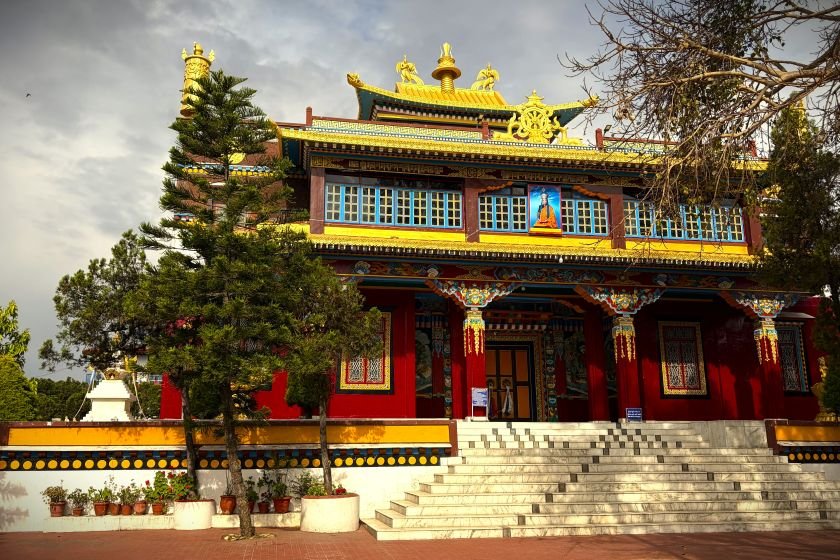
What began in 1967 as a scattering of mud and adobe buildings on terraced hillside has, particularly since the late 1990s, grown into what residents and visitors alike sometimes call a “shining city on a hill” — a campus of Tibetan-style temples finished in vivid color, a library, the Bon Dialectic School, dormitories, a health center, and administrative buildings, home to over 200 monks. The main temple houses a large statue of Tonpa Shenrab Miwoche, Bon’s founder, and photography inside is generally restricted even where it’s permitted elsewhere on the grounds. Across the valley stands Redna Menling — “Land of Precious Medicine” — construction of which began in 2002: the only Bon nunnery outside Tibet, home to roughly 80 nuns, several pursuing the same fifteen-year Geshe academic program available to the monks. A Central School for Tibetans in the valley below, run by the Indian government with a strong Bon studies component, educates the monastery’s youngest residents — including children, some orphaned, sent from Tibet and Nepal’s border regions specifically for the sustenance and education Menri provides.
📜 Regional Context — A Refugee Settlement That Became a World Center
Dolanji’s presence in Solan district places a genuinely global religious headquarters inside a corner of Himachal Pradesh better known for its orchards and hill-station tourism — a reminder of the broader pattern of Tibetan refugee settlement across the Indian Himalayas following 1959, of which Dharamshala’s Dalai Lama residency is the most famous example and Menri a quieter, less-visited counterpart. Unlike the region’s older Hindu temples and Sikh gurdwaras elsewhere in this series, Menri’s story in India is barely six decades old — making it, in local terms, a genuinely recent arrival, even as the tradition it preserves reaches back millennia.
🎉 Festivals and Devotion
- Losar (Bon New Year): The monastery’s most vibrant annual occasion, marked by masked ritual dances, fire ceremonies, and community feasting.
- Tonpa Shenrab’s Birth Anniversary: Observed with scripture recitations and offerings honoring Bon’s founder.
- Daily worship: Morning and evening chanting, incense offerings, and ongoing meditation practice — the steady, everyday rhythm underlying the larger festival calendar.
🏞️ While You’re in the Area
- Redna Menling Nunnery – Across the valley from the main monastery, the only Bon nunnery outside Tibet, and a striking counterpart to visit alongside Menri itself.
- Rajgarh (Peach Valley) – A scenic onward destination for those combining Dolanji with a longer Solan district trip.
- Solan town – The nearest major town, useful for accommodation and onward transport connections.
- Shoolini Mata Temple, Solan – A well-known Shakti shrine in the same district, offering a striking contrast in devotional tradition for those touring the area.
❓ Quick Questions Travellers Ask
Is there an entry fee at Menri Monastery? No, entry is generally free, as with most monastery visits.
Can visitors take photographs inside? Photography is typically restricted inside the main temple itself, though the exterior architecture and grounds can usually be photographed freely.
Is Bon the same as Tibetan Buddhism? No — Bon is Tibet’s older, indigenous religious tradition, closely related to Tibetan Buddhism and sharing some practices and philosophy with it, but distinct in origin and lineage rather than a school within Buddhism itself.
Can visitors interact with the monks? Yes, generally — visitors are typically welcomed respectfully by the monastic community, though as with any active religious institution, it’s courteous to be mindful during prayer times and ceremonies.
How long does a visit typically take? A couple of hours is usually enough to see the main temple, grounds, and get a sense of the community, though longer visits are possible for those interested in Bon philosophy and teachings.
A Last Word
There’s something quietly extraordinary about an institution old enough to trace its monastic roots back three millennia, choosing to hand its future to a lottery — and having that lottery land, almost improbably, on a professor teaching Tibetan studies in Oslo. Menri’s story isn’t really about the past being preserved unchanged. It’s about a tradition old enough to have earned the right to rebuild itself pragmatically, mud brick by mud brick, and trusting the process enough to let chance, rather than certainty, choose who’d lead the rebuilding.
Fact-check note: The 1405 founding of the original Menri Monastery in Tsang, its destruction of predecessor institutions by flood, the 1959 Cultural Revolution-era flight of Bon monks from Tibet, the 1967 establishment of the Dolanji settlement, the Tagdil lottery selection of the 33rd Menri Trizin (Lungtok Tenpai Nyima, formerly Geshe Sangye Tenzing Jongdong, 1929–2017) while he was teaching at the University of Oslo, and the 2002 founding of Redna Menling Nunnery are all corroborated across multiple independent sources, including official Bon organizational histories (Yungdrung Bon Monastic Centre, Bon Foundation, Shenten Dargye Ling) and Wikipedia. One lower-quality source found during research inaccurately conflated Menri with Tibetan Buddhist institutions and cited a “1630 Mongol invasion” and a connection to the Sixth Dalai Lama — these claims do not appear in any credible source and have been excluded here as apparent errors or confusion with a different monastery. Monk and nun population figures vary somewhat by source and year (roughly 200–350 monks depending on when the source was written), so a conservative, commonly-cited figure is used above. No verified GPS coordinates or specific visiting hours could be confirmed, so none are stated as fixed fact.