
Temple & sacred site
Palpung Sherabling Monastic Seat, Bhattu
The Kagyu Seat Hidden in the Forests of Bir
At a glance
- Location
- Bhattu, near Bir, Kangra district
- How to reach
- Use the road approach to Palpung Sherabling and confirm access to the main monastery
In the forested Bhattu area near Bir, Palpung Sherabling brings together Tibetan Buddhist study, ritual art and long retreat under the Tai Situpa lineage.
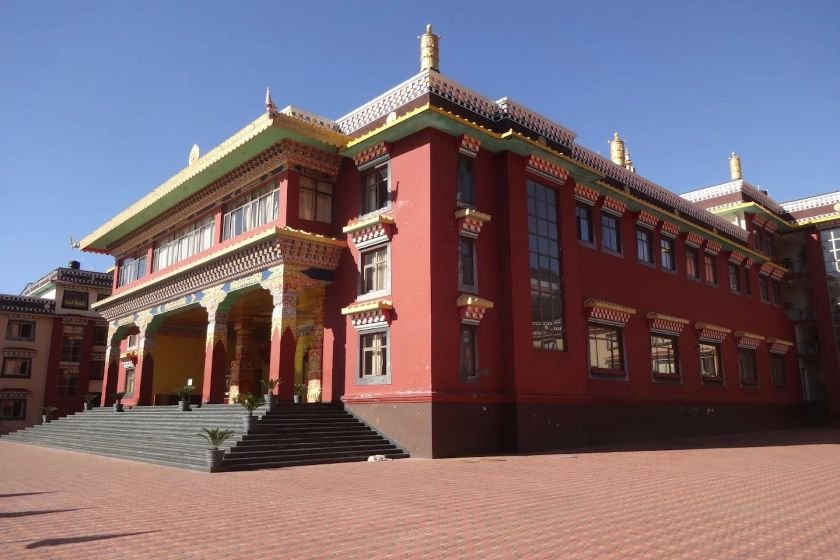
Palpung Sherabling is a major Karma Kagyu monastic seat in Kangra district. Its broad courtyards and Tibetan-style buildings draw the eye, but its purpose reaches beyond what an ordinary visitor sees. This is a place organised around teaching, prayer and the training of practitioners.
The monastery deserves time of its own within a Bir itinerary. The journey to Bhattu takes you into a different part of the region’s life, where the day follows monastic responsibilities and visitors enter only a portion of a much larger institution.
🌄 Location and how to reach it
The monastic seat is at Upper Bhattu, near Bir and Baijnath, in Kangra district.
Google Maps: Find Palpung Sherabling
- Identifying the monastery: Use its full name when arranging transport: several Buddhist institutions are located around Bir, and they are separate destinations.
- By road, air or rail: Road travel connects Bhattu with Bir, Baijnath and Palampur. Gaggal/Kangra Airport serves the region; long-distance rail travellers can continue by road from Pathankot. Check Kangra Valley Railway services separately if you plan to use the narrow-gauge line.
- At the monastery: Ask about the main visitor entrance and permitted parking. For mobility needs, check the route to the particular hall you wish to visit, including any stairs.
🌸 Best Time to Visit
Spring and autumn offer comfortable conditions for combining the monastery with the wider Bir–Baijnath area. Winter calls for warm clothing. During the monsoon, allow extra time for rain and road delays, and avoid building a tight schedule around several distant stops.
Choose your date differently if you are travelling for a teaching. Registration, accommodation and access to a programme must be arranged from its current announcement. An ordinary sightseeing visit does not provide automatic entry to a retreat or teaching.
📜 How the Monastic Seat Took Root
Palpung’s institutional account records that disciples from the Derge and Nangchen regions, settled in Bir, donated forested land in 1975. The 12th Kenting Tai Situpa began establishing the seat there. His official biography identifies 1976 with the establishment of Sherabling in India.
These dates describe stages in its beginnings. The monastery continues the Palpung tradition associated with the Tai Situpa lineage, carrying teaching and artistic knowledge into a new Himalayan setting.
The word “seat” matters here. Sherabling is an institutional home for transmission and training, as well as a place where visitors can encounter Tibetan Buddhist architecture and worship.
🙏 Karma Kagyu Study and Practice
Sherabling’s religious life belongs to the Karma Kagyu tradition. Study and meditation support one another, while ritual knowledge is learned through repeated practice. For a visitor, this helps explain why there is more to the institution than the main prayer hall.
The monastery’s description of monastic life distinguishes prayer monks, students and retreat practitioners, each with different duties. Ritual training includes instruments, chanting, hand gestures and the making of offerings. The buildings support those varied activities.
You do not need to recognise every image or term to visit thoughtfully. Start with the identity of the institution, observe what is happening in the areas open to you and ask a specific question when an appropriate guide or staff member is available.
🏛️ Architecture and the Palpung Artistic Tradition
The official introduction credits the 12th Kenting Tai Situpa with the design and describes traditional Tibetan architectural finishes on modern construction. It also identifies the preservation of Palpung’s artistic lineage as part of the monastery’s purpose.
Look at how the courtyard, painted surfaces and shrine spaces work together. The visual richness is easier to appreciate when you pause over a detail rather than try to take in every building at once. Sacred images and ritual objects should be viewed from permitted positions without being touched.
📿 Why Retreat Areas Require Privacy
Sherabling’s retreat tradition includes the extended Kagyu retreat commonly described as three years and three months. Its published account of the monks’ retreat centre describes a structured programme combining group and individual practice.
Those spaces serve a different purpose from visitor courtyards. Respect closed doors, signs and instructions even when a building appears quiet. The privacy that supports retreat is part of what the institution protects.
Visitors seeking their own study or retreat arrangements should contact Sherabling directly. Older descriptions of accommodation do not establish present availability, suitability or eligibility.
🪔 Teachings, Ceremonies and Visitor Etiquette
Palpung publishes programme announcements through its official channels. Check the venue as well as the date: the wider Palpung community has centres in different places, and an announcement on a shared website may concern another location.
For a normal visit, dress respectfully, speak quietly and follow footwear and photography rules. Leave clear routes for monks and worshippers. During any prayer open to visitors, sit or stand where directed and avoid moving around for photographs.
Never treat ritual sound, instruments or ceremonial objects as props. Their meaning belongs to the practice taking place, even when the ceremony is unfamiliar to you.
🏞️ Nearby Places
- Bir Tibetan settlement: another part of the region’s Tibetan cultural landscape.
- Baijnath Temple: a historic Shiva temple that can provide a different perspective on Kangra’s sacred architecture.
- Tashi Jong: a Drukpa Kagyu monastery and settlement, distinct from Sherabling.
- Palampur: an option for a broader valley itinerary rather than a hurried additional stop.
❓ Questions Before You Go
Is Sherabling in Bir itself? It is in the Bhattu / Upper Bhattu area near Bir. Arrange the final road connection specifically.
Which lineage is it associated with? Karma Kagyu and the 12th Kenting Tai Situpa.
Can visitors enter every building? No. Teaching spaces, residences and retreat areas can have separate restrictions.
Can I attend a teaching without registering? Follow the rules in that programme’s current announcement. Do not assume an ordinary visit includes participation.
A Last Word
Sherabling’s buildings are the visible setting for a life of learning and practice. Give the visit enough time to notice that purpose, and leave the private parts of the monastery to the people whose work continues there.
Sources and Further Reading
- Palpung: introduction to Sherabling — location, beginnings, design and purpose.
- Palpung: biography of the 12th Kenting Tai Situpa.
- Palpung: monastic life at Sherabling.
- Palpung: monks’ retreat centre.
- Palpung Web Center — current programme announcements.