In a valley where most monasteries climb towards cliffs and crowns, Tabo does the opposite — it sits low, quiet, and earth-coloured, guarding a thousand years of Buddhist art inside mud walls.
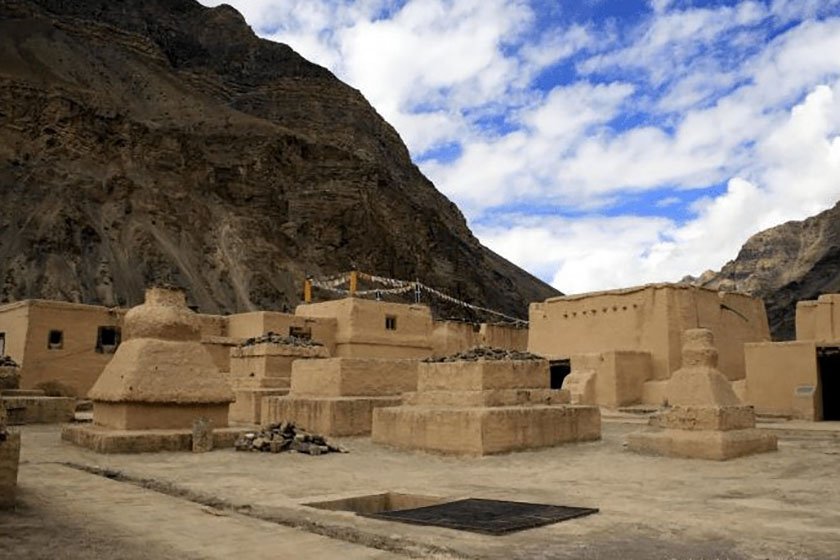
Some sacred places announce themselves from far away. They rise on ridges, flash white against the sky, or make pilgrims look up before they can enter. Tabo Monastery asks for a slower kind of attention. From outside, it can look almost too plain for its reputation — a cluster of mud-plastered temples, chortens, low walls, and sun-baked courtyards resting beside Tabo village in the cold desert of Spiti.
But that plainness is the trick. Tabo’s power was never built around spectacle. It was built around preservation: of paintings, mandalas, translation, monastic learning, and a fragile Indo-Tibetan world that once stretched across mountain trade routes. Founded in 996 CE, the monastery is often called the “Ajanta of the Himalayas” because of its ancient murals, but even that title only catches part of the story. Tabo is not just an art site. It is a room where history still breathes.
🌄 Location & How to Reach It
Tabo Monastery stands in Tabo village, in the Lahaul & Spiti district of Himachal Pradesh, on the road that links Reckong Peo, Nako, Tabo, Dhankar, and Kaza. Unlike Dhankar or Key Monastery, it is not perched dramatically above the valley. It sits in the village itself, close to the Spiti River, surrounded by bare slopes, apricot and apple patches, whitewashed homes, and the wide silence of the high-altitude desert.
Google Maps: Get Directions
Elevation: around 3,050–3,280 metres, depending on whether sources refer to the monastery complex or the wider village. The monastery’s own travel page lists Tabo village at 3,280 metres, while Himachal Tourism lists Tabo Monastery at 3,050 metres.
- By road: Tabo is reached either from the Shimla–Reckong Peo–Nako side or from the Manali–Kaza side. The monastery’s own travel guidance notes both approaches, while also warning that winter, rain, rockfall, and changing road conditions can affect access. Indian nationals generally do not need a permit for Tabo; foreign nationals may require an Inner Line Permit when approaching via Shimla and Reckong Peo, so rules should be checked before travel.
- By rail: There is no railhead in Spiti. Travellers usually come by road after reaching Shimla, Kalka, or Chandigarh, depending on the larger itinerary.
- By air: The most practical airport depends on the route and season. Bhuntar/Kullu, Shimla, and Chandigarh are commonly used as approach points, but all still require a long mountain road journey.
Compared with cliff-top monasteries like Dhankar, Tabo is an easy stop once you are already on the Spiti road. The difficulty is not the final walk; it is the long, patient journey into Spiti itself.
🌸 Best Time to Visit
The most comfortable months for visiting Tabo are usually May to October, when the Spiti circuit is more accessible and the days are easier for walking, photography outside the complex, and combining Tabo with Dhankar, Nako, Gue, or Kaza. The monastery’s own guidance describes winter as long and cold, generally from October to April/May, with possible inaccessibility, and it specifically warns that August rains can make roads dangerous because of rockslides.
The old temple site and Kalachakra Temple are generally open to visitors from 9:00 am to 5:00 pm IST, unless otherwise announced. That said, Tabo is not a theme-park monument. Monastic schedules, restoration needs, festivals, and local conditions can change the visitor experience. Arrive with some flexibility, dress modestly, and avoid expecting the interiors to behave like a museum gallery.
The best time of day is often morning, when the village is still quiet and the old walls seem to absorb the light rather than reflect it. Inside the temples, photography is typically restricted, and rightly so. These are not backdrops. They are living rooms of devotion.
🕉️ The King Who Built a Monastery on a Mountain Route
Tabo’s story begins with a king, a translator, and a frontier.
The monastery was founded in 996 CE by the Buddhist king and royal lama Yeshe Ö of the Purang-Guge kingdom. Its Tibetan name is associated with the idea of a “Place of Happiness.” A renovation inscription in the main temple records that the monastery was renovated 46 years later, in 1042 CE, under Yeshe Ö’s grandnephew Jangchub Ö.
This was not an isolated village shrine built only for local worship. Tabo was part of a larger royal and religious project. The Purang-Guge rulers controlled a territory linked by difficult mountain routes, and monasteries like Tabo helped bind that world together through faith, education, art, and political legitimacy. The monastery’s own historical account describes Tabo as a daughter monastery of Tholing Monastery in western Tibet, tied to the larger movement known as the second spreading of Buddhism.
And then there was Rinchen Zangpo, remembered as the Great Translator. Yeshe Ö’s mission was supported by this extraordinary scholar-lama, whose work helped translate Sanskrit Buddhist texts into Tibetan. Tabo became one of the places where Indian and Tibetan scholars met, exchanged language, and shaped the intellectual bridge between India and Tibet. The monastery’s own history notes that Indian pandits came here to learn Tibetan, and that translations were often carried out by teams of Indian and Tibetan scholars.
So the real legend of Tabo is not a single miracle stone or a deity appearing in a dream. It is quieter and, in some ways, larger. A king built a sacred institution at the edge of worlds, and the desert preserved what many richer places lost.
🕉️ The Room Where the Mandala Became Architecture
The heart of Tabo is the Main Temple, or gTsug la khang. You do not experience it like a normal building, moving from one decorated room to another. You enter it almost like a diagram made physical.
The entry hall contains some of the monastery’s oldest murals, including imagery connected with early Indo-Tibetan cultural exchange and a large Wheel of Life. From there, the visitor moves into the assembly hall, where the space opens into a Vajradhatu Mandala. At the centre sits Vairocana, and around him are 32 clay sculptures representing the families and realms of Akshobhya, Ratnasambhava, Amitabha, and Amoghasiddhi.
This is why Tabo feels different from a monastery you only “see.” Its main temple is meant to be read, walked, circled, and absorbed. The paintings are not decoration in the modern sense. They are teaching, cosmology, memory, and devotion, layered into the walls.
Inside, the air can feel cool and still. The old pigments do not shout. They wait. Faces appear out of dimness. Clay figures seem less like statues than presences that have been sitting through every winter, every invasion scare, every political change, every monk’s chant, and every traveller’s brief astonishment.
🙏 What Tabo Is Known For
Tabo is known above all for Buddhist learning, Indo-Tibetan art, ancient murals, mandala architecture, and continuity of practice. Devotees and travellers come here for different reasons. Some come because it is one of the most important Buddhist sites in the western Himalaya. Some come for the art. Some come because the 14th Dalai Lama has been closely associated with Tabo’s modern revival and presided over major Kalachakra initiations here. The monastery’s own preservation history records Kalachakra initiations in 1983 and 1996, the latter connected with the monastery’s millennium celebrations.
The central spiritual mood is not loud petitioning. It is study, prayer, discipline, and continuity. Butter lamps, chanting, monk debates, ritual cycles, and community life matter here as much as the famous paintings.
For travellers used to big pilgrimage centres, Tabo may feel surprisingly restrained. That restraint is part of its dignity. You do not come here to be overwhelmed by scale. You come to understand how much can survive inside mud, silence, and faith.
🏛️ The Temple Complex That Looks Like the Earth Around It
From outside, Tabo’s old temple complex looks almost grown out of the ground. The buildings are low and earthen, with mud walls, flat roofs, whitewashed details, chortens, and narrow entries. The colour of the monastery belongs to Spiti itself — ochre, dust, shadow, sun.
Himachal Tourism describes Tabo as the largest monastic complex in Spiti, with nine temples, 23 chortens, a monk chamber, and a nun’s chamber. The monastery’s own site divides the evolution of the old temple site into four major phases: the Main Temple in 996 CE, additional temples from 1042–1100 CE, the Golden Temple between 1450–1550 CE, and later structures between 1600–1900 CE.
The important temples include the Main Temple, Maitreya’s Temple, Mandala Temple, Golden Temple, Brom-ston Temple, Protector’s Chapel, and White Temple/Nuns’ Temple. The Maitreya’s Temple contains a mural of Maitreya over six metres high, along with paintings of the Potala Palace in Lhasa and Tashilhunpo Monastery in Shigatse. The Mandala Temple contains murals of major mandalas, including a Vairocana mandala and an Akshobhya mandala. The Golden Temple is known for fine murals with gold applied to some paintings, and tradition says it was once covered in gold.
Above the village, the Tabo caves add another layer to the experience. These cave shrines on the mountain slopes are only partly preserved, but the monastery notes that their sanctuary still includes an entry hall, dormitory, refectory, and assembly hall. Stand there and look down at the village, and Tabo’s logic becomes clearer: the monastery below for study and ritual, the caves above for retreat and inner work.
📜 The Monastery That Became a Bridge Between India and Tibet
Tabo’s historical importance lies in its position between worlds. It was not merely a remote Spiti gompa. It was an Indo-Tibetan intellectual and artistic bridge, shaped by royal patronage, trade routes, translation work, and monastic education.
The monastery’s own history says that its art used Indian forms alongside Tibetan wall texts, creating what is usually described as an Indo-Tibetan visual language. That is what makes the comparison with Ajanta meaningful. Tabo’s murals are not just beautiful old paintings; they are evidence of ideas travelling across mountains, being translated, ritualised, and painted into a Himalayan setting.
But Tabo’s past was not untouched peace. From the 17th to 19th centuries, Spiti was often caught between larger neighbours such as Bashahr, Kullu, and Ladakh. The monastery’s historical account also notes damage linked to conflict, including an attack on the assembly hall in 1837, recorded by inscription and visible damage.
Later, in the 20th century, Tabo needed revival as much as remembrance. In the 1960s, the monastery and village were in poor condition. Local monks and communities invited Tsenshap Serkong Rinpoche, who arrived in 1973 and helped re-energise Buddhist teaching in the valley. By 1976, senior teachers were appointed to revive Buddhist practices, and Tabo slowly became active again as a centre for study and practice.
That modern revival matters. Without it, Tabo might have become only a protected monument. Instead, it remains both heritage and home.
🎉 Festivals and Devotion
- Kalachakra Initiations: Tabo hosted major Kalachakra initiations led by the 14th Dalai Lama in 1983 and 1996. The 1996 event was linked with the monastery’s 1,000-year celebration.
- Chakhar Festival: Commonly associated with Tabo and the wider Spiti Buddhist calendar, this festival is generally described as a periodic celebration involving ritual, community gathering, and masked dance traditions. Dates and cycles should be checked locally before planning around it.
- Daily Monastic Life: The quieter rhythm of Tabo is not limited to festival days. Prayers, study, maintenance of the temples, community interaction, and seasonal routines are part of what keeps the monastery alive.
- Millennium Memory: The 1996 millennium celebration was not just a birthday event. It marked Tabo’s survival across a thousand years of political change, isolation, damage, repair, and devotion.
Festival days can transform the village, but ordinary days may be more revealing. On a quiet morning, Tabo feels less like a famous monument and more like a promise being kept.
🏞️ While You’re in the Area
- Tabo Caves: A short climb above the village, these partly preserved retreat caves give a wide view of the valley and help explain Tabo’s meditative landscape.
- Dhankar Monastery: Around the Kaza–Tabo corridor, Dhankar offers the dramatic cliff-top contrast to Tabo’s grounded mud-walled stillness.
- Gue Mummy: A memorable detour near the Indo-Tibetan border region, known for the naturally preserved body of a monk and often combined with Nako–Tabo travel plans.
- Nako Village and Lake: A gentle stop on the Kinnaur-to-Spiti approach, with a lake, monastery, and high-altitude village setting.
- Kaza: The main base for many Spiti itineraries, useful for onward travel to Key, Kibber, Hikkim, Komic, Langza, and Pin Valley.
🙏 Getting in Touch
Tabo Monastery does list formal contact details, but it also warns that landlines, mobile phones, and internet do not always work reliably in Spiti, and that postal delivery can take time.
Postal address:
Tabo Monastery
The Institute of Studies in Buddhist Philosophy and Tribal Cultural Society (ISBP & TCS)
Village and P.O. Tabo
Distt. Lahaul and Spiti
Himachal Pradesh 172113
India
Email: info(at)tabomonastery.org
Phone: +91 1906 223 315 / +91 94189 63082
Fax: +91 1906 223 403
For practical travel updates, also ask locally in Kaza, Reckong Peo, Nako, or Tabo village, especially about road conditions, permits, and seasonal access.
❓ Quick Questions Travellers Ask
Is Tabo Monastery older than Key Monastery?
Yes, Tabo is generally dated to 996 CE, making it one of the oldest surviving Buddhist monastic sites in the Himalaya. Key is older than many Spiti institutions in its own right, but Tabo’s documented 10th-century foundation is especially significant.
Why is Tabo called the “Ajanta of the Himalayas”?
Because of its extraordinary ancient murals and painted interiors. The comparison points to Tabo’s artistic importance, though the monastery is also a living centre of Buddhist practice, not just an art monument.
Can visitors take photos inside the old temples?
Photography inside sacred interiors is generally restricted or discouraged, especially because the murals are fragile. Treat the interiors as active religious spaces, not photo locations.
How much time should I keep for Tabo Monastery?
Keep at least one to two hours for the monastery complex, and more if you want to climb to the caves, sit quietly, or absorb the murals without rushing.
Can Tabo be visited with Dhankar on the same day?
Yes. Many travellers combine Tabo and Dhankar on the Kaza–Tabo route. Tabo is easier to access once you are on the main road, while Dhankar requires a climb or detour to its dramatic cliffside setting.
A Last Word
Tabo is not the monastery that tries to impress you first. It waits. It lets the cliffs, the river, the wind, and the rough Spiti road strip away your hurry before it shows you what it has kept.
From the outside, it is mud and quiet. Inside, it is a mandala, a school, a royal memory, a translator’s bridge, a monk’s discipline, and a thousand winters of survival. That is the real wonder of Tabo Monastery. Not that it looks ancient, but that after so much time, it is still alive.
Fact-check note: The founding year 996 CE, the role of Yeshe Ö, the 1042 CE renovation, Tabo’s connection with Rinchen Zangpo, and the monastery’s importance as a centre of translation and Indo-Tibetan learning are strongly supported by the monastery’s own historical material. The number of temples/chortens and the description of Tabo as Spiti’s largest monastic complex are supported by Himachal Tourism. Elevation varies across sources: the monastery’s own route page gives 3,280 metres for Tabo village, while Himachal Tourism gives 3,050 metres for Tabo Monastery, so this draft states the range rather than forcing one figure. Exact GPS coordinates were not included because I did not verify them from a sufficiently authoritative source. I also avoided generic copied temple boilerplate — especially deity descriptions that belong to Hindu shrines or unrelated goddess temples — because Tabo’s confirmed context is Tibetan Buddhist, centred on Vairocana, mandalas, monastic learning, murals, and living practice.