On a ridge above the Hamirpur–Awah Devi highway stands a temple built not around a miracle, but around a family’s guilt — twelve brothers who fled for their lives, and the sister they left behind to become a goddess.
Some temples in Himachal exist because a deity chose a spot and refused to leave it. Others exist because of what people did, or failed to do, and then spent generations trying to make right. Tauni Devi Temple belongs to the second category, and it’s a harder, more human story than most — rooted not in royal dreams or wandering lingams, but in displacement, suspicion, and a sacrifice that a family only recognized as sacred after it was too late to take back.
🌄 Location & How to Reach It
- Location: On a ridge along the Hamirpur–Awah Devi highway, Hamirpur district, Himachal Pradesh
- Distance: Sources vary somewhat — most place it between 12 and 15 km from Hamirpur town, with 12–13 km being the most commonly cited figure; a few outlying sources give shorter or longer distances, so treat the exact number loosely
- Google Maps: Get Directions
- GPS Coordinates: Not independently verified for this piece — use the map link above, or search “Tauni Devi Temple, Hamirpur” directly on Google Maps for a precise pin before travelling
- Elevation/terrain: The temple sits on a hilltop at roughly 1,100 metres above sea level, giving it genuinely panoramic views over the surrounding Hamirpur valleys and hills — a noticeably higher, more exposed setting than most other temples in the district
- By road: A short, direct drive from Hamirpur town along the Hamirpur–Awah Devi road; the temple sits directly on this highway, making it an easy stop rather than a detour
- By rail: Una is the nearest railhead, roughly 70–80 km away
- By air: Gaggal Airport (Kangra) is the nearest, around 83–85 km away
Given its hilltop position, this is a slightly more elevated approach than Gasota Mahadev or Jhanyari Devi, but it remains a straightforward highway stop rather than a climb — no trekking required, just a drive with a view at the end of it.
🌸 Best Time to Visit
The temple is pleasant to visit year-round given its breezy, elevated setting, though light woolens are worth packing even for summer evenings, when hilltop temperatures drop faster than in the valley below. For festival atmosphere, Navratri, celebrated in both spring and autumn with bhajans, aartis, and community feasts, is a strong choice, as is the annual fair held in Ashadha (roughly June–July), which specifically commemorates the goddess’s disappearance and draws devotee processions and folk music alongside the religious observance.
🕉️ The Legend: A Sister Left Behind
The story goes back to the Mughal era, when persecution of Hindu communities in the plains pushed many Rajput families toward the safety of the hills. Twelve brothers of the Chauhan clan made that journey from Delhi, fleeing not just for their own survival but to protect their family’s faith and honor from being stripped away by force. Traveling with them was their sister — mute, unable to speak or hear, but by every account a woman of real spiritual strength even before anything supernatural is said to have happened to her.
Accounts differ on exactly what came next, but the more widely repeated version holds that, once the brothers reached this stretch of hill country, something went wrong — a stream of blood was said to appear where they’d begun settling — and their priest, consulted for an explanation, pointed to the mute sister as the cause of the misfortune. Rather than defend her or investigate further, the brothers left her behind and continued on. What she did next has become the temple’s founding story: she undertook intense penance at the site, and on the tenth day of the month of Ashadha, she disappeared into the earth itself. Her brothers, recognizing too late what they’d lost and what she’d become, built a shrine in her memory at the exact spot — the origin of the temple that stands today.
A separate, less widely repeated account frames the story more gently, without the accusation: in this version, the sister simply wandered to the banks of the nearby Pung Khad stream on her own and entered deep meditation there, her soul merging with the divine through devotion alone rather than through injustice. Both versions agree on the essentials — a mute woman, a river or hillside setting, a transformation into a protective goddess — but differ on whether her family’s fear and suspicion played a role in what happened to her. Given how consistently the “accused and left behind” version appears across sources, it’s treated here as the primary tradition, with the gentler account noted as a real but secondary variant.
Because Tauni Devi could not hear in life, devotees don’t ring a temple bell to announce their presence the way they would elsewhere. Instead, two river stones are kept at the temple’s edge, and visitors strike them together when making a wish — a ritual specific to this shrine, built on the belief that vibration, not sound, is what reaches her.
🙏 What the Deity Is Known For
Tauni Devi is worshipped as an incarnation of Durga and stands today as the kuldevi — the clan deity — of the Chauhan Rajputs, with devotee families tracing their connection to her not just across Himachal but across Punjab, Haryana, Delhi, Rajasthan, and Jammu, wherever branches of the same lineage eventually settled. That geographic spread is unusual for a hilltop shrine of this size, and it reflects how far the Chauhan diaspora carried their devotion after the family’s original flight from Delhi.
Beyond her role as clan protector, she’s approached as a guardian and wish-granter more broadly — some local accounts specifically describe her as a protector against seasonal, rainy-weather illness, a practical form of devotion tied to the district’s monsoon vulnerability rather than an abstract miracle. The stone-striking ritual gives the temple its most distinctive identity: a form of prayer built entirely around the idea of being heard by a goddess who, in her human life, could not hear anything at all.
🏛️ The Temple Itself
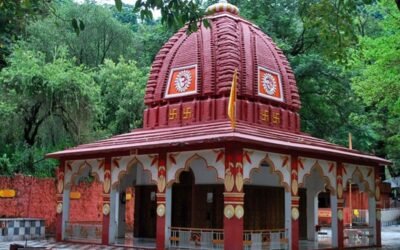
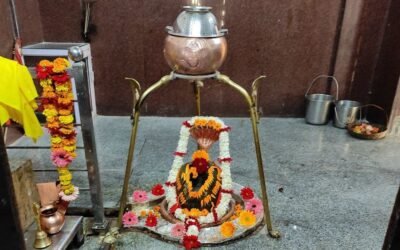
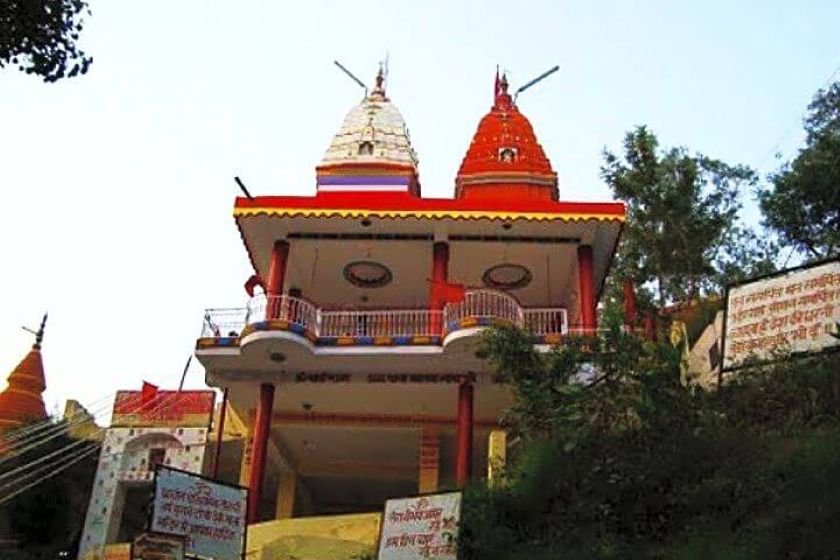
Tauni Devi Temple is a multi-level stone structure, more architecturally developed than many of Hamirpur’s smaller village shrines, blending traditional Himachali stonework with more modern North Indian temple design. The sanctum housing Tauni Devi’s idol sits on the first floor, sharing that level with smaller shrines to Sai Baba, Baba Balak Nath, and Shani Dev — a fairly common arrangement in this region, where a primary deity’s temple often accumulates a handful of other, smaller devotional spaces around it over time. The second floor holds large, brightly colored idols of Lord Shiva and Hanuman.
Outside, a sarai — a traditional pilgrim rest house — accommodates visitors staying longer, and a landscaped park sits alongside the main structure. Given the hilltop position, the real sensory pull here isn’t incense or courtyard sound the way it is at Gasota, but the view itself: a wide, open sweep of Hamirpur’s valleys and pine-covered hills, especially striking at sunrise and sunset, with the temple functioning almost as much as a scenic ridge stop as a devotional destination.
📜 Regional Context: Refuge, Faith, and the Chauhan Legacy
Tauni Devi’s story sits within a specific, well-documented pattern of Rajput clans retreating into the Himachal hills during periods of Mughal expansion and religious pressure on the plains — a pattern that also explains the presence of other kuldevi shrines in the district, like Jhanyari Devi for the Katoch dynasty and Tauni Devi for the Chauhans. Where Jhanyari Devi’s story is fundamentally royal — a king, a dream, a palace procession — Tauni Devi’s is a story of ordinary survival under threat, which may be part of why her worship carries such a strong thread of feminine resilience and why women dealing with domestic hardship specifically seek her out today.
It’s worth noting that a small number of sources attach additional, harder-to-reconcile claims to this temple — one describing Katoch-dynasty construction reaching back to the 6th century, another linking the site to a stay by the Pandavas during their Mahabharata-era exile. Neither of these claims appears consistently elsewhere, and both sit awkwardly alongside the specifically Mughal-era, Chauhan-refuge legend that dominates the record, so they’re flagged here as unverified outliers rather than treated as established history.
🎉 Festivals and Devotion
- Annual fair (Ashadha, roughly June–July): Commemorates the goddess’s disappearance into the earth, marked with devta processions and folk music alongside religious observance.
- Navratri (spring and autumn): Celebrated with bhajans, aartis, and community feasts, drawing large numbers of devotees.
- Daily worship: Morning and evening aartis, stone offerings at the ritual area, and the lighting of ghee lamps.
- Bhandara gatherings: Community feasts organized during major devotional occasions, particularly Navratri.
🏞️ While You’re in the Area
- Awah Devi Temple: Roughly 10 km away, sitting atop the highest hill in Hamirpur district, with its own kuldevi legend and panoramic views to match.
- Gasota Mahadev Temple: About 6 km from Tauni Devi, offering the district’s other well-known “refused to be moved” story, this one centered on a farmer’s plough and a Shiva lingam.
- Sujanpur Fort/Tira: Around 16 km away, home to Katoch-era murals, royal temples, and fort ruins.
- Deotsidh (Baba Balak Nath Temple): A larger regional pilgrimage site roughly 55 km away, worth combining if you’re planning a longer temple circuit through the district.
- Nadaun: About 40 km away, offering a riverside stop along the Beas with its own historical sites, including Nadaun Fort.
❓ Quick Questions Travellers Ask
Why do people strike stones instead of ringing a bell at this temple? Because Tauni Devi is remembered as having been unable to hear in her human life — the stone-striking ritual reflects the belief that vibration, not sound, is what actually reaches her, making it a devotional practice unique to this shrine.
How far is the temple from Hamirpur, exactly? Sources genuinely disagree here, with figures ranging from around 10 km to 15 km depending on the source; 12–13 km is the most commonly repeated distance, so plan around that while allowing some flexibility.
Is this the same clan-deity tradition as Jhanyari Devi Temple? No — Jhanyari Devi is the kuldevi of the Katoch dynasty, while Tauni Devi is specifically the kuldevi of the Chauhan Rajputs; both are real patron-goddess traditions in Hamirpur district, just tied to different family lines.
Is the temple physically demanding to visit, given its hilltop location? Not particularly — it sits directly on the Hamirpur–Awah Devi highway, so it’s a drive-up stop rather than a climb, though the elevation does mean cooler, breezier conditions than the valley below.
Are the Pandava/Mahabharata connections mentioned for this temple reliable? Treat them with real skepticism — that claim, along with an occasional mention of much older Katoch-dynasty construction, appears in only isolated sources and doesn’t align with the far more consistent Mughal-era, Chauhan-refuge origin story that most accounts agree on.
A Last Word
There’s a harder edge to Tauni Devi’s story than to most temple legends in this district — no palace procession, no farmer’s lucky accident, just a family’s fear, a sister left to face it alone, and a devotion that only came afterward, once regret had nowhere else to go. The stones devotees strike here today aren’t decorative ritual; they’re a standing acknowledgment that being heard is something you sometimes have to work for, even for a goddess. Whatever brings you up this ridge, it’s worth remembering that the view over Hamirpur’s valleys was earned, in the story at least, at real cost.
Fact-check note: The core legend — twelve Chauhan brothers fleeing Mughal-era persecution, a mute sister accused of misfortune and left behind, her penance, and her disappearance on the tenth day of Ashadha — is the most consistently repeated account across sources and is treated here as the primary tradition. A gentler variant, in which the sister simply undertakes voluntary meditation at the nearby Pung Khad stream without any accusation, appears in at least one account and is noted as a secondary version rather than dismissed. The temple’s age is most commonly given as around 300 years, though at least one source states 400 years; neither figure is independently verified, and no official founding date exists. Distance from Hamirpur varies meaningfully across sources (roughly 10–15 km); 12–13 km is used here as the most frequently cited figure. Claims connecting the temple to 6th-century Katoch-dynasty construction or a Pandava/Mahabharata-era stay appear in only isolated sources, conflict with the dominant Mughal-era origin story, and are flagged as unverified rather than treated as established fact. No exact GPS coordinates, entrance fees, or official contact details could be verified, and none are invented here.