Trilokinath Temple, Lahaul – The Shrine Where Shiva and Avalokiteshvara Share One Seat
In the Pattan Valley of Lahaul, a white temple above the Chandrabhaga holds one of Himachal’s rarest devotions — a deity worshipped by Hindus as Lord Shiva and by Buddhists as Arya Avalokiteshvara.
Some temples become famous because of height, scale, or spectacle. Trilokinath Temple has something quieter and more difficult to explain. It stands in a mountain village of Lahaul, far from the easy rhythms of the plains, and yet its worship reaches across two great religious worlds without losing its local soul.
To Hindu devotees, the deity is Trilokinath, the lord of the three worlds, a form of Lord Shiva. To Buddhists, the same image is revered as Arya Avalokiteshvara, the Bodhisattva of Compassion, known locally in the Tibetan-speaking world as Garja Fagspa. That shared reverence is not a tourist slogan. It is the daily identity of the shrine.
The temple’s older name, Tunda Vihar, hints at a Buddhist past, while its shikhara-style architecture speaks in the language of Himalayan Hindu temples. In that meeting of forms, Trilokinath becomes more than a place to stop on the Lahaul road. It becomes one of the clearest examples of how the Himalayas have never kept faiths in sealed boxes.
🌄 Location & How to Reach It
Trilokinath Temple is situated in Triloknath village in the Udaipur sub-division of Lahaul and Spiti district, Himachal Pradesh. The shrine lies in the beautiful Pattan Valley, above the wider Chandrabhaga/Chenab river landscape, around 45 km from Keylong and roughly 146 km from Manali by the commonly cited road approach. The final setting is not a crowded town-centre temple. It feels like a mountain shrine held between village lanes, terraced fields, white walls, prayer, and high ridges.
Google Maps: Get Directions
GPS Coordinates: 32.70476, 76.6882
Elevation: around 2,760 metres, though some travel sources use nearby valley-level references, so treat this as an approximate temple-area figure rather than a survey measurement.
- By road: Trilokinath is reached by road from Keylong, Udaipur, or Manali. The official district page places it about 45 km from Keylong and about 146 km from Manali. HRTC buses and local taxis operate in season, but road conditions in Lahaul can change quickly because of snow, rockfall, rain, and winter closures.
- By rail: The official district tourism page lists Shimla Railway Station as the nearest railway station at around 393 km. In practical travel planning, most visitors combine rail with onward road travel via Shimla/Chandigarh/Manali depending on the route.
- By air: The official district page lists Bhuntar Airport near Kullu as the nearest airport, around 218 km away. Even after flying, the onward journey remains a long mountain road trip.
This is not a difficult trek once you reach the village, but it is still a proper Lahaul journey. The road is part of the experience — slow, weather-shaped, and full of valley turns that make the arrival feel earned.
🌸 Best Time to Visit
The most comfortable time to visit Trilokinath Temple is usually from May/June to October, when Lahaul roads are more dependable and the valley is active with farming, travel, and pilgrimage. The older Rohtang route was once the main seasonal gateway, and official descriptions still mention the Rohtang opening window. Today, the Atal Tunnel has changed access to Lahaul, but travellers should still check current road and weather conditions before planning, especially in winter.
For a quieter experience, visit outside major festival days and arrive in the morning or late afternoon. The temple is small enough to see quickly, but rushing would miss its point. The atmosphere here is not about covering a monument. It is about watching two traditions move around the same sanctum with deep familiarity.
The most important festival time is Pauri Fair, held in the third week of August according to the district’s festival page. During this period, Trilokinath changes from a quiet village shrine into one of Lahaul’s most significant gatherings. Pilgrims come from Lahaul, Chamba, Kullu, and nearby Buddhist regions, and the temple becomes both a devotional centre and a cultural fairground.
🕉️ The Deity Worshipped by Two Traditions
The central wonder of Trilokinath is simple to state and hard to fully absorb: Hindus and Buddhists worship the same deity here.
For Hindus, the deity is Lord Shiva as Trilokinath, the lord of the three worlds. For Buddhists, the deity is Arya Avalokiteshvara, the Bodhisattva of Compassion. In Tibetan usage connected with this region, he is remembered as Garja Fagspa. The official district account calls Trilokinath one of the rare shrines where both communities pay reverence to the same image.
This shared worship is not a modern attempt at harmony. It has grown slowly through the valley’s geography and history. Lahaul sits between the cultural worlds of Kullu, Chamba, Ladakh, Tibet, and Spiti. Hindu deities, Buddhist lamas, village oracles, traders, shepherds, and royal patrons all left marks here. Trilokinath holds that layered history in one sanctum.
The image itself is described as a six-armed marble deity, seated in lalitasana, with a figure of the Buddha above the head. That is exactly why the shrine can be seen through different eyes. A Hindu devotee may stand before Shiva. A Buddhist devotee may see Avalokiteshvara. A traveller may see a Himalayan solution to a question that the plains often make too rigid.
There is no need to flatten this into a neat slogan. The beauty of Trilokinath lies in the fact that each tradition is fully present. Neither has to disappear for the other to pray.
🕉️ The Lake, the Cowherd, and the Marble Image
Like many old Himalayan shrines, Trilokinath has a local manifestation story that sounds less like recorded history and more like valley memory.
One version says that where Hinsa Nalla flows today, there was once a lake. From this milky lake, seven mysterious beings would emerge and drink the milk of grazing cows. One day, a cowherd boy named Tundu caught one of them and brought him back towards the village. There, the captured being transformed into a marble deity, and that deity came to be installed in the temple.
In Tibetan versions, the lake is remembered as Ome-cho, meaning something like a milky ocean. Even today, local tradition points to the pale colour of Hinsa Nalla’s water as part of the sacred memory of the place.
Another local tale says that the temple was completed in a single night by a Mah Danav, a great supernatural being. This is the kind of story that appears again and again in Himalayan temple lore: when a structure feels too old, too unlikely, or too powerful for ordinary hands, memory gives the work to beings larger than humans.
These legends are not archaeological proof, and they should not be treated as such. But they are important. They tell us how people of Lahaul understand Trilokinath — not merely as a constructed shrine, but as a deity who revealed himself through landscape, water, animals, and wonder.
🙏 What Devotees Seek Here
Devotees come to Trilokinath for darshan, compassion, protection, fulfilment of vows, and spiritual blessing. The district’s temple page describes it as one of the most sacred pilgrimage places after Kailash and Mansarovar in local devotional imagination. That comparison should be understood as a statement of reverence, not as a measured ranking.
The rituals reflect the shared nature of the shrine. Worship is associated strongly with Buddhist tradition, and the district account notes that this has been the practice since time immemorial. Yet Hindu pilgrims also offer prayers to Trilokinath as Shiva. Prayer wheels, lamps, mantras, offerings, and circumambulation all belong naturally to the temple’s rhythm.
During Pauri Fair, devotees perform parikrama in the gallery between the inner and outer walls of the temple. Many complete three or seven clockwise circumambulations, turning prayer wheels and murmuring Om Mani Padme Hum. Ghee and mustard oil lamps are kept burning, and devotees donate ghee, oil, and money to maintain the light.
In a place like this, devotion does not feel divided. It feels cumulative.
🏛️ The Temple Itself: A Shikhara in the Snow Country
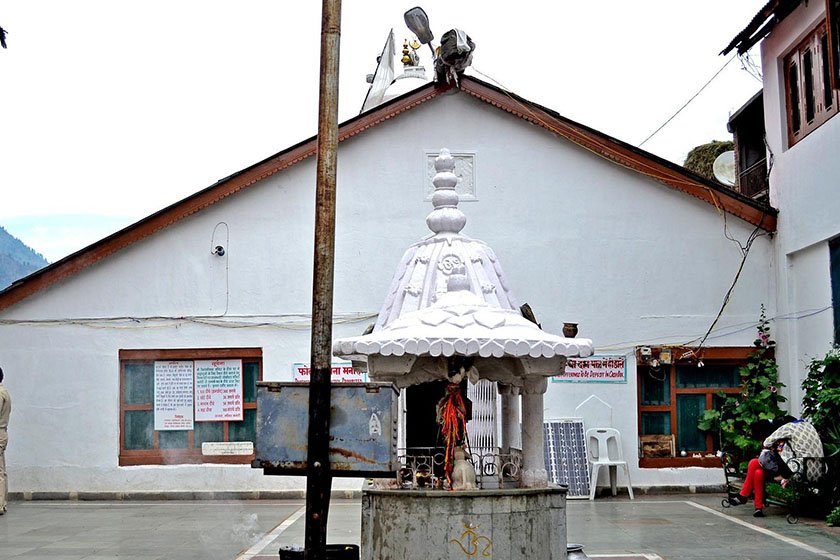
Trilokinath Temple is often described as the only temple in Lahaul built in the shikhara style. Its form connects it to older temple architecture seen in places like Chamba, especially the Lakshmi Narayan temple complex tradition. That architectural memory matters because Lahaul, though geographically remote, has long been connected to Chamba, Kullu, Ladakh, and Tibet through politics, pilgrimage, and trade.
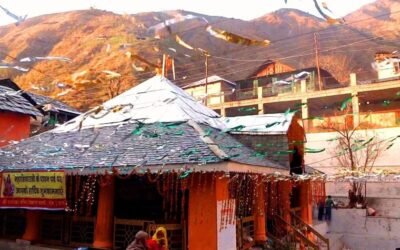
The temple is modest in size, but it has a presence that photographs rarely capture. Whitewashed walls, a rising tower, carved details, fluttering faith symbols, and the sharp mountain air all work together. The shrine does not dominate the valley like a fortress. It glows within it.
Inside, the sanctum carries the weight of many centuries. The deity is the centre, but the experience is also made by lamps, smoke, wood, stone, whispered prayer, and the steady movement of people who know exactly how to behave in the space. Nothing feels staged. It feels inherited.
The temple complex also has practical pilgrim facilities. The district page notes accommodation capacity in the temple complex, a langar in the summer season, small dhabas in Triloknath, and hot water facilities. These details may change over time, so visitors should confirm locally before depending on them, but they show the shrine’s continuing role as a pilgrimage stop rather than a passive heritage site.
📜 The Stone Inscription and the Chamba Connection
The historical account of Trilokinath becomes especially interesting because of a stone inscription found in the temple complex in 2002. According to the official district page, this inscription supports the view that the temple was constructed in the 10th century.
The inscription is said to mention Dvanjra Rana, connected with the ancestors of the present Rana Thakurs of Triloknath village. Local tradition also links the construction to support from King Shell Varman of Chamba, remembered as the founder of Chamba town. The district account further associates the temple’s spiritual history with Mahayogi Siddh Charpati Dar, also called Charpat Nath, who had deep devotion to Avalokiteshvara and is said to have composed verses in his praise.
Some sources and traditions place the deity or shrine even earlier, and Himachal Tourism describes the sanctum image as going back to around the 2nd century AD. This is a much older claim than the 10th-century construction evidence, so it should be handled carefully. The safest way to present the history is this: the temple structure is strongly associated with the late 9th to 10th century, while traditions around the deity may be older and more layered.
That distinction matters. It lets the article respect devotion without pretending that every claim is equally documented.
🎉 Festivals and Devotion
- Pauri Fair: Celebrated in the third week of August, this is the most important public festival linked with Trilokinath. It combines pilgrimage, local trade-like fair activity, music, dance, and ritual procession.
- Procession to Saptdhara: During the fair, a traditional procession is taken out, led by the Thakur of Triloknath on a decorated horse. The procession goes towards the place where, according to tradition, seven deities appeared from seven springs.
- Parikrama and Lamps: Pilgrims circumambulate the temple, rotate prayer wheels, chant Om Mani Padme Hum, and offer ghee or oil for the lamps that burn inside.
- Makarsankranti Abhishek: The official temple page records an annual milk abhishek of the deity on Makarsankranti, locally connected with the name uden/utna.
- Halda and Fagli: These winter festivals belong to the wider Lahaul ritual calendar and are also mentioned in connection with the temple’s local observances.
- Mahakumbh Cycle: The district page notes a 12-year Mahakumbh cycle connected with the temple, with 2015 following the earlier celebration of 2003. Future dates should be verified locally before publishing event-specific travel advice.
🏞️ While You’re in the Area
- Udaipur and Mrikula Devi Temple: About 15 km from Trilokinath, Udaipur is the nearest major settlement and home to the remarkable wooden Mrikula Devi Temple.
- Keylong: The district headquarters and a useful base for exploring Lahaul’s monasteries, villages, and road routes.
- Tandi Sangam: The meeting point of the Chandra and Bhaga rivers, where the Chandrabhaga/Chenab identity begins.
- Sissu: A popular Lahaul stop after the Atal Tunnel, known for its waterfall, lake area, and easier visitor facilities.
- Kardang and Shashur Monasteries: Important Buddhist sites around Keylong that pair well with Trilokinath if you want to understand Lahaul’s mixed sacred geography.
🙏 Getting in Touch
The official district page notes that the temple is maintained under the Government of Himachal Pradesh through a temple committee, with the SDM Udaipur as chairman and local members including representatives connected with Triloknath village.
Official contact number listed: 01909-262244
Because mountain administrative numbers and temple arrangements can change, travellers should also confirm locally through Udaipur, Keylong, or district tourism channels before relying on accommodation, langar, or winter access information.
❓ Quick Questions Travellers Ask
Is Trilokinath Temple Hindu or Buddhist?
It is both in practice. Hindus worship the deity as Lord Shiva / Trilokinath, while Buddhists worship the same deity as Arya Avalokiteshvara.
Where exactly is Trilokinath Temple?
It is in Triloknath village, in the Udaipur sub-division of Lahaul and Spiti district, Himachal Pradesh.
How far is Trilokinath Temple from Keylong?
The official district page gives the distance as about 45 km from Keylong.
What is the best festival to see here?
Pauri Fair, held in the third week of August, is the major festival associated with Trilokinath Temple.
Can Trilokinath be combined with Udaipur?
Yes. Udaipur is about 15 km away and is the practical nearby town for accommodation, food, and a visit to Mrikula Devi Temple.
A Last Word
Trilokinath Temple is not just an old shrine in a remote valley. It is a living answer to a question people often ask too narrowly: who owns a sacred place?
Here, Shiva and Avalokiteshvara do not compete. Lamps burn, wheels turn, mantras rise, bells sound, and pilgrims arrive with different names for the same grace. The temple stands quietly in Lahaul, but what it protects is rare — a form of faith broad enough to let two traditions bow before one image and both feel at home.
Fact-check note: The temple’s location in the Udaipur sub-division, distance of 45 km from Keylong and 146 km from Manali, ancient name Tunda Vihar, shared Hindu-Buddhist worship, deity identifications as Lord Shiva/Trilokinath and Arya Avalokiteshvara/Garja Fagspa, 10th-century construction claim, 2002 stone inscription, shikhara-style architecture, local lake legend, Pauri Fair details, and listed contact number are based primarily on the official District Lahaul and Spiti pages. Himachal Tourism supports the broader point that Trilokinath represents Hindu-Buddhist coexistence in Lahaul, but gives an older date for the sanctum image; because dates differ across sources, this article treats the 10th-century temple construction as the strongest documented historical point and keeps older claims cautious. The Google Maps link uses the official district “Direction” pin: 32.70476, 76.6882. No unrelated goddess-temple boilerplate or generic “three pindis” paragraph has been used, because it does not match Trilokinath’s confirmed Hindu-Buddhist identity.