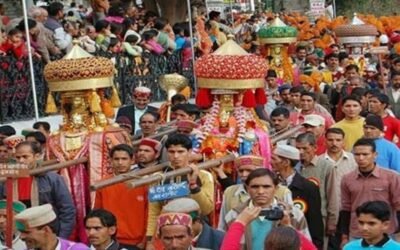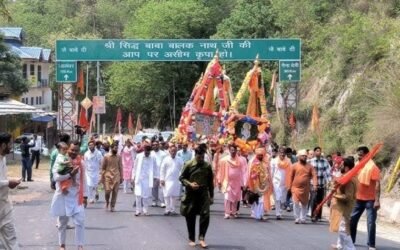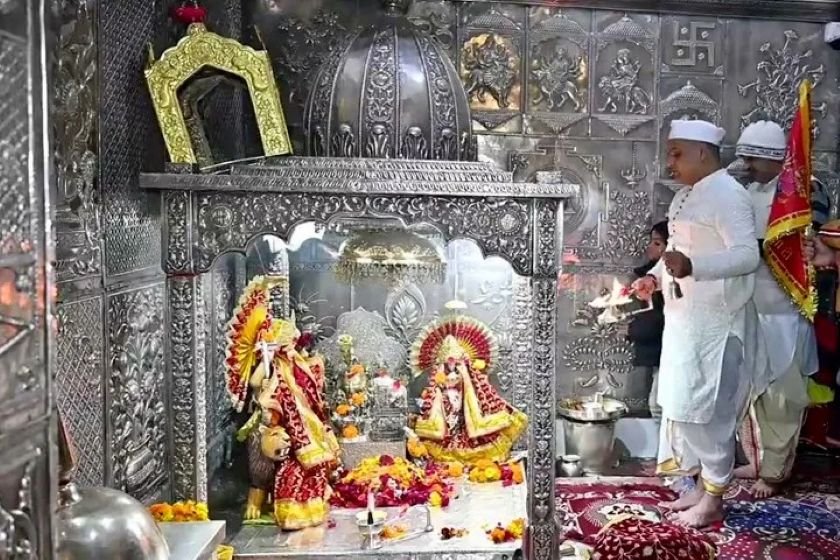
During Navratri, the quiet settlement of Trilokpur becomes one of the busiest pilgrimage centres in southern Himachal Pradesh. Long queues form outside the red-roofed temple complex, devotees arrive carrying coconuts, flowers and red chunris, and devotional chants continue from early morning until late in the day.
Trilokpur Fair is held at the ancient Maa Bala Sundari Temple in Sirmaur district. The fair takes place twice each year—during Chaitra Navratri in spring and Sharad or Ashwin Navratri in autumn. Of the two celebrations, the Chaitra Navratri fair generally attracts the larger gathering.
The fair is centred on the worship of Maa Bala Sundari, a child manifestation of the Divine Mother. Pilgrims travel from Himachal Pradesh, Haryana, Punjab, Chandigarh, Delhi, Uttarakhand and other parts of northern India to seek the goddess’s blessings.
| Quick Detail | Information |
|---|---|
| Festival | Trilokpur Fair or Maa Bala Sundari Navratri Mela |
| Location | Trilokpur, Sirmaur district |
| Principal shrine | Shri Mahamaya Bala Sundari Temple |
| Festival season | Chaitra Navratri and Sharad or Ashwin Navratri |
| Usual months | March–April and September–October |
| Main deity | Maa Bala Sundari |
| Festival type | Religious pilgrimage and temple fair |
| Larger gathering | Chaitra Navratri fair |
| Main activities | Darshan, worship, offerings, havan, langar and fair market |
| Nearest major road point | Kala Amb |
| Distance from Nahan | Approximately 23 kilometres |
| Ideal visit duration | Half day to one full day |
| Date advice | Verify the official annual fair schedule before travelling |
Why Trilokpur Fair Is Important
Trilokpur is one of the most important Shakti pilgrimage centres in Sirmaur. The main temple is dedicated to Mahamaya Bala Sundari, worshipped in the form of a young girl.
The annual Navratri fairs are the most important occasions in the temple calendar. During these periods, the temple complex, approach roads and surrounding market areas fill with pilgrims.
For many families in Himachal Pradesh, Haryana and neighbouring regions, Maa Bala Sundari is worshipped as a family or kul deity. Visiting Trilokpur during Navratri is therefore not simply a sightseeing journey but part of an inherited religious tradition.
Himachal Pradesh Tourism identifies Trilokpur as a highly revered temple of Mahamaya Bala Sundari and notes that Navratri fairs are held there twice each year.
Maa Bala Sundari and the Meaning of Trilokpur
Maa Bala Sundari is worshipped as the child form of the Divine Mother. The word “Bala” refers to a young girl, while “Sundari” means beautiful. The deity is associated with innocence, divine energy, protection and spiritual power.
The name Trilokpur is traditionally associated with a group of three Shakti shrines in the area. The principal temple is dedicated to Maa Bala Sundari, while other shrines in the wider sacred landscape are associated with different forms of the goddess.
Pilgrims may combine their visit to the main shrine with nearby temples, although the exact route and accessibility should be confirmed locally.
The Legend of the Salt Bag
The best-known origin story of the Trilokpur temple survives through local religious tradition.
According to the legend, a trader named Ram Dass purchased a sack of salt. While selling from the sack, he noticed that the quantity of salt did not seem to decrease.
The goddess later appeared to him in a dream and revealed that her sacred presence was inside the bag. He was instructed to establish the pindi and build a temple at Trilokpur.
Unable to construct the temple alone, Ram Dass is said to have sought assistance from the ruler of the former Sirmaur state. Royal support was then provided for the construction of the shrine.
The temple is commonly associated with the late 16th century and is traditionally said to have been completed around 1573. Later rulers of Sirmaur are believed to have renovated or supported the shrine.
This account is an important part of the temple’s living oral tradition. Individual details differ between retellings and should be understood as sacred legend rather than fully documented historical evidence.
Chaitra Navratri Fair
The Chaitra Navratri fair is held during the spring Navratri period, usually in March or April.
This is generally considered the larger of the two annual fairs. Pilgrims begin arriving from the opening days of Navratri, while the heaviest crowds are often seen on important fasting days, Ashtami, Navami and the concluding period.
The spring weather is usually pleasant to warm during the daytime, but the temple area can become extremely crowded.
Himachal Pradesh Tourism describes the Bala Sundari fair as a major Navratri event held at Trilokpur near Nahan and notes that large numbers of devotees attend.
Sharad or Ashwin Navratri Fair
The second annual fair takes place during Sharad Navratri, also known as Ashwin Navratri, usually in September or October.
The autumn fair follows a similar devotional pattern, with special worship, darshan, offerings, temple ceremonies and pilgrim facilities.
Although it may be smaller than the Chaitra gathering, it still attracts large numbers of worshippers, particularly on Ashtami and Navami.
The Sirmaur district administration issues separate orders and arrangements for the Ashwin fair, demonstrating that it is treated as a major organised pilgrimage event.
Darshan at Maa Bala Sundari Temple
During the fair, devotees enter the temple through managed queue systems. Waiting times can vary from a few minutes during quieter hours to several hours on peak days.
Pilgrims commonly carry:
- Coconuts
- Red chunris
- Flowers
- Sweets
- Incense
- Sacred threads
- Other traditional offerings
Offerings should be purchased only from authorised or established vendors. Follow temple instructions regarding which items may be taken inside the sanctum.
Once inside, darshan may be brief because temple staff must manage a continuous flow of pilgrims.
Visitors should avoid stopping inside narrow passages, taking extended photographs or attempting to move against the queue.
Worship and Religious Ceremonies
Special worship is performed throughout Navratri.
Depending on the day and official schedule, religious activities may include:
- Morning and evening aarti
- Recitation of Durga prayers
- Havan and yajna
- Offering of flowers and prasad
- Kanya pujan
- Devotional singing
- Distribution of blessed food
- Temple processions or ceremonial observances
Some rituals may be arranged privately by families or groups. Visitors should not enter restricted areas or photograph private worship without permission.
The Fair Market
A large temporary market develops around the temple and approach roads during the Navratri fair.
Visitors commonly find stalls selling:
- Religious offerings
- Photographs and images of the goddess
- Red chunris and sacred threads
- Toys and household goods
- Sweets and snacks
- Clothing and accessories
- Decorative items
- Local and regional products
The market is busiest during the afternoon and evening.
Because crowd movement can be slow, visitors should avoid carrying bulky bags and should keep wallets and mobile phones secure.
Langars and Community Food
Religious organisations and community groups often arrange langars and food-distribution services during the fair.
Depending on the organiser, pilgrims may receive:
- Dal and rice
- Chapati and vegetables
- Halwa
- Tea
- Drinking water
- Fruit
- Simple prasad
Langar should be accepted respectfully. Take only as much food as you can finish and place disposable plates or cups in the designated waste collection area.
Temple fairs generate considerable waste, and responsible behaviour is essential for keeping the pilgrimage route clean.
Fair Dates and Official Programme
Trilokpur Fair does not follow fixed Gregorian calendar dates. It is organised according to the Navratri calendar.
The exact duration, traffic plan, security arrangements, medical services and parking system are announced separately for each fair.
Before travelling, confirm:
- Opening and closing dates
- Peak darshan days
- Temple timings
- Parking arrangements
- Road restrictions
- Queue entry points
- Public transport services
- Medical and emergency facilities
Do not rely entirely on dates published for a previous year.
Best Day and Time to Visit
The best time depends on whether you want to experience the main religious gathering or avoid the largest crowds.
Opening days: Suitable for experiencing the beginning of Navratri, though queues may already be long.
Ashtami and Navami: Spiritually important and generally among the busiest days.
Weekdays: Often more manageable than weekends, although crowd levels still depend on the religious calendar.
Early morning: Usually the best time for quieter darshan.
Late afternoon and evening: The market becomes lively, but parking and queues may be more difficult.
Families with young children, elderly people or anyone unable to stand for long periods should avoid the peak days whenever possible.
How to Reach Trilokpur
Trilokpur lies in the southern part of Sirmaur district, close to Kala Amb and the Haryana border.
From Kala Amb
Kala Amb is the nearest major road junction and the most practical gateway to Trilokpur.
The distance is approximately 6 to 7 kilometres, depending on the route. Taxis, shared vehicles and special fair-period transport may be available.
From Nahan
Trilokpur is approximately 23 to 25 kilometres from Nahan.
The road descends from Nahan towards Kala Amb before turning towards Trilokpur. Travel time can increase significantly during Navratri because of traffic controls and pilgrim vehicles.
From Chandigarh
Travellers from Chandigarh can reach Trilokpur through Panchkula, Naraingarh, Kala Amb and the local approach road to the temple.
The journey usually takes approximately two-and-a-half to three-and-a-half hours, depending on traffic.
From Ambala
Ambala is well connected by road and rail. From Ambala, travellers can proceed through Naraingarh and Kala Amb towards Trilokpur.
From Paonta Sahib
The route from Paonta Sahib generally passes through Dhaula Kuan and Kala Amb before reaching Trilokpur.
By Train
There is no railway station at Trilokpur.
Useful broad-gauge railway stations include:
- Ambala Cantonment
- Chandigarh
- Kalka
- Yamunanagar–Jagadhri
From the railway station, continue by taxi or bus towards Kala Amb and Trilokpur.
By Air
Chandigarh Airport is the most practical major airport.
Dehradun Airport may also be considered by travellers combining the journey with Paonta Sahib, though the road journey to Trilokpur is longer.
Where to Stay
Accommodation directly around Trilokpur can be limited and fills quickly during Navratri.
Practical places to stay include:
- Trilokpur temple accommodation, where available
- Kala Amb
- Nahan
- Naraingarh
- Paonta Sahib
Kala Amb is the nearest practical base, while Nahan offers a wider selection of hotels and a quieter environment.
Temple accommodation and dharamshalas may follow separate booking systems. Confirm availability, bedding, washrooms and check-in rules before travelling.
Parking and Traffic During the Fair
Traffic management is one of the most important practical concerns during Trilokpur Fair.
Temporary parking areas may be created away from the temple. Private vehicles may not be permitted to proceed directly to the main entrance during peak periods.
Visitors should:
- Follow official traffic diversions
- Park only in authorised areas
- Avoid roadside parking
- Be prepared to walk
- Note the location of the parking area
- Keep extra time for shuttle or pedestrian movement
- Avoid carrying unnecessary luggage
Traffic congestion is usually heaviest on weekends, Ashtami, Navami and the concluding days.
Facilities for Pilgrims
During major fair periods, the administration and temple trust generally arrange additional facilities.
These may include:
- Managed queues
- Police and security deployment
- Drinking water
- Medical assistance
- Temporary toilets
- Lost-and-found services
- Parking areas
- Public announcements
- Langar facilities
- Crowd-control barriers
The availability and location of these facilities may change from year to year.
Weather and What to Carry
Weather conditions differ between the two annual fairs.
During Chaitra Navratri
Days may be warm, especially around Kala Amb and the lower Sirmaur region.
Carry:
- Light cotton clothing
- Sun protection
- Drinking water
- Comfortable footwear
- A light layer for early morning
During Sharad Navratri
Days are generally pleasant, while evenings may feel cooler.
Carry:
- A light jacket
- Comfortable shoes
- Water
- Rain protection if required
- Basic medicines
For both fairs, carry some cash because mobile networks and digital payments may become unreliable in heavy crowds.
Cultural and Temple Etiquette
Trilokpur Fair is primarily a religious pilgrimage.
Visitors should:
- Dress modestly
- Remove footwear before entering designated temple areas
- Cover the head if instructed
- Follow the queue
- Avoid pushing
- Do not touch sacred objects
- Do not photograph the sanctum without permission
- Keep mobile phones silent
- Avoid eating inside restricted areas
- Follow instructions from temple staff and police
- Respect separate queue arrangements where provided
The temple should not be treated merely as a tourist attraction or fairground.
Visiting with Children and Elderly Pilgrims
The fair can be physically demanding because of long queues, warm weather and crowded approach roads.
Helpful precautions include:
- Visit early in the morning
- Avoid peak festival days
- Carry prescribed medicines
- Keep children close
- Select a meeting point
- Carry water and light food
- Avoid standing in tightly packed queues for too long
- Ask volunteers about senior-citizen arrangements
- Use authorised resting areas
Anyone with heart, respiratory or mobility problems should plan carefully and avoid the busiest hours.
Safety and Crowd Awareness
Large religious fairs require basic crowd-safety precautions.
Keep valuables secure and avoid wearing expensive jewellery. Do not accept unsolicited help with money, offerings or accommodation.
Never leave children unattended. Save the telephone number of your hotel, driver or accompanying group.
In an emergency, follow police announcements and move calmly towards the nearest open area rather than pushing against the crowd.
Nearby Temples in the Trilokpur Sacred Circuit
The wider Trilokpur area is traditionally associated with three principal Shakti shrines.
Pilgrims may visit:
Maa Bala Sundari Temple: The main and most visited shrine.
Lalita Devi Temple: Another important shrine associated with the sacred Trilokpur landscape.
Tripur Bhairavi Temple: A further goddess shrine in the wider area.
Road distance, access and opening conditions should be confirmed locally before attempting the full circuit.
Nearby Places to Visit
A visit to Trilokpur can be combined with several nearby destinations.
Kala Amb: The closest commercial town and main road gateway.
Nahan: The district headquarters, known for Rani Tal, temples, old markets and colonial-era character.
Suketi Fossil Park: An open-air fossil and life-size model park near Kala Amb.
Paonta Sahib: A major Sikh pilgrimage town on the banks of the Yamuna.
Renuka Ji: A sacred lake and temple destination surrounded by forested hills.
During Navratri, avoid planning too many places in one day because traffic near Trilokpur can be unpredictable.
Frequently Asked Questions
When is Trilokpur Fair held?
It is held twice annually during Chaitra Navratri and Sharad or Ashwin Navratri.
Which Trilokpur fair is larger?
The Chaitra Navratri fair generally attracts the larger gathering.
Where is Trilokpur located?
Trilokpur is in Sirmaur district, close to Kala Amb and approximately 23 kilometres from Nahan.
Who is worshipped at Trilokpur Temple?
The main deity is Maa Mahamaya Bala Sundari, worshipped as a child form of the Divine Mother.
What is the main legend of the temple?
Local tradition says that the goddess appeared in a trader’s bag of salt and instructed him in a dream to establish her shrine.
Is there an entry fee?
General temple entry is normally free, although offerings, parking and individual services may involve separate charges.
How long does darshan take during Navratri?
Waiting time varies greatly. On peak days it may take several hours.
Is accommodation available near the temple?
Limited temple, dharamshala and local accommodation may be available. Kala Amb and Nahan offer more reliable options.
Can elderly pilgrims visit during the fair?
Yes, but they should avoid peak days, arrive early and check whether special queue or assistance arrangements are available.
Is photography allowed?
Photography may be permitted in public exterior areas, but it should not be assumed inside the shrine. Always follow posted instructions.
Final Words
Trilokpur Fair is one of Sirmaur’s most significant annual expressions of faith. Its importance lies not only in the size of the gathering but in the continuing relationship between Maa Bala Sundari and the families who return to her shrine generation after generation.
The market, food stalls and movement of thousands of pilgrims give the fair its public energy, but its true centre remains the brief moment of darshan inside the temple.
Visitors who plan carefully, arrive early and respect the religious character of the shrine can experience Trilokpur not simply as a crowded Navratri fair, but as a living pilgrimage tradition deeply rooted in the cultural identity of Sirmaur.