
Temple & sacred site
Chamunda Devi Temple, Devi Kothi
The Wooden Shrine and Painted Stories of Churah
At a glance
- Location
- Devi Kothi village, Churah, Chamba district
- How to reach
- Via Tissa towards Bairagarh, then the local road to Devi Kothi
A doorway inscription at Devi Kothi names the ruler who built the shrine. Inside, painted stories open another chapter in the history of Chamba’s art.
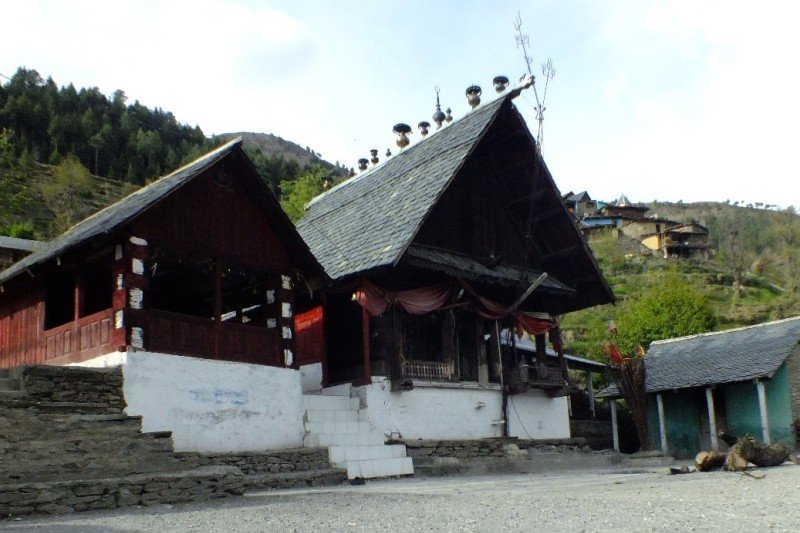
The Chamunda temple in Devi Kothi is known locally as the shrine of Chaunda Bhagwati. Its carved timber, slate roof and painted panels belong to a living village temple in Churah. Give yourself time for the drive and the threshold. Some of the details are easiest to appreciate by looking slowly and asking what is open to visitors.
🌄 Location and how to reach it
The shrine is in Devi Kothi village, in the Churah area of Chamba district. The state heritage inventory records the road approach through Bairagarh. Tissa is the useful service point on the Churah side of the journey.
Google Maps: Find Chamunda Devi Temple, Devi Kothi
- By road: From Chamba, follow the Churah route via Tissa towards Bairagarh and confirm the branch to Devi Kothi. Ask about the local road before setting out after heavy rain.
- By public transport: Check the current Tissa or Bairagarh connection and arrange the last leg in advance. Ask about the return before committing to a late-day arrival.
- On foot: In Devi Kothi, ask for Chaunda Bhagwati or the old Chamunda shrine. The heritage inventory places it on a terrace towards the southwest of the village.
🌸 Best Time to Visit
Go in daylight if you want to study the timber and the paintings where access is allowed. Leave time for the return through Churah. The temple is an active place of worship, so ask locally whether the painted areas are accessible and when a visit would be least disruptive.
📜 The Inscription at the Door
Himachal’s Department of Language, Art and Culture attributes the temple to Raja Umed Singh of Chamba in 1754. It gives a specific basis for the date: an inscription in Tankari script on wooden panels beside the main doorway. The building has been refurbished over time. The department describes a mixture of older carvings and more recent workmanship.
The carving belongs to the experience of arriving at the shrine. Look at the doorway and the timber under the roof. The department’s account notes mythological figures, including subjects drawn from Shaiva and Shakta traditions. The roofing and wooden structure are also part of the building’s local character.
🎨 How to Look at the Murals
The painted panels include scenes of the goddess and episodes from the Bhagavata Purana. Art historian Vijay Sharma points to links between some Krishna scenes and the illustrated Bhagavata associated with Laharu’s school, examples of which are held at the Bhuri Singh Museum in Chamba. The temple murals and the museum folios give two ways to see how related stories travelled across painting formats.
The date of the paintings is less straightforward than the date at the door. A state heritage survey places the murals in the early nineteenth century on stylistic grounds. The 1754 inscription gives a date for the temple’s foundation. The paintings may belong to a later chapter of its use.
🙏 Visiting with Respect
Ask before entering the painted areas or using a camera. Keep hands and bags clear of the painted walls and woodwork. If the inner area is closed, spend time with the exterior and leave worshippers room to pass through the doorway.
❓ Quick Questions Travellers Ask
- Is this the Chamunda temple in Chamba town? This shrine is in Devi Kothi in Churah. Use both names when planning the drive.
- What is the first detail to look for? Start with the carved doorway and ask where the Tankari inscription can be seen.
- Can I see the murals on every visit? Ask the temple caretakers. Access depends on the spaces open to visitors and the worship taking place.
A Final Thought
The doorway records the temple’s patron. The painted panels tell sacred stories in the language of Chamba’s artists. It is worth giving both your attention.