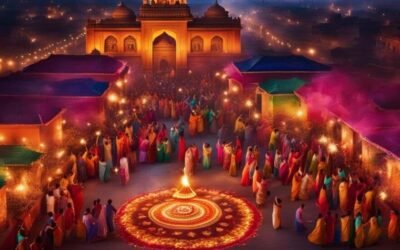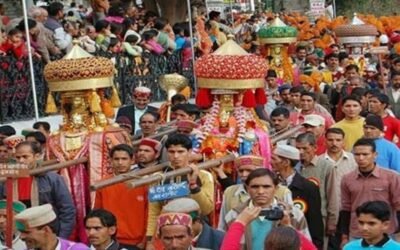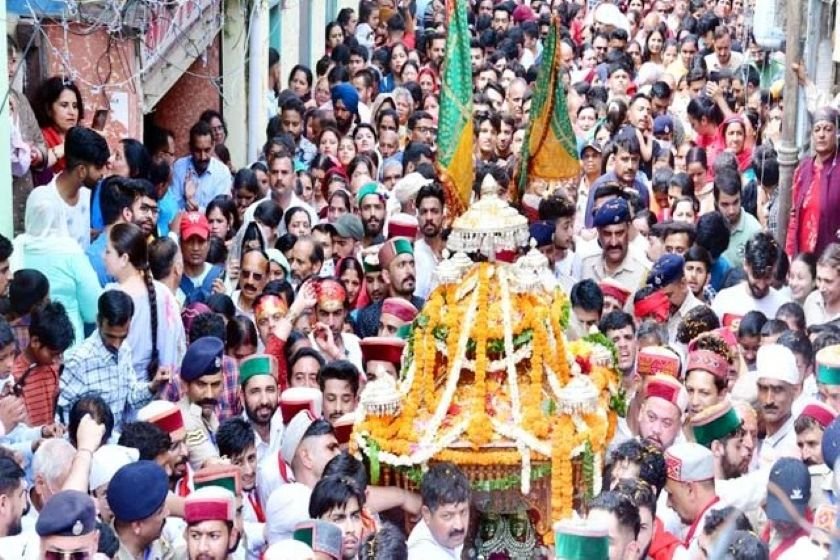
For three days every June, Solan changes completely. Roads around the old town fill with devotees, temple bells mix with the sound of drums, markets remain crowded late into the evening, and the flower-covered palanquin of Maa Shoolini moves slowly through streets lined with waiting families.
Shoolini Fair, locally known as Maa Shoolini Mela, is the most important annual religious and cultural celebration in Solan. The festival honours Maa Shoolini, the presiding deity of the town, and centres on her ceremonial journey from the main temple to the shrine associated with her elder sister in Ganj Bazaar.
What began as a local expression of faith has grown into a major public fair featuring religious ceremonies, folk performances, exhibitions, sports competitions, food stalls, amusement rides and cultural evenings. Despite its modern scale, the procession of Maa Shoolini remains the spiritual heart of the celebration.
| Quick Detail | Information |
|---|---|
| Festival | Maa Shoolini Fair |
| Location | Solan town, Himachal Pradesh |
| District | Solan |
| Main venues | Shoolini Mata Temple, old Solan market areas and Thodo Ground |
| Usual month | June |
| Duration | Three days |
| Principal deity | Maa Shoolini |
| Main ceremony | Shobha Yatra of Maa Shoolini’s palanquin |
| Festival type | Religious, cultural and community fair |
| Best day for procession | Opening day |
| Ideal visit duration | One or two days |
| Nearest railway station | Solan Railway Station |
| Nearest major airport | Chandigarh Airport |
| Annual date advice | Confirm dates and the procession programme with the Solan district administration |
Why Shoolini Fair Is Important to Solan
Maa Shoolini is regarded as the principal deity and spiritual guardian of Solan. The town’s identity is closely connected with her temple, and the annual fair is one of the rare occasions when the entire community participates in a shared religious and cultural celebration.
For local residents, Shoolini Mela is more than a public event. Families prepare for it in advance, markets are decorated, community groups organise food and water services, and devotees wait along the procession route for a glimpse of the goddess.
The festival is also an important homecoming period. People who have moved away from Solan frequently return to meet relatives and participate in the celebrations. This combination of devotion, community participation and local memory gives the fair a character that cannot be understood through its entertainment programme alone.
Maa Shoolini and the Temple Tradition
Maa Shoolini is worshipped as a form of the Divine Mother and is commonly associated with Durga. Her name is traditionally connected with the word “shool,” meaning spear or trident, symbolising divine strength and protection.
Local religious tradition considers her the ruling deity of the Solan region. The Shoolini Mata Temple stands near the old court area and remains one of the town’s most revered shrines.
Written historical information about the earliest period of the shrine is limited, and several stories surrounding the goddess survive through oral tradition. These accounts should be understood as part of Solan’s inherited religious culture rather than treated as uniformly documented history.
The Tradition of Maa Shoolini Visiting Her Sister
The principal tradition associated with the fair is the ceremonial visit of Maa Shoolini to the shrine of her elder sister in Ganj Bazaar.
On the opening day, priests perform special worship and a havan at the main temple. The goddess is then placed in a beautifully decorated palanquin covered with flowers, cloth and ceremonial ornaments.
The palanquin leaves the temple accompanied by priests, hereditary attendants, musicians, devotees and representatives of the administration. According to local belief, Maa Shoolini remains with her sister during the three-day celebration before returning to her main shrine on the concluding day.
This sacred visit forms the religious framework of the entire mela. Cultural programmes and markets may attract large crowds, but the journey of the goddess is the reason the festival is held.
Opening-Day Shobha Yatra
The opening procession is the most important and visually striking part of Shoolini Fair.
After worship at the temple, the flower-decorated palanquin is carried through the older parts of Solan. Traditional drums, brass instruments, devotional music and groups of attendants accompany it. Religious tableaux, local organisations and cultural performers may also join the procession.
Thousands of people gather on roadsides, balconies, rooftops and market entrances to see the goddess. Devotees offer flowers, bow as the palanquin passes and sometimes distribute water, fruit or food to visitors.
The procession traditionally moves through important parts of the town, including the old court area and market streets, before reaching Ganj Bazaar. The exact route and traffic arrangements can change each year, so visitors should follow the programme issued by the district administration.
The Atmosphere Along the Procession Route
The narrow streets of old Solan become extremely crowded during the Shobha Yatra. Shopfronts are decorated, flower petals are showered upon the palanquin, and residents wait for hours before the procession arrives.
The movement is usually slow because devotees gather closely around the goddess. Musicians, security personnel, volunteers and temple attendants work together to keep a passage open.
Visitors attending for the first time should not expect to follow the entire procession easily. It is usually better to choose one viewing location, arrive early and remain there until the palanquin has passed.
Families with young children or elderly members should avoid the most congested lanes and select a wider point along the officially announced route.
Three Days of Religious Observances
Although the opening procession receives the greatest attention, worship continues throughout all three days.
Devotees visit the shrine where Maa Shoolini is believed to stay with her sister. Offerings, prayers and community services continue as people arrive from Solan and nearby villages.
On the final day, another ceremonial procession accompanies the goddess back to her main temple. This return journey marks the religious conclusion of the annual visit.
Ritual timings may change, and visitors interested in attending the departure or return ceremonies should confirm the schedule locally.
Cultural Programmes at Thodo Ground
Thodo Ground serves as the main venue for the larger public and cultural part of the fair.
The programme commonly includes:
- Himachali folk dances
- Nati performances
- Local singers and musicians
- School and college presentations
- Cultural troupes from different regions
- Evening performances by invited artists
- Government and departmental exhibitions
- Sports and community competitions
Cultural evenings attract very large audiences. Entry and seating arrangements may vary, particularly when well-known performers are scheduled.
The official programme should always be checked before travelling because performers, timings and entry arrangements are revised every year.
Traditional Sports and Public Competitions
Shoolini Fair is not limited to religious worship and music. Sporting and community events have long formed part of the celebration.
Depending on the annual programme, visitors may see wrestling competitions, traditional games, athletic events, children’s activities, exhibitions and public shows.
Wrestling has particular importance in many Himachali fairs because it connects village-level sporting traditions with large community gatherings. Modern programmes may also include volleyball, kabaddi or other organised competitions.
Fairground, Markets and Amusement Rides
During Shoolini Mela, temporary markets and stalls appear around the main fair areas.
Visitors commonly find:
- Food and sweet stalls
- Clothing and household goods
- Toys and children’s products
- Local handicrafts
- Government information displays
- Commercial exhibitions
- Agricultural products
- Amusement rides
- Games and temporary attractions
The mela becomes particularly busy in the evening when families arrive for shopping, rides and cultural performances.
Visitors buying higher-value products should check quality carefully. Not every shawl, cap or handicraft sold at a large fair is necessarily handmade or produced locally.
Bhandaras and Community Food Service
One of the most memorable aspects of Shoolini Fair is the scale of voluntary food and water distribution.
Local organisations, businesses, neighbourhood groups and individual families organise bhandaras at different points across Solan. Depending on the organiser, these may serve rice, dal, vegetables, halwa, fruit, cold drinks, tea or drinking water.
These services are generally offered as an act of devotion and community participation rather than as commercial food stalls.
Visitors should accept food respectfully, avoid unnecessary waste and place disposable plates or cups only in designated bins. Large public meals can generate considerable waste, making responsible behaviour especially important.
Shoolini Fair Dates
The fair is normally held over three days in June. Exact dates are announced annually by the district administration.
Dates should not be assumed from a previous year because administrative planning, public holidays and ceremonial arrangements may vary.
Before travelling, confirm:
- Opening procession date and time
- Palanquin route
- Cultural-night programme
- Traffic restrictions
- Parking areas
- Closing procession schedule
Best Day to Attend
The best day depends on the kind of experience you want.
Opening day: Best for witnessing the main Shobha Yatra and the departure of Maa Shoolini from the temple. This is also the most congested period.
Second day: Usually more comfortable for visiting exhibitions, shopping areas, sports events and cultural programmes.
Final day: Best for those who want to witness the concluding ceremonies and the goddess’s return to the main temple.
Visitors primarily interested in the religious tradition should attend the opening or closing procession. Families interested in the fairground may find the second day easier to manage.
How to Reach Solan
Solan is situated along the Chandigarh–Shimla corridor and is one of the most accessible district headquarters in Himachal Pradesh.
From Chandigarh
Solan is approximately 65 to 70 kilometres from Chandigarh by road. The journey commonly takes two to three hours, depending on traffic.
Festival-period congestion can increase travel time considerably, particularly near Dharampur, Kumarhatti and the approaches to Solan.
From Shimla
Solan is approximately 45 kilometres from Shimla. Regular buses and taxis operate between the two towns.
From Delhi
Travellers from Delhi can follow the route through Panipat, Karnal, Ambala, Chandigarh and Kalka before climbing towards Solan.
An overnight stay is advisable rather than attempting a rushed same-day return during the fair.
By Train
Solan lies on the Kalka–Shimla narrow-gauge railway.
Solan Railway Station is close to the main town, making the toy train a scenic option. However, trains have limited capacity and journey times are longer than travelling by road.
Reservations should be made well in advance during the fair period.
By Air
Chandigarh Airport is the most practical major airport for most visitors. From Chandigarh, Solan can be reached by taxi or bus.
Shimla Airport at Jubbarhatti is geographically closer but generally has fewer flight options.
Where to Stay
Solan has hotels, guest houses and homestays in and around the main town.
Convenient areas include:
- Solan town centre
- Chambaghat
- Deonghat
- Saproon
- Kumarhatti
- Barog
- Dharampur
Staying near the town centre provides easier walking access but may involve noise, crowds and limited parking.
Barog and Kumarhatti are quieter alternatives for travellers with private vehicles, although road congestion should be considered.
Rooms fill quickly during Shoolini Mela, so advance booking is strongly recommended.
Traffic and Parking During the Fair
Traffic management is one of the biggest practical concerns during Shoolini Fair.
Roads around the temple, old court, Mall Road, Upper Bazaar, Ganj Bazaar and Thodo Ground may be closed, diverted or restricted during processions.
Visitors should:
- Use only authorised parking areas
- Avoid entering central Solan in a private vehicle during the procession
- Follow police diversions
- Be prepared to walk
- Allow additional travel time
- Avoid stopping on the highway
Parking availability and road closures change each year. Check current advisories from the Solan district administration or local police before departure.
Weather in Solan During the Fair
June in Solan is generally warm during the day, with cooler evenings. Pre-monsoon showers or sudden rain are possible.
Carry:
- A light rain jacket or umbrella
- Comfortable walking shoes
- Drinking water
- A light layer for the evening
- Basic medicines
- A power bank
- Some cash
Crowded market lanes may become slippery after rain, so footwear with proper grip is useful.
Cultural Etiquette
Shoolini Fair is a public celebration, but its central ceremonies remain religious.
Visitors should follow a few basic principles:
- Do not touch the palanquin or ceremonial ornaments.
- Do not obstruct the procession route.
- Avoid walking directly in front of the deity.
- Ask before photographing priests or close rituals.
- Do not use flash photography near the palanquin.
- Keep an appropriate distance from temple attendants.
- Dress respectfully when entering shrines.
- Avoid pushing through the crowd for photographs.
- Follow instructions issued by police and volunteers.
The palanquin procession is not merely a performance arranged for visitors. It is a sacred journey undertaken according to local tradition.
Visiting with Children and Elderly Travellers
Families can attend Shoolini Fair, but the opening procession may be difficult for small children, elderly people and anyone uncomfortable in tightly packed crowds.
Practical precautions include:
- Attend during the morning or early afternoon
- Avoid the narrowest market lanes
- Select a fixed meeting point
- Write a contact number on a child’s identity card
- Carry essential medicines
- Keep children away from procession ropes and moving palanquins
- Avoid overcrowded cultural-night entrances
The second day is generally easier for families interested mainly in stalls, exhibitions and rides.
Nearby Places to Visit
Shoolini Fair can be combined with several nearby attractions.
Jatoli Shiv Temple: A prominent Shiva temple located a short drive from Solan.
Mohan Shakti National Heritage Park: A large heritage and temple complex near Harat.
Karol Tibba: A forested hill and trekking destination above Solan.
Barog: Known for its railway station, pine-covered surroundings and historic railway tunnel.
Dagshai: A quiet cantonment town with colonial-era buildings and a historic jail museum.
Kasauli: A popular hill station approximately an hour from Solan, depending on traffic.
Do not schedule too many nearby places on the day of the main procession. Traffic restrictions can make travel unpredictable.
Frequently Asked Questions
When is Shoolini Fair held?
It is generally held for three days in June. Exact dates are announced annually.
Where is Shoolini Fair organised?
Religious ceremonies begin at Shoolini Mata Temple, while major cultural programmes and public events are generally organised at Thodo Ground and other locations around Solan.
What is the main attraction of Shoolini Fair?
The principal religious event is the Shobha Yatra in which Maa Shoolini’s decorated palanquin is carried through Solan.
Why does Maa Shoolini visit Ganj Bazaar?
Local tradition holds that the goddess travels to meet and stay with her elder sister during the three-day fair.
Is there an entry fee?
General access to the fair and procession is normally free. Specific seating areas or individual attractions may have separate arrangements.
Which day is best for photography?
The opening day offers the most striking procession scenes, but it is also extremely crowded. Photography should never interfere with religious ceremonies.
Is parking available near Thodo Ground?
Temporary parking arrangements are generally announced, but nearby spaces fill quickly. Visitors should use authorised parking and expect to walk.
Can Shoolini Fair be visited as a day trip from Chandigarh?
It is possible, but festival traffic may make the journey tiring. Staying overnight in Solan, Barog or Kumarhatti provides a more relaxed experience.
Final Words
Shoolini Fair is the celebration through which Solan expresses its deepest connection with its presiding deity.
The cultural evenings, fairground rides and crowded markets give the mela its public energy, but its real meaning lies in the flower-covered palanquin moving through the old town, families waiting along the route, volunteers serving food and the belief that Maa Shoolini has stepped outside her temple to visit her people.
Visitors who arrive with patience and respect will experience more than a busy annual fair. They will witness a living community tradition that continues to shape Solan’s religious and cultural identity.