A five-minute walk from Naggar Castle sits a temple that has outlived the empire that built it
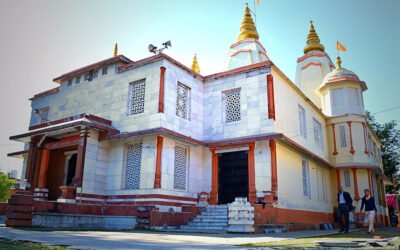
A quick clarification up front, since this trips up a lot of travel writing online: this is not the Gauri Shankar Temple in Jagatsukh, roughly 20 km away near Manali. That’s a separate, older shrine with its own history. This one sits in Naggar itself, practically in the shadow of Naggar Castle, and it carries a distinction that historians take seriously even if most tourists walk straight past it on their way to photograph the castle: it’s widely regarded as the last surviving monument of the Gurjara-Pratihara architectural tradition anywhere in the Himalaya.
That’s a heavier claim than it sounds. The Gurjara-Pratiharas were a major dynastic power across north and central India between roughly the 8th and 11th centuries, and their building style left its mark on temples as far south as Rajasthan and Madhya Pradesh. That the style also reached this deep into a Himalayan valley, and that a piece of it is still standing, largely intact, in a small courtyard below a 16th-century castle, is the kind of detail that turns a five-minute stop into something worth genuinely slowing down for.
🌄 Location & How to Reach It
- Location: Below Naggar Castle, Naggar village, Kullu District, Himachal Pradesh – 175130
- GPS Coordinates: 32.1131° N, 77.1641° E
- Google Maps: Get Directions
- Altitude: Roughly 1,800 metres
- Distance: About 20 km from Manali, 22 km from Kullu town
This is one of the easiest temples in the valley to reach on foot once you’re in Naggar — it sits barely five minutes’ walk from Naggar Castle, on the same lane most visitors already take toward the Roerich Gallery. Regular buses and taxis connect Naggar to both Kullu and Manali, and once you’re in the village, everything worth seeing, including this temple, is within comfortable walking distance of the bus stand.
Getting to Naggar first: The nearest airport is Bhuntar (~35 km), and the nearest railheads are Joginder Nagar or Pathankot, both a considerable journey away. Most travellers reach Naggar via road from Kullu or Manali rather than any direct rail connection.
🌸 Best Time to Visit
Naggar is pleasant across most of the year, but timing does shape the experience. March to June brings mild temperatures and the surrounding hillsides in bloom — good conditions for combining this temple with a longer walk around the castle grounds. September to November offers the clearest skies and mountain views, without monsoon rain making the stone courtyard slick. Winter turns Naggar genuinely beautiful under snow, though a few of the higher village roads can ice over, so it’s worth checking conditions if you’re travelling in January or February.
Temple timings: Most sources list the temple as open roughly 8:00 AM to 7:00 PM, though as with several heritage-status shrines in this valley, exact hours can shift slightly depending on local arrangements — worth a quick local check if you’re arriving very early or late in the day.
🕉️ Inside the Sanctum
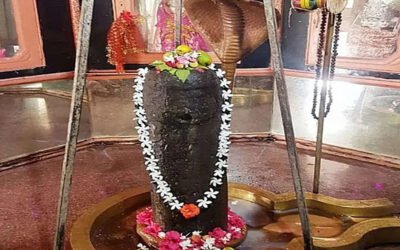
Step into the garbhagriha and you’ll find Shiva and Parvati represented together, seated on a pedestal above Nandi, their images dressed in gold jewellery beneath what several visitors describe as a silver canopy — a level of ornamentation that stands out against the otherwise austere stone architecture surrounding it. The inner walls carry detailed carvings: Ganesh, musicians mid-performance, dancers captured in motion, all worked into stone with a precision that feels almost incongruous for such a small, easily overlooked shrine.
Local tradition offers its own account of the temple’s origin, distinct from the archaeological dating — some in the village will tell you the temple dates back to the era of the Mahabharata itself, built by the Pandavas during their travels through the valley. It’s worth holding both stories at once rather than picking one as definitively correct: the scholarly consensus, based on architectural style and its place in the Gurjara-Pratihara tradition, points to a construction period around the 11th to 12th century CE, while the Pandava association is a piece of living local belief that adds its own layer of meaning to the site, even without archaeological support.
🏛️ Architecture That Shouldn’t Really Be Here
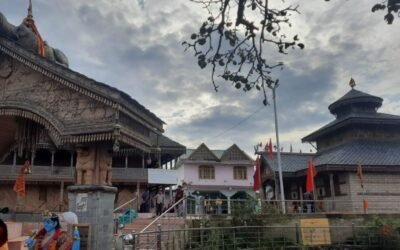
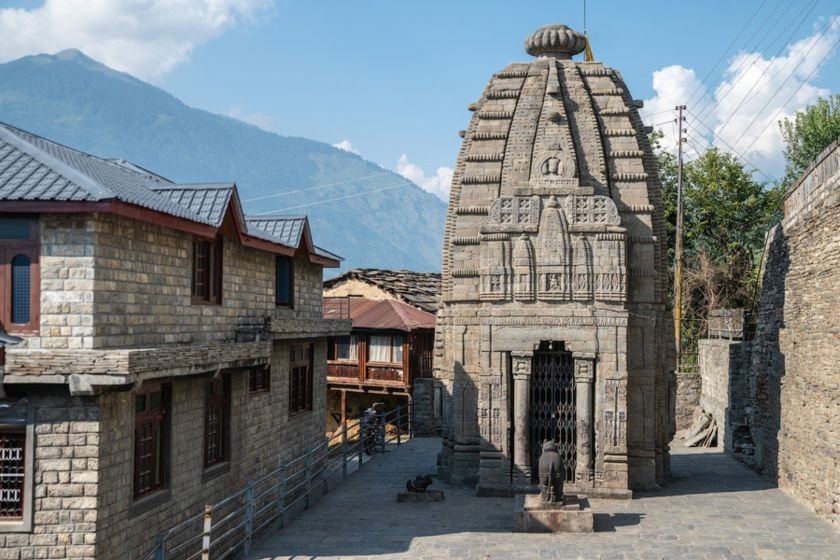
This temple is built in the Shikhara style — a form of North Indian temple architecture defined by a tall, curving tower rising above the sanctum, quite different from the wooden pagoda-roofed temples that dominate the rest of the Kullu Valley, including nearby Tripura Sundari and Hidimba Devi. That difference is exactly what makes this temple architecturally significant: it represents a building tradition that took root in the plains of central and northern India and, unusually, made its way this far into the mountains, where it left almost no other trace.
The tower itself rises in nine distinct tiers, worked in dark stone and decorated with ardharatna motifs — a level of formal, geometric ornamentation quite different from the figurative wood carving found elsewhere in the valley. The base is square, solid, and entirely stone-built, with the whole structure now protected and maintained by the Archaeological Survey of India as a heritage monument. Outside the temple stands a carved Nandi, facing the sanctum, positioned to look out toward the Beas River and the wider Kullu Valley beyond — a view that, on a clear day, stretches to the snow-covered ridgelines above.
📜 Standing Alone in Time
What gives this temple its real weight isn’t just its age but its isolation, historically speaking. The Gurjara-Pratihara architectural tradition produced a scattering of similar temples across Himachal Pradesh — the rock-cut complex at Masrur in Kangra district, the Vishveshwar Mahadev temple at Bajaura, and the older Shiva-Parvati and Gayatri temples at Jagatsukh among them. But this particular shrine, sitting quietly below Naggar Castle, is frequently singled out by historians as the tradition’s final surviving example in the region — the last clear architectural echo of a dynasty whose political power had faded from these hills centuries before Naggar itself rose to prominence as Kullu’s capital.
There’s something worth sitting with in that: an empire that once shaped temple architecture across a huge stretch of India left behind, in this one Himalayan valley, a single small shrine — no grand inscriptions, no dramatic legend of its founding beyond what local memory has layered on top, just carved stone that quietly kept standing long after everything else about the people who built it had been forgotten.
🎉 Festivals and Worship
- Maha Shivratri: The temple’s principal festival, drawing devotees from Naggar and the surrounding villages for prayer and celebration.
- Daily worship: Modest and quiet, tended by local priests, with devotees visiting for peace and blessings rather than large ceremonial occasions.
- Combined visits: Many visitors time their stop here alongside Naggar Castle’s own cultural events, given the temple’s location right at the castle’s edge.
🏞️ While You’re in the Area
- Naggar Castle: Right beside the temple — the 16th-century Kathkuni fort of the Kullu rajas, now a heritage hotel and small museum.
- Jagatipatt Temple: Inside the castle grounds itself, the small shrine associated with the valley’s council of deities.
- Tripura Sundari Temple: A short walk further into the village, a wooden pagoda-style Shakti shrine.
- Murlidhar Krishna Temple: On a ridge above Naggar, standing on ground older than the village itself.
- Nicholas Roerich Art Gallery: The former home and studio of the Russian painter, close by.
🙏 Getting in Touch
There’s no independent phone number or booking contact for this temple specifically — as an ASI-protected monument, it’s managed as part of the wider heritage site around Naggar Castle rather than run through a private contact. For questions about access, timings, or any restrictions, the Naggar Castle reception or the Himachal Pradesh Tourism office is the most reliable point of contact.
❓ Quick Questions Travellers Ask
Is this the same temple as the one in Jagatsukh? No. This Gauri Shankar Temple is in Naggar village, roughly 20 km from Manali, right beside Naggar Castle. The Jagatsukh temple of the same name sits much closer to Manali, about 6 km away, and is a separate, distinct structure with its own history.
Is there an entry fee? The temple itself doesn’t appear to charge separately; it’s generally visited alongside Naggar Castle, which does have its own modest entry fee for the fort and museum.
How long does a visit take? Just 10–15 minutes for the temple itself, though most visitors pair it naturally with a longer visit to Naggar Castle, which can take 45 minutes to an hour.
Is it accessible for those with mobility difficulties? The path from the main village lane involves a short, moderate climb, which a few visitor accounts flag as mildly challenging for elderly or less mobile travellers — nothing extreme, but not entirely flat either.
Is photography allowed? Generally yes around the temple grounds, though as always, it’s respectful to be mindful near the sanctum itself during active worship.
A Last Word
Naggar has no shortage of temples with bigger crowds and grander legends, and this one rarely makes anyone’s must-see list. But there’s something quietly remarkable about standing in front of a stone tower that represents the last physical trace, anywhere in these mountains, of an empire that once shaped the religious architecture of half of India. Whether you find that history compelling or lean instead toward the version where the Pandavas themselves built it, the temple holds both stories the same way it’s held its ground for nearly a thousand years — without needing anyone to settle the argument.
Fact-check notes: This article draws on independent sources including Trawell, Holidify, and Google Places live data, cross-checked for consistency, with particular care taken to keep this temple clearly distinct from the separate, similarly named Gauri Shankar Temple in Jagatsukh — a confusion that appears repeatedly across existing online travel content, sometimes within a single article. Both the scholarly dating (11th–12th century CE, Gurjara-Pratihara style) and the local oral tradition attributing the temple to the Pandavas are presented honestly as separate claims rather than merged into one account. Verified GPS coordinates were pulled from live location data; posted hours (8 AM–7 PM) are commonly cited but not independently confirmed as currently accurate, so a local check is recommended. No independent phone number or contact exists for this temple, and none has been invented.