Against the backdrop of the snow-lined Dhauladhar range stands a temple built almost entirely from white marble in the 1980s — carrying, a little unexpectedly, the name of a wandering saint who is said to have meditated here generations before anyone thought to build in stone at all.
Most temples in this region take their name from the deity enshrined inside them. Baba Baroh Temple does something different: it’s named after a man, not a god, and the story of how this specific patch of Kangra hillside became sacred enough to eventually host a modern marble landmark says as much about layered local history as it does about any single miracle. This is a temple with two separate origin points — an old saint’s presence that gave the place its name, and a much more recent act of private devotion and philanthropy that gave it its walls.
🌄 Location & How to Reach It
- Location: Baroh village, Baba Baroh tehsil, Kangra district, Himachal Pradesh
- Distance: About 23 km from Kangra town; roughly 45–55 km from Dharamshala, with sources genuinely varying on the exact figure; around 12 km from Ranital
- Google Maps: Get Directions
- GPS Coordinates: Not independently verified for this piece — use the map link above, or search “Baba Baroh Temple, Kangra” directly on Google Maps for a precise pin before travelling
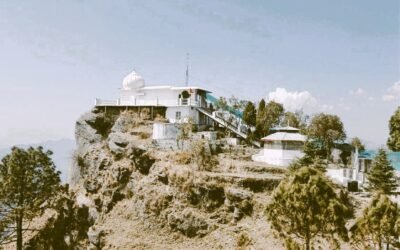
- Elevation/terrain: The temple stands atop a hill with the snow-capped Dhauladhar range directly behind it, giving it a genuinely dramatic backdrop even by the high standards of this region
- By road: Well connected by bus from Kangra, with direct services running to Baroh; the drive is described as scenic but winding, and a river roughly 3–4 km before the temple offers a popular stop for visitors along the way
- By rail: Kangra Mandir Station is the closer regional option at roughly 17 km; Pathankot Junction, about 85 km away, is the nearest broad-gauge station
- By air: Gaggal Airport (Dharamshala/Kangra) is the nearest, with an onward drive of roughly 90 minutes to the temple
Access here is straightforward by road and bus, though the area itself is noted for having relatively few tourist-oriented hotels or restaurants nearby — this is a temple visited on a day trip from Kangra or Dharamshala rather than a place most travellers base themselves in overnight.
🌸 Best Time to Visit
The temple draws its heaviest visitor traffic during Dasara/Navratri, and Janmashtami and Deepavali are similarly significant occasions here given the temple’s dual devotion to Krishna and Durga. Outside of festival season, sunrise and sunset are specifically called out by visitors as the best times to be at the temple, when the light on the Dhauladhar range behind it is at its most striking.
🕉️ The Legend: A Saint’s Name, A Family’s Marble
The story of this place actually unfolds in two distinct stages, separated by what may be centuries. According to local folklore, during the era of Sikh rule in the region, two saints — Baba Baroh and Baba Fattu — arrived in the Kangra hills. They found support from the local kings of Kangra, who helped them establish their own places of worship in the area. It’s from the first of these two saints that the village, and eventually the temple, took its name: Baba Baroh. Beyond that basic outline, detailed specifics of the saint’s life and deeds are thin in the available record — what survives most clearly is the name itself, carried forward long after whatever original, presumably modest, site of devotion he established.
The temple that actually stands here today, however, is a much more recent creation. It was built in the 1980s by B. R. Sharma (recorded in some sources as Bali Ram Sharma), a devout follower and local philanthropist, along with his family. What makes this detail slightly unusual is that Sharma is described in some accounts as a devotee of Lord Shiva, yet the temple he built centers primarily on Radha and Krishna, with Durga and other deities enshrined alongside them — a reminder that a temple’s founder and its primary deity don’t always align in an obvious way, and that acts of devotion and philanthropy don’t require narrow theological consistency to be sincerely meant.
🙏 What the Deity Is Known For
As a Radha-Krishna temple with a significant Durga shrine built into the same structure, Baba Baroh functions as a genuinely multi-deity devotional site rather than a single-god pilgrimage destination. Devotees come seeking the blessings associated with Krishna and Radha’s devotional love, alongside Durga’s protective strength, and the temple has also become known locally less for any specific miracle and more for its role as a hub of community welfare — running a langar (community kitchen), maintaining a cow shelter, and hosting large festive bhandaras during major Hindu festivals. In that sense, its reputation rests as much on ongoing social service as on any singular devotional legend.
🏛️ The Temple Itself
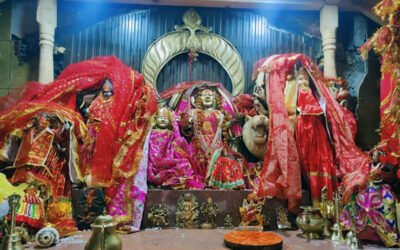
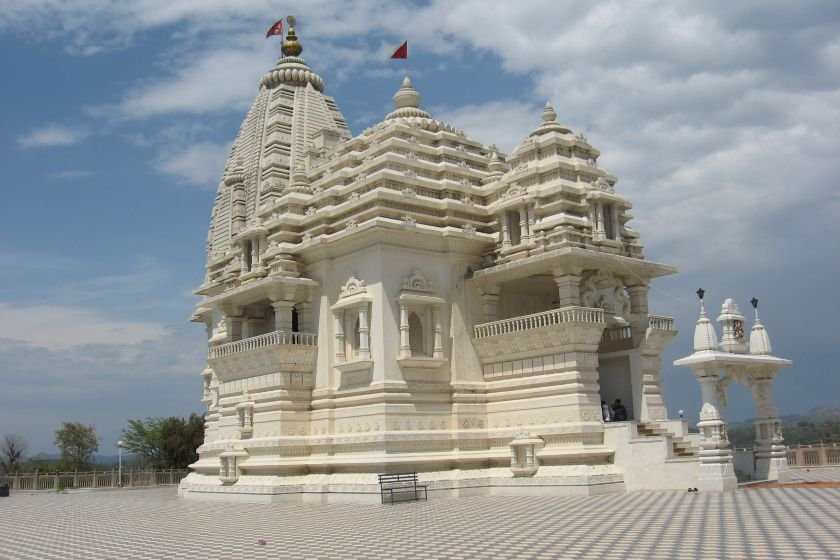
This is, without question, the most architecturally elaborate temple in this series so far. Built almost entirely from white marble — reportedly more marble than any other temple in Himachal Pradesh — the structure is a two-storey building blending traditional North Indian temple elements with more modern design choices. The ground floor houses the main Radha-Krishna idols, carved in white marble, while the upper floor holds a separate idol of Goddess Durga, made of metal rather than marble. A balcony inside connects the two levels, allowing visitors a dual view of both sets of idols from a single vantage point — an unusual and thoughtful architectural touch for a temple of this kind.
The complex extends well beyond the main shrine. Additional shrines to Shiva, Hanuman, and Sai Baba sit within the grounds, with a large Hanuman statue standing guard over the spacious courtyard. That courtyard itself is one of the temple’s defining features: wide, marble-floored, and opening onto panoramic views of the Dhauladhar range and the Kangra valley below, glowing distinctly under both sunlight and moonlight according to visitor accounts. A well-constructed langar hall completes the practical side of the complex, reflecting the temple’s ongoing role as a community welfare center as much as a devotional one.
📜 Regional Context: A Modern Landmark in an Ancient Devotional Landscape
Kangra district is home to some of Himachal’s oldest and most storied temples — the ancient Shaktipeeth of Brajeshwari Devi in Kangra town, the rock-cut marvels of Masroor, the riverside shrine of Chamunda Devi. Baba Baroh Temple stands in deliberate contrast to all of that: a genuinely modern construction, built within living memory by a single devoted family rather than emerging from centuries of dynastic patronage or ancient legend. That contrast is part of what makes it worth understanding in context — it demonstrates that Kangra’s devotional landscape isn’t a closed, purely ancient one, but a living tradition still capable of producing significant new pilgrimage sites through private devotion and philanthropy, even in the modern era. Its popular billing as a “gateway to the temples in the hills” reflects that role — a newer, accessible landmark that often introduces visitors to the wider, older temple circuit of the district.
🎉 Festivals and Devotion
- Janmashtami: Celebrated with bhajans, dramatized Krishna leelas, and a midnight aarti marking Krishna’s birth.
- Navratri/Dasara: The temple’s peak visitor season, marked by Durga Saptashati recitations, aartis, and community feasts featuring Kangri Dham — the traditional festive meal of Kangra district, prepared by botis (Brahmins specializing in this style of cooking) and served on leaf plates called pattlu, typically including steamed rice, rajma madra, dal, a sweet-sour khatta gravy, and a sweet rice dessert called meetha bhaat to finish.
- Deepavali and Basant Panchami: Marked with decorative lighting and floral rangolis across the marble courtyard.
- Daily worship: Morning and evening aartis, incense offerings, and chanting of Krishna and Durga hymns.
🏞️ While You’re in the Area
- Brajeshwari Devi Temple: A major Shaktipeeth located in Kangra town itself, one of the district’s most historically significant shrines.
- Masroor Rock Cut Temples: Often described as the “Kangra’s Kailash,” these 8th-century rock-cut temples are a dramatic architectural counterpoint to Baba Baroh’s modern marble construction.
- Chamunda Devi Temple: A well-known riverside Shakti shrine on the Baner river, worth combining with a wider Kangra temple circuit.
- Kangra Fort: One of the oldest and largest forts in the Himalayan region, offering a substantial historical detour from temple-focused sightseeing.
- The river stop near Baroh: Roughly 3–4 km before the temple on the approach road, a popular informal spot for visitors to pause, relax, and even swim before continuing to the temple.
❓ Quick Questions Travellers Ask
Why is a Radha-Krishna temple named after a saint rather than the deity? The name predates the current structure — it comes from Baba Baroh, a saint associated with the area from an earlier era, while the marble temple that exists today was built much later, in the 1980s, by a separate family unconnected to that original naming.
How old is the temple, really? The temple building itself is comparatively recent, dating to the 1980s, even though the place name and its association with a saint’s presence are considerably older and less precisely dated.
Is this a good stop if I’m mainly interested in ancient temples? Not if that’s your only interest — this is a modern construction rather than a historical one, but it pairs very well with older sites like Brajeshwari Devi or the Masroor rock-cut temples for a fuller sense of Kangra’s devotional range, both old and new.
Are there facilities for visitors, like food or lodging? The temple itself runs a langar and welcomes visitors for community meals, especially during festivals, but the surrounding area has relatively few dedicated tourist hotels or restaurants, so most visitors treat it as a day trip from Kangra or Dharamshala rather than an overnight stay.
What’s the best time of day to visit for photography? Sunrise and sunset are specifically recommended by past visitors, when light on the white marble and the Dhauladhar backdrop is at its most dramatic.
A Last Word
Baba Baroh Temple carries two stories at once — an old saint whose name outlasted whatever modest devotion he first established, and a family in the 1980s who chose to answer that legacy with white marble, community kitchens, and a courtyard that opens straight onto the Dhauladhars. It’s a useful reminder that not every meaningful temple in Himachal needs centuries of myth behind it; sometimes recent, sincere devotion, built in full view of an ancient mountain range, is enough to earn a place on the list.
Fact-check note: The temple’s construction in the 1980s by B. R. Sharma (also recorded as Bali Ram Sharma) is consistently reported across sources. The saint-naming legend involving Baba Baroh and Baba Fattu during the era of Sikh rule appears in fewer, less detailed sources than the temple’s construction history, and specific biographical details about the saint himself could not be verified — this is stated plainly rather than embellished. Distance from Dharamshala varies meaningfully across sources (45–55 km); no single figure is treated as definitive here. No exact GPS coordinates, entrance fees, or official contact details could be verified, and none are invented here.