A spider drew the blueprint, the timber climbed the mountain by itself overnight, and a hermit who vanished by morning left a god behind him
Some temples get their legends from ancient texts. Balu Nag’s come from something closer to living folk memory — stories still told by villagers in the Banjar valley the way you’d describe something that happened to a relative, not something read in a book. By the time you’ve heard two or three of them, you start to understand why this modest wooden shrine, tucked into a high meadow above the village of Bahu, commands the kind of devotion that ancient stone temples elsewhere in Himachal often have to earn through sheer antiquity alone. Balu Nag doesn’t need the antiquity. He has the stories.
🌄 Location & How to Reach It
- Location: Bahu village, near Chethar, Banjar Tehsil, Kullu District, Himachal Pradesh – 175123
- GPS Coordinates: 31.6418° N, 77.3173° E
- Google Maps: Get Directions
- Altitude: Set in a high alpine meadow, considerably above Bahu village itself
- Distance: Roughly 10 km from Jibhi, about 6.5 km from Banjar
This is not a temple you drive up to. From the nearest parking area, visitors describe a walk of roughly one to one-and-a-half hours through dense deodar forest before the trees open out into the meadow where the temple sits. The path is generally described as manageable rather than technically difficult, though the final stretch involves a rough, ascending track, so proper footwear matters more here than it might elsewhere. Several visitors specifically mention the walk itself as much of the appeal — deep cedar forest giving way, quite suddenly, to open grassland and mountain views.
Getting to the trailhead: Taxis and buses run from Kullu, Mandi, and Manali to Banjar, from where local transport or a taxi can get you to the starting point near Bahu/Chethar. The nearest railway station is Joginder Nagar, roughly 146 km away — a substantial onward journey by road, typical of most temples in this part of the valley.
🌸 Best Time to Visit
March through June brings the meadow to life with wildflowers and comfortable trekking weather, while September to November offers the clearest mountain views and drier trail conditions. Monsoon months make the forest path genuinely slippery and are best avoided if you can help it. Winter closes the route effectively, with snow settling over the high meadow and making the walk both difficult and, by most accounts, inadvisable for casual visitors.
If your visit can coincide with Nag Panchami, several visitors specifically mention a traditional bull-fighting contest and a substantial local fair held at the temple around this time — a genuinely rare thing to witness for outsiders, and worth planning around if that kind of living folk festival interests you.
Temple timings: No formal posted hours exist for this remote shrine — it’s accessible during daylight hours, and given the trek involved, most visitors plan to arrive well before midday to allow time for the walk back down before dark.
🕉️ The God Who Arrived From Elsewhere
Local legend traces Balu Nag’s story back to the very beginning of things. According to the tale told around Bahu, a demon named Pouni Dauint once tormented the celestial beings from somewhere deep in the Himalaya. Anant Balu Nag — a serpent deity dwelling in the netherworld — rose to confront him, and dispatched the demon in a matter of seconds. Having done what the gods above him could not, Balu Nag settled on a mountain, created a sacred pond there, and then set out on a long, wandering journey across a chain of holy sites — Himsoo, Mansarovar, Bharmour among them — before finally arriving in this valley, at a place that would come to be called Balo.
The story of how he chose to stay is, in its own way, even more distinctive. A family named Mehta, living nearby, were visited one evening by a wandering hermit who asked simply for food and shelter. The Mehtas’ wife, gathering wood in the forest, called her husband, and together they welcomed the stranger in. Pleased by their hospitality, the hermit stayed the night — and by morning had vanished, leaving behind an unexplained abundance of firewood stacked in the courtyard. Soon after, a voice — understood to be the deity himself — made clear he wished to remain there permanently, and instructed the family to raise a pindi, the stone form through which the deity’s presence is honoured, and build a temple around it. That temple became Balu Nag’s shrine at Bahu.
It’s a story with a familiar shape — hospitality rewarded, a divine guest revealed only after departing — but told here with enough specific, local detail (a real family name, a real place, a firewood-filled courtyard) that it feels less like abstract myth and more like something the valley genuinely remembers happening.
🏛️ A Temple Built by Instinct, Not Just Hands
Ask around locally and you’ll likely hear a second, distinct legend — this one about the building itself rather than the deity’s arrival. According to local oral tradition, the temple’s design was laid out following a pattern spun by a spider, taken as a divine blueprint for the structure. Construction is said to have taken two years, and one detail recurs specifically in local telling: the great wooden beams needed for the temple were brought up from lower elevations, and each day’s supply, however far it had been carried, would mysteriously be found even higher up the mountain by the following morning — as though the timber were making its own way toward the temple overnight, carried by the deity’s own will rather than human effort alone.
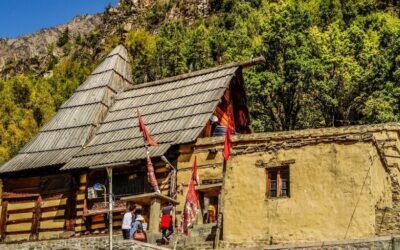
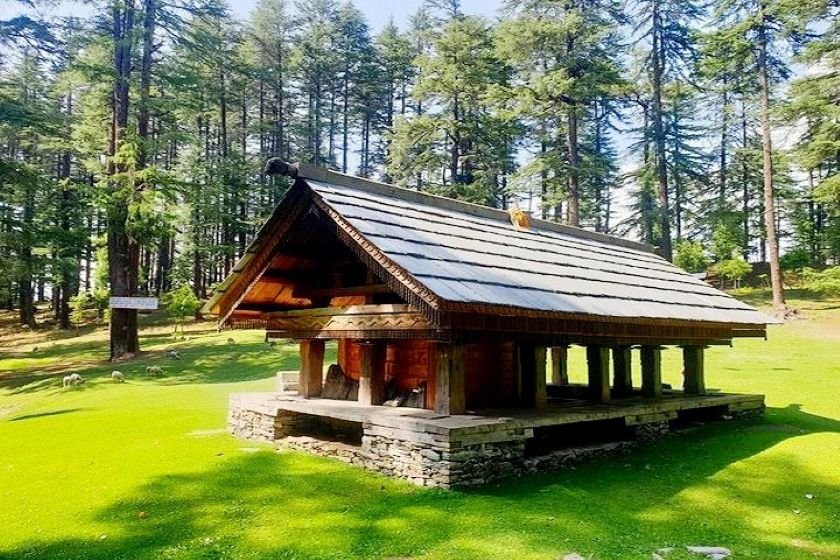
Whatever you make of that story, the finished result is a genuinely striking example of Kath-Kuni architecture — the traditional Western Himalayan building technique that interlocks timber and stone without nails, engineered to flex under snow load and seismic movement rather than crack. Visitors consistently describe the temple as remarkably well preserved, its wooden structure, slate roof, and stone foundation still carrying an unmistakable sense of age and authenticity rather than showing signs of heavy-handed modern restoration.
According to local records, Balu Nag’s worship isn’t confined to this single shrine — branch temples associated with the same deity exist in several nearby villages, including Gohar, Khuhan, and Khaneti in neighbouring Mandi district, and in the villages of Bahu and Shaush closer to Banjar itself — suggesting a following considerably wider than the modest, remote setting of the main temple might first suggest.
🌲 The Meadow Itself
What strikes most visitors as much as the temple’s stories is simply where it sits: a lush green meadow, ringed by dense deodar and pine forest, with snow-dusted peaks visible above the treeline depending on the season. A handful of local vendors set up near the temple selling tea, coffee, and regional specialities like siddu (a steamed, stuffed local bread) — a small but welcome comfort after the walk up. Several visitors describe the setting as among the most peaceful they’ve encountered anywhere in Himachal Pradesh, helped considerably by how few people make the effort to reach it compared to the valley’s more accessible temples.
🎉 Festivals and Living Devotion
- Nag Panchami: The temple’s most significant occasion, marked by a substantial local fair and, notably, a traditional bull-fighting contest — a distinctive regional custom rarely seen by outside visitors.
- Balu Nag Mela (spring/summer): A wider community fair involving devta processions, folk music, and shared feasting.
- Sankranti and Navratri: Marked with special pujas and offerings.
- Daily worship: Simple and consistent — ghee lamps, milk and flower offerings, and local hymns, maintained by devotees from Bahu and neighbouring villages.
Perhaps the most quietly moving expression of devotion to Balu Nag isn’t a festival at all: at a small government school in nearby Pujali village, students begin each morning with a self-written hymn to Balu Nag Ji rather than a standard assembly prayer — a small but genuine sign of how deeply this deity remains woven into daily life here, well beyond the temple’s own walls.
🏞️ While You’re in the Area
- Jibhi Waterfall: A scenic waterfall roughly 16–17 km away, one of the area’s most visited natural spots.
- Chehni Kothi: A historic multi-storey tower temple dedicated to Shringa Rishi, notable for its distinctive Kath-Kuni architecture.
- Shringa Rishi Temple, Baggi: Dedicated to one of the eighteen principal deities of the Kullu Valley.
- Great Himalayan National Park: A UNESCO World Heritage Site within reach of the wider Banjar-Jibhi area.
🙏 Getting in Touch
There’s no formal contact number or booking arrangement for this remote temple — it’s cared for by local priests and the surrounding village community rather than run as a managed tourist site. If you’re planning a visit, asking locally in Banjar or Jibhi about current trail conditions is more useful than seeking any official contact point, particularly if you’re travelling outside the more forgiving summer months.
❓ Quick Questions Travellers Ask
How difficult is the walk to the temple? Moderate. Expect roughly 1 to 1.5 hours on foot from the nearest parking area, mostly through forest, with a rougher, ascending final stretch. It’s manageable for reasonably fit visitors but not something to attempt in poor footwear or bad weather.
Is there anywhere to eat near the temple? Yes — local vendors near the temple typically sell tea, coffee, and regional snacks like siddu and momos, though options are basic and seasonal rather than guaranteed.
Can I visit in winter? Not recommended. Snow makes the meadow and forest path difficult and potentially unsafe to navigate outside of the main travel season.
Is this the same as other “Balu Nag” temples mentioned online? Largely yes, though be aware that branch shrines to the same deity exist in several nearby villages across Kullu and Mandi districts. This article covers the main temple at Bahu, near Chethar, which is the one most commonly referenced by visitors and travel accounts.
Is it worth the trek? Overwhelmingly, visitor accounts say yes — repeatedly citing the meadow’s tranquility, the well-preserved traditional architecture, and the relative absence of crowds as the reward for the walk.
A Last Word
There’s a particular kind of magic to a temple whose founding story doesn’t involve a king’s decree or a dynasty’s ambition, but a wandering hermit accepting a stranger’s hospitality, and a family who simply agreed to keep him. Whatever actually happened on that mountainside generations ago, the meadow at Bahu still carries the feeling that something was, in fact, welcomed here — and stayed because it wanted to, not because anyone built something grand enough to demand it.
Fact-check notes: The earlier draft of this article, published on the site, included the “three pindis — Maha Kali, Maha Lakshmi, Maha Saraswati” paragraph found in several other temple articles on the site — this is a fourth confirmed instance of the same error, and is especially inapplicable here, since Balu Nag is a male serpent deity, not a goddess. It has been removed. This rewrite draws on multiple independent sources, including local oral legend translated from Hindi-language regional folklore sites, visitor accounts, and Google Places live data, to build a fuller and more accurate picture. Verified GPS coordinates were pulled from live location data. No phone number or formal contact exists for this remote temple, and none has been invented.