Before Naggar, before Sultanpur, before Manali had a name people outside this valley would recognise — there was Jagatsukh
A quick note before anything else, because the internet gets this one tangled more often than not: there are two temples called Gauri Shankar in the Kullu Valley, roughly 20 kilometres apart, and a surprising number of travel articles mix up their details — sometimes within the same paragraph. This one sits in Jagatsukh, barely 6 km from Manali, not the better-known Gauri Shankar shrine near Naggar Castle further down the valley. If you’re planning a visit based on something you read online, it’s worth double-checking which one a source is actually describing.
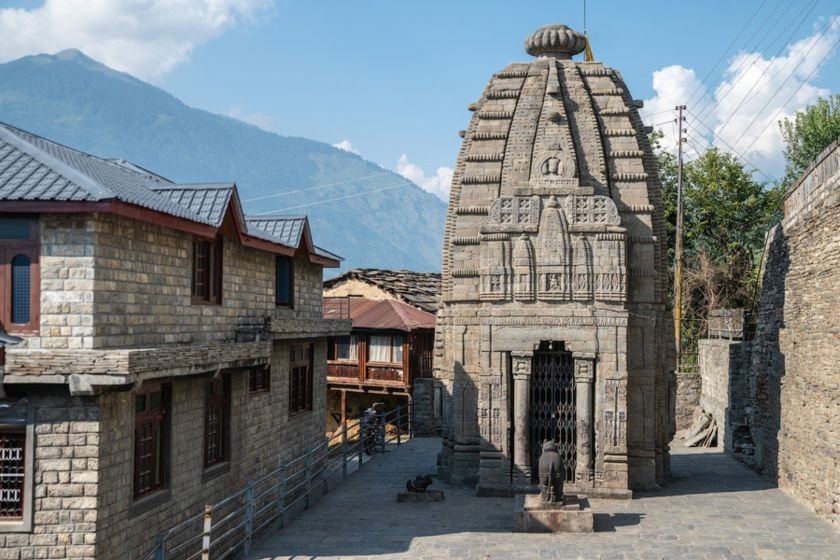
Jagatsukh itself deserves more attention than it usually gets. Long before Naggar became Kullu’s capital, and centuries before Sultanpur took over that role near modern Kullu town, this quiet village — known in antiquity as Nast — was where the kings of Kullu actually ruled from. Tradition holds it stayed the seat of power for more than ten generations of rulers. What’s left of that history today is scattered across a handful of old temples tucked into the village, and the finest of them is this one: a small, stone shrine dedicated to Shiva and Parvati together, standing on ground that’s been sacred for well over a thousand years.
🌄 Location & How to Reach It
- Location: Jagatsukh village, on the Manali–Naggar road, Kullu District, Himachal Pradesh – 175143
- GPS Coordinates: 32.1983° N, 77.2027° E
- Google Maps: Get Directions
- Altitude: Roughly 1,900 metres
- Distance: About 6 km from Manali town, roughly 15 km from Naggar along the same road
Jagatsukh sits directly on the Manali–Naggar road, which makes this one of the easier temples on this list to reach — no long trek, no complicated route-finding. Regular local buses run between Manali and Naggar and stop at Jagatsukh along the way, and taxis from Manali will get you there in well under 20 minutes. Once in the village, the temple complex is a short walk from the main road, within the same cluster of old shrines that also includes the Gayatri and Sandhya Devi temples.
Getting to Manali first: The nearest airport is Bhuntar (Kullu-Manali Airport), about 50 km south. Regular Volvo and HRTC buses connect Manali to Delhi, Chandigarh, and Shimla, and most travellers visiting Jagatsukh do so as a short detour on the way to or from Naggar rather than as a dedicated trip.
🌸 Best Time to Visit
Since this temple sits right on the main road rather than requiring a climb, it’s genuinely accessible year-round, weather permitting. March to June brings the mildest conditions and the surrounding apple orchards in bloom. September to November offers the clearest views of the peaks around Deo Tibba, visible from parts of the village. Even winter is manageable here, since the road stays open longer than the higher trekking routes elsewhere in the valley — though snow does settle over the temple courtyard in January and February, which several visitors describe as genuinely beautiful against the old stone carving.
Temple timings: No formal, universally posted hours are listed for this specific shrine — it functions as a village temple rather than a ticketed attraction, and is generally accessible during daylight hours. Early morning or late afternoon tends to be quietest.
🕉️ Inside the Sanctum
Unlike most Shiva temples, where you’ll find a lingam standing alone, the sanctum here holds Shiva and Parvati together, represented in a single sacred stone — a shila — rather than as two separate icons. It’s a detail that matters: this joint representation is part of why the temple carries the name Gauri Shankar (Gauri being Parvati, Shankar being Shiva), emphasising their union rather than presenting them as separate deities sharing space.
The shrine itself is compact — a small, square sanctum fronted by a portico with fluted pillars, the whole structure raised on a plinth. Step around the outside and you’ll find niches carved into the walls holding figures of Surya, Vishnu, and Brahma, an arrangement that places this modest village temple within a much larger tradition of Hindu cosmology, honouring the wider pantheon even while centred on Shiva and Parvati specifically. Two stone lions sit at the entrance, and scattered in the courtyard around the temple are broken lingam fragments and other carved relics — remnants, most historians believe, of an even older structure that once stood on this same spot.
That detail about the courtyard relics turns out to matter more than it first appears.
📜 A Temple Built On Top of an Older Temple
Here’s where the honest history gets genuinely interesting, and where sources tend to disagree in ways worth knowing about before you visit. Most accounts trace this temple’s origins to the 8th century CE, during the period when the Gurjara-Pratihara dynasty’s architectural influence extended from central India up into the Himalaya, leaving similar temples scattered across Kullu, including the Vishveshwar Mahadev temple at Bajaura and the Gayatri temple standing just a few yards from this one. Scholars researching the region’s Pratihara-era architecture have specifically named the Jagatsukh Shiva temple as one of the clearest surviving examples of that influence reaching this far north.
But the structure standing today isn’t simply an unbroken 8th-century original. Archaeological and epigraphic research — including an inscription documented on stone slabs by the historian Hiranand Sastri in the early 20th century — points to a later reconstruction, with different scholars dating that rebuild anywhere from the late 13th century to as late as 1428 CE, under a ruler named Maharaja Udharan Pal. What almost every serious source agrees on is this: the temple you see today is what historians sometimes call a “vernacular” rebuild, constructed in the local wood-and-stone style of its own era, standing on the foundation — and likely incorporating some material — from a genuinely older “classical” temple whose scattered fragments still lie in the courtyard. So when you see those broken lingams and loose stone carvings lying around the temple grounds, you’re not looking at debris. You’re looking at the remains of the building’s own earlier self.
There’s also a curious, well-documented layer of religious overlap here worth mentioning: some accounts of the temple site note two carved circles associated with Buddhist iconography near its base — a small but telling sign of how thoroughly Buddhist and Hindu traditions once intermingled across this part of the Himalaya, long before the region’s religious identity settled into the form it holds today.
🏛️ Jagatsukh’s Wider Legacy
To really appreciate this temple, it helps to see it as one piece of a larger, half-forgotten story. Jagatsukh isn’t just an old village with an old temple — it’s remembered in regional chronicles as the founding seat of the entire Kullu dynasty. Local tradition tells of a fugitive prince named Bihangamani Pal, said to have fled here from Mayapuri near Badrinath and taken shelter with a local potter; the villagers, dissatisfied with their existing ruler, are said to have made him their raja instead, founding the line that would eventually rule the whole valley. A rock partway between Manali and Jagatsukh is still pointed out locally as the spot where this founding prince used to sleep.
Jagatsukh held onto its status as capital for generations before power shifted to Naggar, and only much later to Sultanpur, near what’s now Kullu town. That long royal history is why this unassuming village, easily overlooked by travellers speeding along the Manali–Naggar road toward more famous stops, actually holds one of the richest concentrations of old temples anywhere in the valley — alongside the Gauri Shankar shrine, you’ll find the Gayatri temple close by, and further into the village, the Sandhya Devi temple, whose own inscription (dated 1428 CE by most scholarly accounts) is considered by historians to be the earliest precisely dated temple record anywhere in the Kullu Valley.
🎉 Festivals and Village Life
- Chacholi Jatra: Jagatsukh’s most significant local festival, held on the full moon day of Chaitra (roughly February–March), celebrated simultaneously across five neighbouring villages — Jagatsukh, Banahra, Khakhnal, Gojra, and Bahnu.
- Shivratri: As with most Shiva temples, this remains an important day of worship here, drawing devotees from the surrounding villages.
- Daily worship: Maintained by local priests and villagers; several visitors specifically mention warm, informal conversations with the temple’s caretakers as a highlight of visiting.
🏞️ While You’re in the Area
- Gayatri Temple: Just a few yards from the Gauri Shankar shrine, within the same temple cluster.
- Sandhya Devi Temple: Home to the valley’s earliest precisely dated temple inscription, a short walk further into the village.
- Takshak Nag Temple: A roughly two-hour uphill walk from Jagatsukh, set deep in cedar forest — a considerably more demanding but rewarding detour for those with time.
- Deo Tibba viewpoints: Trekking routes from the Jagatsukh area lead toward views of Deo Tibba, the highest peak in Kullu district.
- Naggar: 15 km further along the same road, home to Murlidhar Temple, Tripura Sundari, Jagatipatt, and the other Gauri Shankar Temple — easily combined into a single day’s route if you’re travelling between Manali and Naggar anyway.
🙏 Getting in Touch
There’s no formal contact number or booking system for this temple — it’s a working village shrine, cared for by local priests rather than run as a tourism operation. If you need current information on access or festival dates, asking locally in Jagatsukh itself, or checking with the Himachal Pradesh Tourism office in Manali, is the most reliable option.
❓ Quick Questions Travellers Ask
Is this the same as the famous Gauri Shankar Temple near Naggar Castle? No — and this is worth being clear about, since online sources frequently confuse the two. This temple is in Jagatsukh, about 6 km from Manali. The other, more commonly written-about Gauri Shankar Temple sits near Naggar Castle, roughly 20 km from Manali. They’re separate structures with separate histories, though both are dedicated to Shiva and Parvati.
How old is the temple, really? It depends what you’re asking about. The site’s religious and architectural origins trace to around the 8th century CE, but the physical structure standing today is a later reconstruction — most scholarly estimates place that rebuild somewhere between the late 13th and early 15th centuries. Older, original relics from the earlier temple remain visible in the courtyard.
Is there an entry fee? No — this is a functioning village temple, not a ticketed monument, and there’s no charge to visit.
How much time should I set aside? Because it’s directly on the road with no trek involved, most visitors comfortably see the temple, the neighbouring Gayatri temple, and the village itself within 30–45 minutes, making it easy to fit into a longer Manali-to-Naggar day trip.
Is it easy to combine with other Jagatsukh sights? Very easily — the Gayatri and Sandhya Devi temples are both within short walking distance, and together with the Gauri Shankar shrine, they form a compact, easily walkable heritage cluster right in the village.
A Last Word
There’s a particular kind of history that doesn’t survive in grand monuments but in small, half-forgotten places that quietly outlast the empires built around them. Jagatsukh is exactly that kind of place — a village whose name barely registers on most Manali itineraries, sitting on ground that was once the beating political heart of the entire Kullu Valley. Stand in front of that small stone sanctum, with broken fragments of an even older shrine scattered in the grass around it, and you’re looking at something rarer than most temples in this valley can offer: not one age of history, but two, stacked one on top of the other, both still quietly holding their ground.
Fact-check notes: This article draws on independent art-historical and archaeological sources (Hill Post’s documented field visits, ResearchGate scholarship on Gurjara-Pratihara temples in Himachal Pradesh, and Optima Travels’ epigraphic account), cross-checked for consistency, rather than relying on a single blog source that explicitly restricts reuse of its content. A significant point of confusion across many online sources was flagged and corrected: this Jagatsukh temple is frequently mixed up with the separate, better-known Gauri Shankar Temple near Naggar Castle (roughly 20 km away) — several existing articles online blend details of both temples together inaccurately, and this piece keeps them clearly distinct. Sources also genuinely disagree on the exact rebuild date of the current structure (ranging from the late 13th century to 1428 CE) — this is presented honestly as a scholarly range rather than a single settled figure. Verified GPS coordinates were pulled from live location data; no official posted opening hours or public contact number exist for this village shrine, and none has been invented.