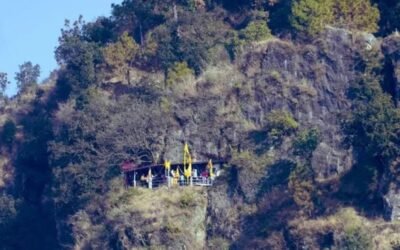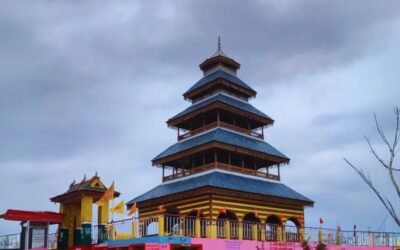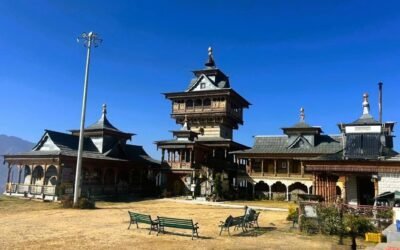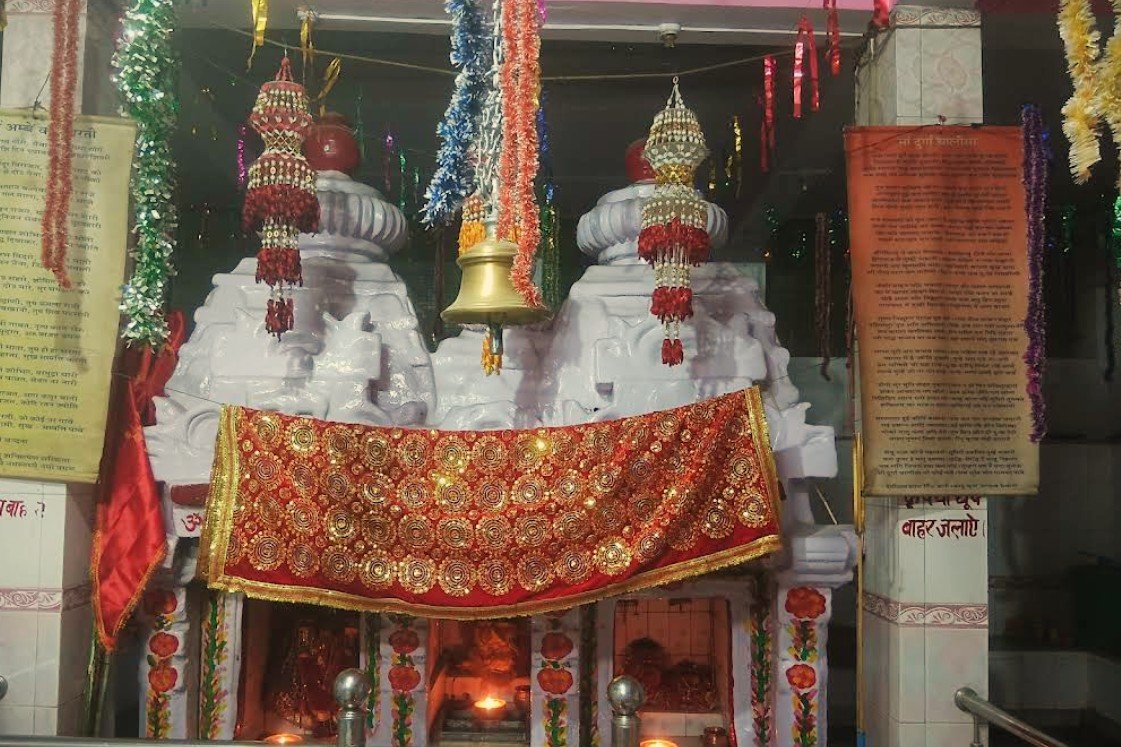
A hill king built this temple for his fiercest goddess sometime around 1650 — and whatever story he had in mind for doing so simply wasn’t written down, or hasn’t survived if it was.
Most of the temples in this series come with an origin story attached, even a contested or thinly-sourced one — a vision, a battle, a promise. Jakholi Devi has almost none of that. What survives clearly is the bare institutional fact: a ruler of the hill state of Baghal built a temple to Bhadra Kali here, in the mid-17th century, around the same years his dynasty was establishing Arki as its capital. Why he chose this specific goddess, this specific spot, or what moved him to build it — none of that appears to have made it into any record accessible today. It’s a useful reminder that not every sacred site gets to keep its founding myth; some simply get kept, generation after generation, without anyone writing down the reason why.
🌄 Location & How to Reach It
Jakholi Devi Temple — also referred to as the Bhadrakali Temple, Arki — sits roughly 7 km from Arki town, in Solan district, Himachal Pradesh.
Google Maps: Get Directions
- By road: Arki itself sits roughly 38–52 km from Shimla (sources vary on the exact figure) and about 40 km from Solan, at an elevation of around 1,050 metres. Regular buses and taxis connect Arki to both Shimla and Chandigarh, with the temple itself a short further drive or taxi ride away.
- By rail: The nearest broad-gauge railway station is Shimla, roughly 19 km from Arki; Kalka, on the narrow-gauge Kalka–Shimla line, is a further option at around 45 km.
- By air: Jubbarhatti (Shimla) Airport is nearest, about 40 km away, with Chandigarh Airport a secondary option at roughly 99–100 km.
Once in Arki, the temple is a manageable short trip rather than a trek — easily combined with a visit to Arki Fort and the town’s other historic sites in a single day.
🌸 Best Time to Visit
Arki’s mid-hill elevation keeps it pleasantly warm through summer and comfortably cool rather than harshly cold in winter, making it visitable across most of the year; March–June and September–November offer the clearest weather for combining the temple visit with exploring the wider town. As with most Devi temples in the region, Navratri is likely to be the busiest and most devotionally significant period, though specific festival details unique to Jakholi Devi itself aren’t well documented beyond this general expectation.
🕉️ A Silence Where a Legend Should Be
What can be said with reasonable confidence is this: the temple was built by a ruler of the princely hill state of Baghal for the goddess Bhadra Kali, sometime around 1650 — the same period in which Arki itself was being established as Baghal’s capital by Rana Sabha Chand, a descendant of the Panwar Rajput Rana Ajai Dev who had founded the state centuries earlier. That timing is worth noting on its own: this wasn’t simply a temple appearing out of ancient, undated legend, but a specific act of royal patronage coinciding with a specific dynasty consolidating its new seat of power — the kind of pairing (a new capital, a new or newly-honored state goddess) that recurs across Rajput hill-state history in this region.
Beyond that bare fact, though, the trail goes quiet. No surviving legend explains why this particular location was chosen, what vision or victory (if any) prompted the goddess’s installation here, or what relationship the ruling family held with her afterward. Bhadra Kali herself, in the broader Hindu tradition, is a fierce protective form of the supreme goddess — associated in various regional retellings with the destruction of demons like Daksha’s tormentors or the buffalo-demon lineage of Mahishasura — but nothing ties any of those pan-Indian legends specifically to this Arki shrine. What’s honest to say is that this temple’s meaning, for the people who built and maintained it, was likely rooted in the everyday business of dynastic protection and state religion rather than a single dramatic myth — the kind of quiet, functional sacredness that doesn’t always survive as a story, even when the building itself does.
🙏 What the Temple Is Known For
As a Bhadra Kali shrine, Jakholi Devi draws devotion consistent with the goddess’s fierce, protective character across Hindu tradition — worshippers seeking safety, strength, and protection from harm rather than gentler, more domestic blessings. Some regional listings describe it as one of Himachal Pradesh’s Shaktipeeths, though it’s worth being clear that this isn’t one of the classical group of 51 (or 52) Shakti Peethas recognized in wider pan-Indian tradition — it’s a separate, locally significant Shakti shrine, and the “Shaktipeeth” label here likely reflects regional reverence rather than inclusion in that specific, older mythological framework.
🏛️ The Temple Itself
The temple is generally described as built in the Shikhara style common to Hindu temple architecture across northern India — a tapering tower-like superstructure over the sanctum — though detailed, independently verifiable descriptions of its specific carvings, materials, or layout are hard to come by beyond this general architectural classification. What can be said is that it sits within a broader cluster of historic religious sites around Arki, including the cave-temple Lutru Mahadev Temple, itself associated with a royal dream-vision and 17th-century construction, and other shrines reflecting Baghal’s layered devotional landscape.
📜 Regional Context — Arki’s Layered Religious Geography
Arki, as the former capital of the princely hill state of Baghal — founded by the Panwar Rajput Rana Ajai Dev and later consolidated under Rana Sabha Chand around the mid-17th century — carries a concentration of temples and monuments tied directly to its ruling dynasty’s patronage, including the Lutru Mahadev cave temple and the town’s well-known fort and palace complex. Jakholi Devi fits within this pattern as a state-associated shrine from the same formative decades of Baghal’s rule, even without a specific surviving story explaining its founding — a useful contrast to sites like Katasan Devi or Bhureshwar Mahadev elsewhere in this series, where the founding legend, however contested, at least survives in some form.
🎉 Festivals and Devotion
- Navratri: Likely the temple’s most significant devotional period, in keeping with general Devi worship patterns across the region, though specific local celebration details for Jakholi Devi aren’t well documented.
- Ongoing local devotion: The temple appears to function primarily as a working local and regional shrine rather than a major pilgrimage destination drawing crowds from beyond Solan district.
🏞️ While You’re in the Area
- Arki Fort – The former seat of the Baghal rulers, now partly a heritage hotel, with 19th-century frescoes in the Pahari school of miniature painting.
- Lutru Mahadev Temple – A cave shrine to Shiva near Arki, associated with a royal dream-vision and roughly contemporary construction to Jakholi Devi.
- Diwan-i-Khas, Arki Palace – A striking blend of Rajput and Mughal architectural styles within the fort complex.
- Durga Temple, Arki – Another of the town’s Shikhara-style Devi shrines, worth combining with a Jakholi Devi visit.
- Shoolini Mata Temple, Solan – A well-known Shakti shrine in the district town, if extending the trip further.
❓ Quick Questions Travellers Ask
Is there an entry fee at Jakholi Devi Temple? No, entry is free, as with most local Devi shrines in the region.
Is Jakholi Devi one of the famous Shakti Peethas of India? Not in the classical, widely-recognized sense — while some regional sources describe it loosely as a Shaktipeeth, it isn’t part of the traditional group of 51/52 Shakti Peethas linked to the Sati legend found elsewhere in Hindu tradition.
How far is the temple from Arki town itself? Roughly 7 km, making it an easy short trip rather than a dedicated excursion.
Can this be combined with visiting Arki Fort? Yes — most visitors treat Jakholi Devi, Arki Fort, and the Lutru Mahadev cave temple as a single day’s circuit around the town.
Is there a specific legend behind the temple’s founding? No well-documented one — what’s known is simply that it was built by a Baghal ruler around 1650, without a surviving account of the specific circumstances.
A Last Word
There’s a particular kind of honesty in a temple that survives without a story to justify itself — no vision, no battle, no dramatic act of gratitude, just a dynasty’s decision, made nearly four centuries ago, to build somewhere for their fiercest goddess and keep tending it ever since. Not every sacred place needs a legend to be worth visiting. Sometimes the plain fact of continuity — a shrine still standing, still visited, its original reasoning simply lost to time — is the more honest story to sit with.
Fact-check note: The temple’s construction by a ruler of the Baghal princely state around 1650, coinciding with Arki’s establishment as the state’s capital under Rana Sabha Chand, is corroborated by Wikipedia’s entry on Arki. Beyond this bare institutional fact, no specific founding legend, vision, or motivating event for the temple could be found in available sources — this thinness of legend is itself noted honestly above rather than invented. The temple’s description as a “Shaktipeeth” appears in at least one regional tourism source but is not consistent with the classical 51/52 Shakti Peetha tradition, and this distinction is flagged above. Distances to Arki vary meaningfully across sources (38–52 km from Shimla depending on source), so a range is given. No verified GPS coordinates, temple timings, or architectural details beyond its general Shikhara style could be confirmed, so none are stated as fixed fact.