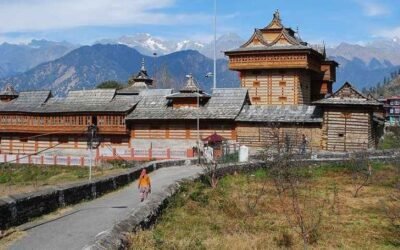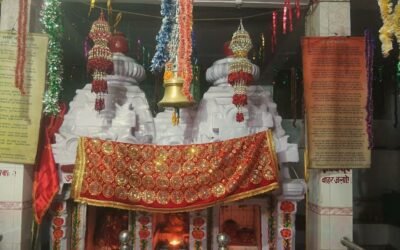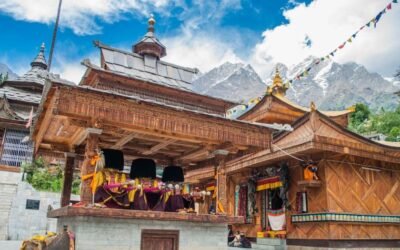
At a quiet river confluence in Himachal Pradesh sits a stone said to have done what entire armies could not: turn back Alexander the Great.
There’s a familiar shape to certain temple legends — the unstoppable outsider, marching in with overwhelming force, who arrives at one particular spot and simply stops. Not defeated in battle, but undone by something harder to name: awe, devotion, a feeling too large to push past. Kathgarh Mahadev Temple, tucked at a river confluence in Kangra district, is built around exactly that kind of story. Local tradition holds that this is where Alexander’s eastward campaign finally lost its momentum — not because of an army, but because of a single, naturally split stone linga and the unshakeable faith of the man kneeling before it. Whether that’s literal history or something closer to legend doing what legend does best, the temple’s stranger, more verifiable feature is arguably even harder to explain: a Shivling that is said to physically shift with the seasons, its two halves drawing closer each year until, on one particular night, they touch.
🌄 Location & How to Reach It
Kathgarh Mahadev Temple sits in Kathgarh village, Indora tehsil, in Himachal Pradesh’s Kangra district, close to the point where the Beas River meets a smaller tributary — referred to as the Choch (or Chonch) in most local accounts, though at least one source names a different pairing of rivers, so the exact tributary name isn’t fully settled across sources. The temple is roughly 7–8 km from Indora town and around 15 km from Damtal.
Google Maps: Get Directions
The site sits in flat river-plain terrain rather than up in the hills, which makes it one of the more physically accessible temples in this part of Himachal.
- By road: Reports of the distance from Pathankot vary quite a bit between sources — anywhere from roughly 12 km to 25 km — so it’s worth confirming your specific route rather than relying on a single figure; the town is well connected by regular bus services from Punjab, Himachal Pradesh, and neighbouring states.
- By rail: Pathankot is the nearest major railway junction, with strong connections across North India.
- By air: Gaggal Airport near Kangra is the nearest, though at roughly 95 km away, it’s a longer transfer than for temples closer to Dharamshala.
Compared to hill-climb temples like those inside forts or on ridgelines, Kathgarh is a straightforward, low-effort visit — the challenge here isn’t the terrain, it’s simply getting confirmation on which road actually gets you there fastest, since distances quoted online don’t fully agree.
🌸 Best Time to Visit
Reported temple timings vary — some sources cite roughly 6 a.m. to 9 p.m., while another describes the temple as open all day except for a short closure around 11 a.m. for ritual bathing (ishnaan) of the deity — so it’s sensible to treat these as approximate and check locally, or via the temple’s own contact details, before planning around a specific hour. October through March brings the most comfortable weather for a visit to this lower-altitude site.
The temple’s single biggest occasion by far is Mahashivratri, when a three-to-four-day fair — organised by the Kathgarh Mandir Nyas — draws devotees from Himachal Pradesh, Punjab, Haryana, and Jammu & Kashmir. Mondays during the monsoon month of Sawan are also considered especially auspicious here, along with Ram Navami and Janmashtami.
🕉️ The Legend: A War in Heaven, A Conqueror Undone
Kathgarh’s core legend, drawn from the Shiv Purana, doesn’t start with the temple at all — it starts with a quarrel between two gods. According to the story, Brahma and Vishnu once fell into a dispute over which of them held supremacy, a dispute that escalated toward using divine weapons capable of unravelling creation itself. To stop the destruction, Shiva is said to have manifested as a towering pillar of fire between them. Vishnu, taking the form of a boar, dug downward trying to find its base; Brahma flew upward as a swan searching for its peak. Neither could find an end to it — though Brahma, the story goes, returned claiming he’d found the top, a claim that didn’t hold up. This fire-pillar, in the version of the story told at Kathgarh, is identified with the linga now enshrined at this specific temple, self-manifested (swayambhu) rather than carved by human hands.
A second, more historically framed legend attaches itself to the same stone: that Bharat, Lord Rama’s brother, is said to have paused here to pay respects to Shiva on a journey to visit his grandparents in Kashmir, tying the site loosely into the Ramayana’s geography.
The story most associated with Kathgarh in popular memory today, however, involves Alexander the Great. According to local tradition, when Alexander’s campaign reached the area near the Beas, he encountered a fakir deep in worship at this very linga. Impressed by the man’s refusal of wealth and his singular devotion, and reportedly struck by an overwhelming feeling in the linga’s presence, Alexander is said to have called off his advance — a claim some retellings connect to accounts of Alexander’s soldiers refusing to march further east, a documented historical event, though the specific link to this exact site and stone is a matter of local tradition rather than something that shows up in Greek historical sources. He is credited with leveling the ground, building a boundary wall, and constructing octagonal stone platforms toward the river that are still pointed out to visitors today. This is worth holding with real curiosity rather than certainty — Alexander’s historically documented mutiny happened near the Beas/Hyphasis river generally, and the specific attribution to Kathgarh’s platforms and boundary wall appears mainly in regional and temple-tourism sources, not in classical historical accounts of the campaign.
What can be said with more confidence is the temple’s more recent, better-documented history: Maharaja Ranjit Singh, ruler of the Sikh Empire, is credited with constructing the current temple structure to shelter and protect the self-manifested linga, a project multiple independent sources agree on even where they disagree on the building’s architectural style.
🙏 What the Shivling Is Known For
The linga at Kathgarh is worshipped in its Ardhanarishwar form — Shiva and Parvati as a single, inseparable divine whole, split here into two distinct stone sections rather than fused into one androgynous figure as in classical Ardhanarishwar sculpture elsewhere. The larger section, standing some 7–8 feet, represents Shiva; the smaller, at 5–6 feet, represents Parvati. What draws devotees specifically to this shrine, more than to Shiva temples generally, is the belief that the gap between the two halves shifts with the seasons and the phases of the moon — widening in summer, narrowing in winter — and that the two are believed to draw fully together on Mahashivratri, marking the symbolic reunion of Shiva and Shakti.
Because of that framing, pilgrims come here specifically seeking marital harmony, resolution of family discord, and a sense of balance between opposing forces in their own lives — a devotional focus that’s noticeably more specific than the general protection or prosperity sought at many other Shiva shrines. Ritual offerings follow familiar Shaivite patterns: milk, bilva (bel) leaves, red cloth, and ghee lamps. Worship here has also been maintained across generations by the same priestly family, with the current mahant continuing a hereditary line of caretakers.
🏛️ The Temple Itself
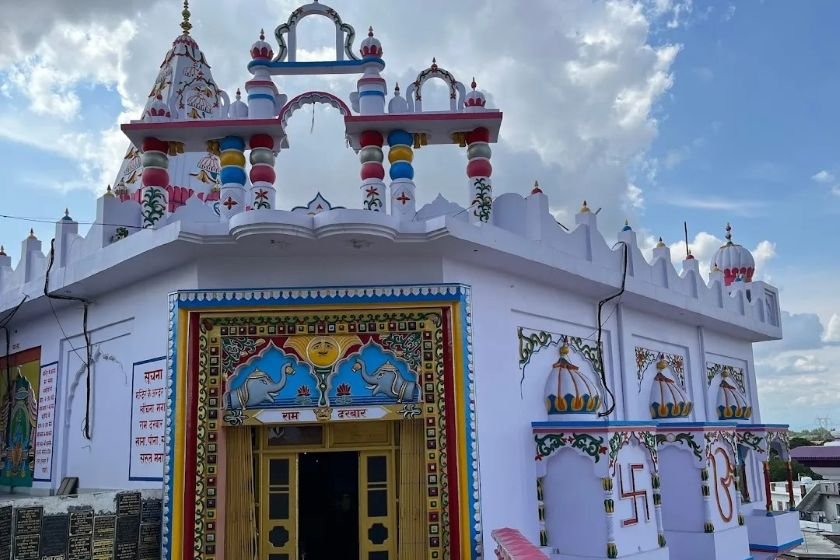
Physical descriptions of Kathgarh’s architecture don’t fully agree with each other — one account describes the temple as built in a Roman architectural style, another calls it Mughal-style construction — and rather than force those into a single confident claim, it’s worth simply noting that the style is disputed across sources, likely reflecting different observers’ impressions of a structure that has clearly been rebuilt or renovated more than once since its original construction.
What’s consistent is the core object of worship: an octagonal-based stone linga, its surface a dark, blackish-brown to grey sandy stone, split vertically into its two named sections and standing on a plain that meets the river close by. Visitors describe the platforms toward the Beas, said to date to the temple’s earliest recorded history, as still intact — flat, worn stone surfaces that connect the shrine physically to the water it sits beside. Inside, expect a working ritual space rather than an elaborately carved showpiece: incense, the residue of milk and ghee offerings on old stone, and — especially in the days around Shivratri — a steady stream of pilgrims queuing for darshan of the two joined stones.
📜 Kangra, the Beas, and a Layered Regional History
Kathgarh sits within Kangra district, a region whose temple history stretches back well over a thousand years and includes far grander, more architecturally elaborate sites — the rock-cut Masroor Temples, the fortified shrines of Kangra Fort, and the Shakti Peeth at Brajeshwari Devi among them. Kathgarh’s significance is different in character: it’s tied less to dynastic patronage in its earliest period and more to a layered stack of legend — Puranic, epic, and semi-historical — all converging on one riverside stone. Maharaja Ranjit Singh’s involvement links the site to the wider Sikh Empire’s 19th-century expansion into the Kangra hills, a period when Ranjit Singh’s rule reshaped religious patronage across much of Punjab and the surrounding hill states.
🎉 Festivals and Devotion
- Mahashivratri: The temple’s major annual event, marked by a three-to-four-day fair organised by the Kathgarh Mandir Nyas, drawing pilgrims from across North India.
- Sawan Mondays: Considered especially auspicious for worship at the temple through the monsoon month.
- Ram Navami and Janmashtami: Also observed with dedicated rituals.
- Daily worship: Regular Shaivite rituals conducted by the resident priestly family.
🏞️ While You’re in the Area
- Pathankot: A well-connected town nearby with rail links across North India, useful as a base or a stop on the way in.
- Masroor Rock Cut Temples: Roughly a couple of hours away, an 8th-century complex carved from a single rock outcrop.
- Kangra Fort and Ambika Devi Temple: Further into Kangra district, combinable with Kathgarh on a longer regional temple circuit.
- Baijnath Temple: A 13th-century Shiva shrine elsewhere in the Beas valley, worth combining if you’re touring Kangra’s Shaivite sites.
- Beas riverside: The confluence area itself, worth a slow walk for anyone interested in the octagonal platforms and the river setting that shapes so much of the temple’s legend.
❓ Quick Questions Travellers Ask
Is photography allowed inside the temple? Accounts differ — at least one source states photography isn’t permitted, so it’s best to check with temple staff on arrival rather than assume.
Can I contact the temple in advance for timings or festival dates? Yes — a temple contact number and website have been publicly listed (kathgarhmandir.com), which is useful given how much the reported timings vary source to source.
Do I need to visit specifically on Mahashivratri to see anything unusual? Mahashivratri is when the fair and the largest crowds happen, and when the symbolic “union” of the two linga halves is most spoken about, but the temple and its unusual stone are there to see year-round.
Is there accommodation near the temple? The temple itself is a modest rural shrine rather than a tourist hub; Pathankot, with its wider range of hotels, is the more practical base for an overnight stay.
Is the story about Alexander the Great something historians accept? Not as documented history — Alexander’s campaign in this general region and his army’s eventual refusal to advance further are historically recorded, but the specific connection to this shrine and its stone platforms comes from local and regional tradition rather than classical Greek or Indian historical sources.
A Last Word
Whatever you make of Alexander kneeling before a fakir on the banks of the Beas, there’s something genuinely disarming about a temple whose central object is said to move — slowly, seasonally, according to a logic no one has fully explained — toward a single night of union each year. Kathgarh doesn’t need the conqueror’s story to be strictly true to hold your attention; the stone itself, split and rejoining, framed by a legend that reaches back through the Ramayana to a war between gods, does most of that work on its own. It’s a temple built less around architecture than around a question it never quite answers: what does it take to stop something that seems unstoppable? Standing at that river confluence, watching pilgrims queue for a stone said to be closing the distance between its own two halves, the question feels less like history and more like something the place is still quietly asking.
Fact-check note: The temple’s association with a naturally split, swayambhu Shivling worshipped as Ardhanarishwar, its restoration under Maharaja Ranjit Singh, its location at a river confluence in Kathgarh village, Indora tehsil, and its major Mahashivratri fair are well corroborated across multiple independent sources. Genuinely unsettled across sources and flagged above rather than resolved with false precision: the exact name of the tributary river at the confluence, precise distances from Pathankot, exact temple timings, the architectural style of the current structure (variously described as Roman or Mughal in style), and the specific historical accuracy of the Alexander legend as tied to this exact site. No independently verified GPS coordinates or entry fee could be confirmed; check with the temple directly using the publicly listed contact details.