Ask who built this hilltop shrine to Kali and you’ll get three different, centuries-apart answers — a 9th-century king, a Patiala Maharaja exiled from Shimla, and a 20th-century priest who quietly rebuilt the whole thing with his own hands. All three are probably right, in their own way.
Most temples in this series have one founding moment, however contested or thinly documented. Kali Ka Tibba has three, stacked on top of each other like geological layers — an ancient dream-vision, a royal act of devotion centuries later, and a much more recent, much better documented act of practical reconstruction. Rather than a problem to resolve, that layering is close to the honest truth of how most old hilltop shrines actually survive: not as a single untouched relic, but as a site people keep returning to rebuild, generation after generation, each one leaving behind a story that later gets told as though it were the beginning.
🌄 Location & How to Reach It
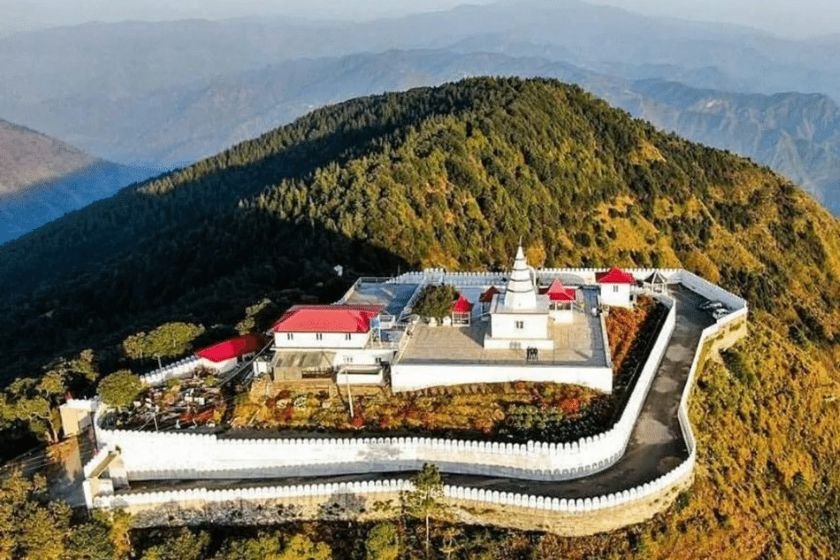
Kali Ka Tibba sits atop one of the highest points in the Chail area, Solan district, Himachal Pradesh, roughly 6 km from Chail town along the road toward Kandaghat, at an elevation reported anywhere from about 2,225 to 2,510 metres (7,300–7,500 feet) depending on the source — high enough, in any case, to sit above Shimla itself.
Google Maps: Get Directions
- By road: Chail is roughly 42–45 km from both Shimla and Solan, and about 120 km from Chandigarh Airport, all comfortably reached by taxi or bus. From Chail itself, a narrow hill road leads most of the way up toward Kali Ka Tibba, with a parking area near the top.
- On foot: From the last parking point, a short trek of around 1–1.5 km covers the final stretch to the temple — manageable for most visitors, with the white temple building visible from a distance as you approach.
- By rail: Kalka Railway Station, on the broad-gauge line, is the nearest major station, roughly 86 km away, with onward road travel required.
The final approach roads are narrow and can be steep in places, so it’s worth taking the drive slowly, particularly if you’re continuing on to Kandaghat afterward.
🌸 Best Time to Visit
Spring (March–June) and autumn (September–November) offer the clearest skies and most reliable mountain views across the Shivalik range and toward Choor Chandni peak. Navratri is the temple’s standout festival period, drawing large numbers of pilgrims for folk performances and rituals dedicated to the goddess. Interestingly, at least one longtime visitor recommends the monsoon months (August–November) for a different kind of experience entirely — mist drifting through the temple grounds and dense, atmospheric forest cover — though this is very much a minority, mood-over-convenience recommendation rather than the standard advice, and monsoon travel on these roads does carry the usual hill-country caution around slippery surfaces.
🕉️ Three Stories, Three Builders
The oldest story places the temple’s beginnings in the 9th century: a king of Himachal Pradesh, troubled by recurring dreams of a fierce and compassionate goddess, is said to have received a direct command from Kali to build a shrine at the peak of this particular hill. According to the story, he obeyed quietly, wary of the unrest it might cause in a kingdom he worried was already divided, and what he built was modest — a small structure sometimes remembered by the older name “Sidh Temple,” rather than anything grand. No written historical record confirms this date or the king’s identity, and it should be read as inherited local tradition rather than documented history — but the tradition itself has clearly proven durable, still repeated by nearly every source that discusses the temple today.
A second, considerably more recent and better-documented story credits the temple’s construction to Maharaja Bhupinder Singh of Patiala, in the early 1900s — the same ruler responsible for developing Chail itself as his private hill retreat after a well-known falling-out kept him away from Shimla’s own social circles. In this telling, the Maharaja built the temple as a personal act of devotion to Kali, folding it into the wider development of Chail as a royal retreat, complete with what would later become Asia’s highest cricket ground nearby.
And then there’s a third, quieter act of rebuilding, closer to living memory: because the temple sits within the boundaries of the protected Chail Wildlife Sanctuary, its development over the 20th century came with real practical complications. A priest associated with the older Sidh Temple, remembered by name as Shambhu Bharti, is credited with regularizing the site, building the boundary wall, cutting the access road that now brings most visitors up the hill, and constructing the small pond where devotees take a ritual dip — in effect, building most of the physical temple experience visitors actually encounter today.
Three builders, three centuries, three different reasons for building — and no serious effort in any source to reconcile them into one tidy narrative. That’s arguably the most honest thing about Kali Ka Tibba: it isn’t one story wearing the appearance of history. It’s several real acts of devotion and practical labor, genuinely layered on top of each other over a very long time.
🙏 What the Temple Is Known For
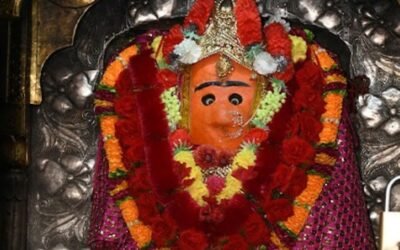
Kali Ka Tibba draws devotees seeking protection, prosperity, and general spiritual upliftment, consistent with Kali’s broader character as a fierce, powerful, protective form of the goddess. Its reputation as a wish-fulfilling shrine is one repeated frequently by visitors and locals alike — people describing arriving with heavy burdens and leaving lighter, and treating sincere prayer here as unusually likely to be answered. Alongside the main Kali shrine, at least one visitor account mentions a Panchmukhi (five-faced) Hanuman also enshrined at the site, though this detail doesn’t appear consistently enough across sources to state with full confidence. What’s more consistently emphasized, across nearly every account, is less a specific devotional practice than the atmosphere itself — visitors repeatedly describe the site’s silence, isolation, and panoramic stillness as being as central to the experience as the goddess worshipped there.
🏛️ The Temple Itself
The temple presents as a modern, white marble structure — bright enough that more than one visitor has recommended sunglasses for the reflected glare — with the main image of Kali reportedly carved from black marble and worshipped daily. The grounds, thanks to the more recent rebuilding effort, are notably well-kept for a remote hilltop site: clean washrooms, ample parking, small shops, drinking water, and the ritual pond mentioned above, all maintained by the local community and temple management together. Photography inside the temple itself is generally prohibited, and visitors are asked not to enter while wearing leather items or under the influence of alcohol — standard practice at many Devi shrines in the region, enforced here with particular care given the site’s rising popularity.
📜 Regional Context — A Hilltop Shrine Above a Maharaja’s Retreat
Chail’s own modern history is worth knowing alongside the temple’s, since the two are so closely intertwined: Maharaja Bhupinder Singh of Patiala developed the town as his personal summer retreat in the early 20th century after tensions with the British administration in Shimla made that city’s social scene difficult for him — a well-documented piece of colonial-era princely history that also produced Chail Palace and the famously high-altitude cricket ground nearby. Kali Ka Tibba’s position as the highest point in the immediate area gave it obvious appeal as a site of both religious and scenic significance for that development, layering a Maharaja’s early-20th-century ambitions directly on top of a much older hilltop devotional tradition.
🎉 Festivals and Devotion
- Navratri: The temple’s major annual event, marked by folk performances, special rituals, and heavy pilgrim traffic across both the spring and autumn observances.
- Daily worship: Regular darshan and prayer continue year-round, with the temple open to visitors throughout the day, though exact opening hours are reported inconsistently across sources (ranging from as early as 5 AM to as late as 9 PM, or a more modest 8 AM–6 PM window) — worth confirming locally before planning an early or late visit.
🏞️ While You’re in the Area
- Chail Palace – Maharaja Bhupinder Singh’s former summer residence, now a heritage hotel, and the anchor of Chail’s royal history.
- Asia’s Highest Cricket Ground – A short distance away, though situated within a military area requiring permission to access.
- Siddhababa Temple – Also within a restricted military zone near Chail, worth checking access requirements before planning a visit.
- Chail Wildlife Sanctuary – The forested protected area surrounding the temple itself, home to a range of Himalayan flora and fauna.
- Kandaghat – A nearby town on the road toward Solan, useful for onward travel connections.
❓ Quick Questions Travellers Ask
Is there an entry fee at Kali Ka Tibba? No, entry is free, and the temple is well-equipped with visitor facilities including washrooms, parking, and shops.
How far is the trek to the temple? From the last parking point, it’s roughly 1–1.5 km on foot; some sources suggest small vehicles can go closer still, though a short walk is the norm for most visitors.
Can I take photographs inside the temple? Photography is generally prohibited inside the temple itself, in keeping with practice at many Devi shrines in the region.
Which origin story is correct — the 9th-century king or the Maharaja of Patiala? Neither is independently confirmed as definitive; both are repeated widely in local tradition, and it’s entirely possible the site has genuinely been built, abandoned, and rebuilt more than once across the centuries, which would make both stories partially true.
What’s the best time of day to visit? Morning or evening, both for cooler temperatures and to catch sunrise or sunset views across the Shivalik range from the hilltop.
A Last Word
There’s a temptation, writing about any old temple, to smooth its history into a single clean story with one hero and one moment of founding. Kali Ka Tibba resists that, cheerfully, at every turn — a king who may have dreamed it into being, a Maharaja who may have built it in earnest, and a priest who quite certainly built the version of it still standing today. Maybe the truest thing you can say about a mountaintop shrine that’s survived this long is that it was never really finished being built at all.
Fact-check note: Maharaja Bhupinder Singh of Patiala’s development of Chail as a royal retreat and his association with the temple’s early-1900s construction, alongside the separate 9th-century dream-vision legend, are both widely repeated across multiple independent sources, though neither is backed by a definitive historical record, and sources do not attempt to reconcile the two. The priest Shambhu Bharti’s role in rebuilding and regularizing the modern site (wall, road, pond) is documented in at least one detailed source and presented here with that context. The temple’s altitude is reported inconsistently (roughly 2,225m–2,510m/7,300–7,500ft depending on source), so a range is given. A Panchmukhi Hanuman shrine at the site is mentioned in only one visitor account and could not be independently confirmed, so it’s flagged as uncertain above. No verified GPS coordinates or definitive opening hours could be confirmed across sources, so a range is given rather than a fixed time.