Six kilometres out of Hamirpur town, along a road that sees more shepherds than sightseers, stands a two-century-old shrine to a goddess who, according to local memory, once blinded the men who tried to take her away from home
There’s a particular kind of temple legend found all over Himachal — the one that exists purely to explain why a shrine sits exactly where it does, and nowhere else. Kalanjari Devi Temple has one of the more direct versions of that story. No elaborate curse, no generations-long penance. Just an attempted theft, a sudden and total loss of eyesight, and a hurried retreat that fixed everything the moment the goddess was set back down on her original ground.
🌄 Location & How to Reach It
- Location: Kalanjari village, on the Hamirpur–Awah Devi road, Hamirpur District, Himachal Pradesh
- Distance: Roughly 6 km from Hamirpur town
- Google Maps: Get Directions
- GPS Coordinates: Not independently verified for this piece — use the map link above, or search “Kalanjari Devi Temple, Hamirpur” directly on Google Maps for a precise pin before travelling
- Elevation context: Hamirpur district sits at a comparatively low elevation for Himachal, mostly between 400–1,100 metres, so this is an easy, low-altitude visit rather than a mountain undertaking
By road: Local buses and shared taxis run the Hamirpur–Awah Devi road regularly; a private taxi covers the distance in about 15–20 minutes from Hamirpur town.
By rail: Una is the nearest railhead, roughly 70 km away, with Pathankot a further option at around 120 km.
By air: Gaggal Airport (Kangra) is the nearest, a little over 80 km from Hamirpur town.
Unlike some of the more punishing temple approaches in this district’s higher valleys, this one asks almost nothing of you logistically. It’s a genuinely easy add-on to a Hamirpur itinerary rather than a dedicated expedition.
🌸 Best Time to Visit
Any time of year works for a quiet darshan — the low elevation means this temple doesn’t face the seasonal road closures that plague higher-altitude shrines in Chamba or Kinnaur. But if you want to see the place at full intensity, time your visit for the Asharh fair, held roughly through June–July, when the temple becomes the centre of a genuinely large gathering rather than a peaceful, half-empty sanctum.
Temple timings: Generally open through daylight hours; there’s no strict published schedule, so arriving mid-morning to early afternoon is the safest bet for a settled visit.
🕉️ The Legend: A Theft That Failed
According to the story told across Hamirpur and neighbouring Mandi district, the idol of the goddess was, at some point in the temple’s early history, taken by a group from Mandi who intended to install her in their own territory. What exactly motivated the attempt — devotion, rivalry, or simply the desire to claim a powerful deity for themselves — isn’t part of the surviving telling. What is remembered clearly is what happened next: partway through the journey back to Mandi, every one of the carriers lost their eyesight, all at once, with no warning.
Blind and presumably terrified, the group had little choice but to turn around. They retraced their steps back to the exact spot the idol had been taken from, in Kalanjari, and set her down. The moment they did, their sight returned.
It’s a short, almost clipped story — no drawn-out moral, no divine monologue explaining the punishment. Just an act, a consequence, and a resolution, all compressed into a single journey. That compactness is probably why it’s endured for two centuries without needing embellishment: it doesn’t read as folklore dressed up for effect, it reads as something a village simply remembers happening.
The upshot, in local understanding, is straightforward. This isn’t a temple site chosen for scenery or convenience. It’s a site the goddess is understood to have chosen for herself, and defended the one time someone tried to move her.
🙏 What the Goddess Is Known For
Kalanjari Devi is worshipped as a form of Durga — Shakti in one of her more approachable, everyday-concerns aspects rather than her fiercest forms. She doesn’t carry the pan-Himachal recognition of a Chintpurni or a Jwala Ji; her following is regional, concentrated in Hamirpur and the districts around it, and built almost entirely through generations of word-of-mouth rather than any wider mythological anchor like the Shakti Peeth network.
What people actually come here for is fairly consistent across accounts: wishes they need fulfilled, illnesses they’re hoping to recover from, and a general sense of protection through difficult periods. Saints and wandering ascetics are said to favour the site too, using it as a quiet place for meditation away from the town below — a detail repeated often enough locally that it’s clearly part of how the temple sees itself, even if no one can point to a specific saint or a specific date.
There’s no grand ritual calendar here, no shamanic possession or blood offering of the kind found at some of Himachal’s fiercer Kali shrines. This is a temple of ordinary devotion — quiet requests, quiet gratitude — and that plainness is very much part of its character.
🏛️ The Temple Itself
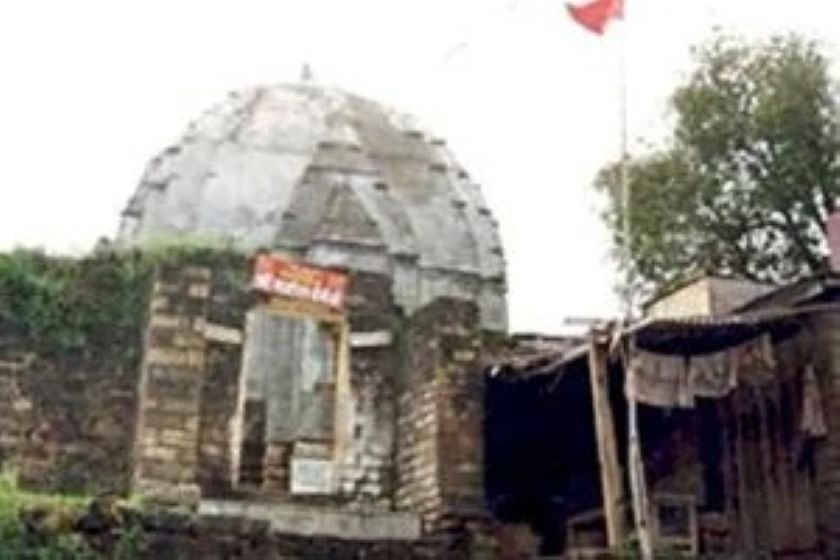
Architecturally, Kalanjari Devi Temple doesn’t try to compete with the carved stone shrines of Kangra or the copper-roofed sanctums found deeper in Chamba. It’s built in the modest, functional hill style common across this belt of Hamirpur — local stone and timber construction, low and unshowy, sitting into its surroundings rather than dominating them.
That plainness has its own effect. Walk in on an ordinary day and there’s very little to distract from the actual business of being at a temple: incense in the air, the particular hush that settles over small hill shrines away from any major road, birdsong filling in wherever conversation isn’t. It’s not a place built for photographs. It’s a place built to be sat in.
📜 A Region Built by the Katoch Legacy
Hamirpur’s temple landscape doesn’t exist in isolation — it’s shaped by the same regional history that produced towns like Sujanpur Tira nearby. Hamirpur town itself takes its name from Raja Hamir Chand of the Katoch dynasty, who ruled the area in the early 18th century, and the district’s cluster of two-hundred-year-old shrines — Kalanjari, Jhanyari, Tauni Devi, and others within a short radius of each other — largely trace back to that same broad era of local Rajput patronage, when smaller hill kingdoms across this part of Himachal were actively building and endowing temples as expressions of both faith and authority.
That context matters a little here: Kalanjari isn’t an isolated curiosity but one node in a genuinely dense network of similarly aged devi and Shiva shrines scattered across a fairly small stretch of Hamirpur district, most of them still functioning exactly as they did two centuries ago.
🎉 Festivals and Devotion
- Asharh Fair (June–July): The temple’s major annual event, drawing devotees from Hamirpur, Mandi, and surrounding districts for bhajans, cultural programs, and communal worship.
- Navratri: Observed with additional aartis and a steadier flow of visitors than an ordinary day, though without the scale of the Asharh gathering.
- Daily worship: Simple morning and evening rituals, kept largely local in character outside the main fair season.
🏞️ While You’re in the Area
- Tauni Devi Temple: Roughly 12–13 km away, notable for a local custom of making wishes by striking stones together rather than through conventional offerings.
- Gasota Mahadev Temple: An older Shiva shrine, around 8 km from Hamirpur town, tied to a pastoral cattle fair that reflects the district’s agricultural roots.
- Sujanpur Tira: A heritage town roughly 25 km away, with a cluster of Katoch-era temples, painted walls, and the remains of a former royal seat — worth a half-day on its own.
- Jhanyari Devi Temple: Another roughly 200-year-old shrine close to Hamirpur town, dedicated to the Kul-Devi of the Katoch dynasty, easy to combine with a Kalanjari visit given the short distance between them.
❓ Quick Questions Travellers Ask
Is this a difficult temple to reach? Not at all — it’s one of the more accessible shrines in this part of Himachal, a short drive from Hamirpur town on a maintained road, with no trekking required.
Is the Asharh fair the only time worth visiting? No — an ordinary day gives you a quiet, contemplative visit, while the fair gives you the temple at its most communal and alive. Choose based on which experience you’d rather have.
Is there a formal Shakti Peeth connection here, like Chintpurni or Jwala Ji? No — Kalanjari Devi’s significance is regional and legend-based rather than tied to the pan-Himalayan Shakti Peeth tradition associated with Sati’s body parts.
What should I bring? Nothing elaborate is expected — simple offerings if you wish, and comfortable footwear for the short walk from wherever you park or get dropped off.
Can this be combined with other sightseeing in a day? Easily. Its proximity to Jhanyari Devi, Gasota Mahadev, Tauni Devi, and Sujanpur Tira makes it simple to build a full, unhurried day of temple-hopping around Hamirpur town.
A Last Word
There’s nothing dramatic about Kalanjari Devi Temple on an ordinary afternoon — no towering architecture, no fierce ritual, no crowd. What it has instead is a story that’s stayed essentially unchanged for two hundred years, about a goddess who simply refused to be moved, and a village that has never seriously doubted it. Standing in that plain little hill shrine, with the incense drifting and the road to Hamirpur curling away below, it’s easy to understand why the story never needed embellishing. Some places don’t earn their reputation through spectacle — they earn it by quietly outlasting every reason they might have had to be forgotten.
Fact-check notes: This piece draws on multiple independent regional sources (Hamirpur district tourism write-ups, local temple listings, and historical district records) that consistently describe the temple’s age (roughly 200 years), its location on the Hamirpur–Awah Devi road, the Mandi-relocation legend, and the Asharh fair timing. Precise GPS coordinates and a verified contact number could not be confirmed from available sources and have deliberately been left out rather than invented — readers planning a visit should confirm the exact location via Google Maps or by asking locally in Hamirpur before setting out.