At the point where the Beas river meets the Kunah Khad stream, stands a 400-year-old Shiva temple that two different legends claim as their own — one about exiled brothers building through the night, the other about a goddess finally forgiven
Most old temples in Himachal settle for one origin story. Bil-Kaleshwar Mahadev has two, and neither one has ever fully pushed the other aside. Ask a priest here about the temple’s beginnings and you might get the Pandavas. Ask a pilgrim doing the last rites of a parent and you’ll likely hear about a goddess unburdening centuries of guilt. Both stories point to the same stretch of riverbank near Nadaun, and both explain, in their own way, why this modest confluence became one of the more quietly significant Shiva sites in the district.
🌄 Location & How to Reach It
- Location: On the Nadaun–Sujanpur road, at the confluence of the Beas river and the Kunah Khad, Hamirpur district
- Distance: Roughly 5 km along the Nadaun–Sujanpur highway
- Google Maps: Get Directions
- By road: Well connected by the Nadaun–Sujanpur road; local buses and taxis run this stretch regularly from both towns
- By rail: Una Railway Station is the nearest, linked to Chandigarh, Ambala, Rupnagar, and Delhi
- By air: Sri Guru Ram Das Jee International Airport, Amritsar, is the nearest major airport, roughly a two-hour drive from Una
The temple sits at low elevation on level ground by the riverbank, so this is an easy, unhurried visit rather than a climb — most of the effort here is in getting to Hamirpur district at all, not in reaching the shrine itself once you’re there.
🌸 Best Time to Visit
The temple can be visited comfortably through most of the year, but the Baishakh mela, held around April–May, is when it draws its biggest crowds and feels most alive. Outside the fair, mornings by the riverbank tend to be the quietest and most pleasant time to sit a while.
🕉️ The Legend: Two Stories, One Riverbank
The older and more widely repeated version ties Bil-Kaleshwar to the Pandavas of the Mahabharata. During their years of exile, the story goes, the five brothers began building a temple at this very spot, working through the night with help from Vishwakarma, the divine architect of the gods. It was meant to be finished before sunrise, in secret. But local villagers spotted the construction underway, and once outsiders had seen it, the work could go no further — the Pandavas were forced to abandon the temple unfinished and move on. It stood incomplete for a long stretch of time afterward, until a king of the Katoch dynasty eventually took up the task and completed it, centuries later, in the form the shrine holds today.
The second story belongs to an older, more mythic timeframe — the Satyug. As it’s told locally, the Asuras had once been granted great power by Lord Shiva, and used it to torment everyone living on earth. The distressed Devtas approached Brahma for a solution, and somewhere in that chain of events, the goddess found herself carrying a burden of guilt she couldn’t shake. She wandered the Himalayas for ages, praying continuously to Shiva, until one day, by this same river, he finally appeared before her and released her from it. A Shivalingam was installed at the exact spot of that meeting, and the site came to be known as Mahakali Kaleshwar — the root, in local memory, of the name Bil-Kaleshwar itself.
Neither story cancels the other out here. They simply sit side by side, the way old legends often do in places that have been sacred for longer than anyone can precisely date — one story explaining the architecture, the other explaining the ground itself.
🙏 What the Temple Is Known For
Bil-Kaleshwar’s most distinctive role today has less to do with darshan and more to do with grief. Devotees who cannot make the journey to Haridwar to immerse the ashes of a deceased loved one bring them here instead — the confluence of the Beas and the Kunah Khad is regarded by many in the region as carrying the same spiritual weight as the Ganga at Haridwar. That single association has quietly shaped much of the temple’s day-to-day significance: this isn’t primarily a place people come to ask for favours, but one they come to for closure.
Alongside that, it remains a working Shiva temple in the fuller sense — the lingam is worshipped daily, and the Baishakh mela draws devotees purely for celebration and community as well.
🏛️ The Temple Itself
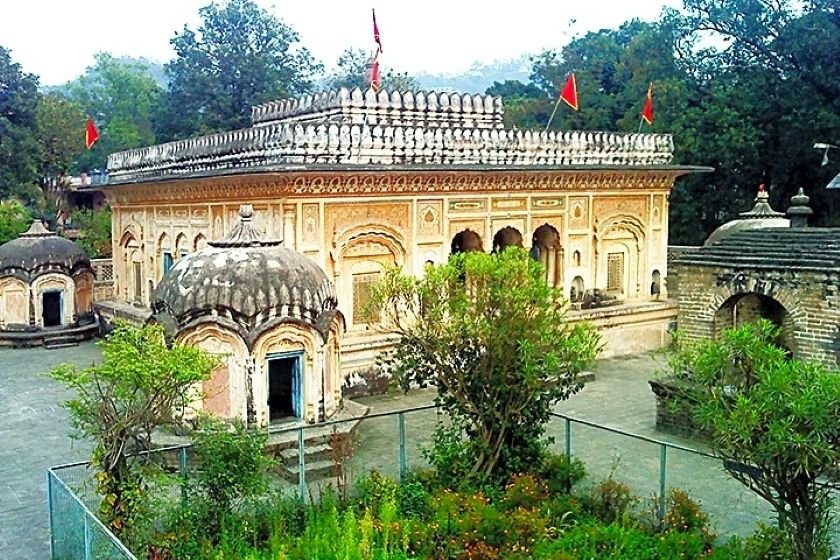
Set right where two waters meet, the temple has a naturally dramatic backdrop that owes nothing to embellishment — the sound of moving water is a constant presence here in a way it isn’t at most inland hill shrines. The architecture itself reflects its patchwork history: begun in one era, abandoned, then finished in another, centuries apart, under Katoch patronage. That layered construction gives the temple a slightly different character from the more uniform hill-style shrines scattered through the rest of Hamirpur — it feels older and more settled, less like a single act of devotion and more like an accumulation of them.
📜 Regional Context
Bil-Kaleshwar sits within the same Katoch-era temple landscape as Hamirpur’s other major shrines — the dynasty that founded Hamirpur town under Raja Hamir Chand is the same one credited with finishing this temple’s construction after the Pandavas’ unfinished attempt. That pattern repeats across the district: older legendary foundations, later completed or restored under Katoch rule, producing the dense cluster of centuries-old temples — Bil-Kaleshwar, Gasota Mahadev, Narvadeshwar, Murli Manohar — that now define religious life across Hamirpur and neighbouring Sujanpur Tira.
🎉 Festivals and Devotion
- Baishakh Mela (April–May): The temple’s principal annual fair, drawing large numbers of devotees for worship and community gathering.
- Maha Shivratri: Observed with additional rituals, as at most Shiva temples across the region.
- Ash immersion rites: A steady, quieter form of devotion carried out throughout the year rather than tied to any festival calendar.
🏞️ While You’re in the Area
- Gasota Mahadev Temple: Another centuries-old Shiva shrine nearby, with a pastoral cattle fair tradition of its own.
- Sujanpur Tira: A short drive away, home to a cluster of Katoch-era temples, murals, and the remnants of a former royal seat.
- Murli Manohar Temple: Located within Sujanpur Tira itself, a Krishna-Radha shrine built by a Katoch ruler in the late 18th century, worth combining with a Bil-Kaleshwar visit.
- Nadaun town and the Beas riverfront: Worth a slow walk if you’re already at the confluence — the town has its own quiet historical layers connected to the Beas.
❓ Quick Questions Travellers Ask
Is it true this temple is used like Haridwar for immersing ashes? Yes — this is one of its most distinctive local roles; many families in the region choose this confluence when travel to Haridwar isn’t feasible.
Which legend is the “real” one — the Pandavas or the goddess’s penance? Neither is treated as more authoritative than the other locally; both are told, often by the same people, without much concern for reconciling them.
Is the temple accessible without a long walk or trek? Yes — it sits directly on the Nadaun–Sujanpur road at low elevation, making it one of the easier temple visits in the district.
When is it busiest? The Baishakh mela in April–May draws the largest crowds; visit outside that window for a quieter experience by the river.
Can this be paired with Sujanpur Tira in one trip? Comfortably — the two are close enough to combine into a single day covering multiple temples and a heritage town.
A Last Word
There’s something fitting about a temple with two competing origin stories sitting at the exact point where two bodies of water become one. Bil-Kaleshwar doesn’t ask you to choose between the Pandavas and the goddess’s long penance — it simply holds both, the way the river holds the confluence, without needing either story to explain away the other. Stand at that meeting point of the Beas and the Kunah Khad, ashes and offerings both making their way into the same current, and it’s easy to see why this modest riverside shrine has carried the weight of Haridwar for people who could never make that longer journey.
Fact-check notes: The temple’s age (400+ years), location at the Beas–Kunah Khad confluence, the Pandava/Vishwakarma construction legend, and its informal role as a Haridwar-equivalent immersion site are corroborated across multiple independent regional sources. The Satyug/Mahakali penance legend appears in at least one detailed regional account but is less widely repeated than the Pandava story, so it’s presented here as a secondary, locally-told tradition rather than the dominant version. Exact GPS coordinates were not independently verified — please confirm location via the map link above before travelling.