Tap the right rock inside this hillside cave and it rings out like a damru — no myth required, visitors do it themselves and hear it plainly
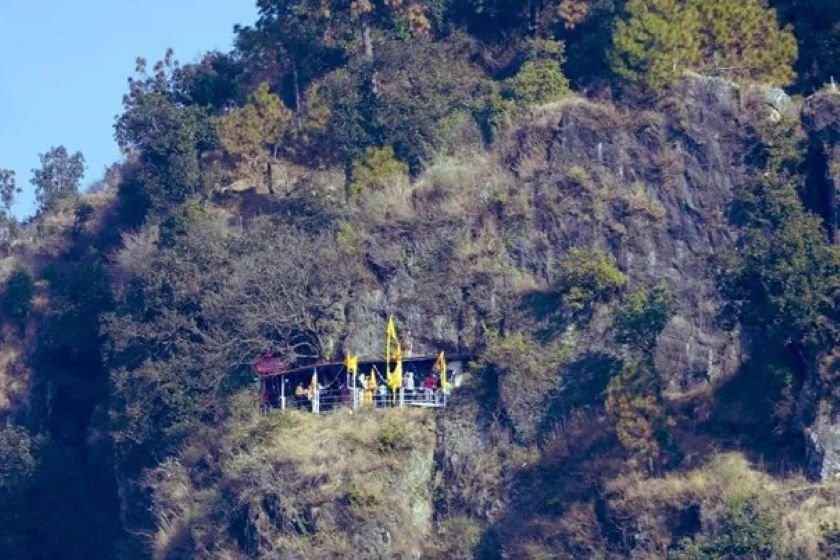
A quick note before anything else, since the name causes real confusion: this is not the same as “Dev Dhank” in Nirmand, Kullu district — a separate cave shrine tied to the Bhasmasur legend and a supposed secret route to Shrikhand Mahadev. Solan’s Shiv Dhank, also known locally as Panch Mundiya Mahadev, is its own distinct site — a small natural cave temple tucked into forested hills near Barog, reached by a short, genuinely pleasant trek that’s become a popular weekend outing for people from Solan, Kasauli, and even day-trippers from Chandigarh.
🌄 Location & How to Reach It
- Location: Near Barog/Chewa village, Solan District, Himachal Pradesh – 173209
- GPS Coordinates: 30.9101° N, 77.0658° E
- Google Maps: Get Directions
- Distance: Roughly 2–3 km trek from the trailhead; Barog Railway Station is about 6 km away, Solan town about 10 km
A genuinely important note, straight from experienced visitors: there are two possible approach routes, and only one of them is recommended. Enter from the Barog side, via Chewa village — this route is well-defined, family-friendly, and considered safe. Visitors specifically and repeatedly warn against approaching from the Solan side (Amravati enclave), describing that route as steep, unmarked, and easy to get genuinely lost in thick forest — something to attempt only if you’re young, experienced, and comfortable with off-trail hiking, and strictly not recommended if you’re travelling with family or older relatives.
The Chewa route in practice: From Solan, head along the Solan–Dharampur road for roughly 5–6 km until you reach a turning toward Chewa School. Follow this for about a kilometre until the road turns unpaved and vehicles can go no further — this is where the trek itself begins. The trail from here is described consistently as a single, clear path with no risk of taking a wrong turn, involving some uphill sections but nothing technically difficult. Most visitors cover it in roughly 1 to 2 hours each way at a comfortable pace, and it’s specifically described as manageable even for first-time trekkers, families, and older visitors.
By rail: Barog Railway Station, on the scenic Kalka–Shimla narrow-gauge line, is the closest railhead at around 6 km, making this a genuinely appealing stop if you’re already travelling that heritage route.
🌸 Best Time to Visit
Since the trek is short and the temple sits at a comparatively modest elevation, this is a genuinely year-round destination, unlike most of the higher temples in this guide. March to June and September to November offer the most comfortable trekking weather. Monsoon months make the trail slippery and are best approached with real caution, or avoided if you’d rather not deal with wet, uneven footing. Winter treks are possible too, though cold and fog can roll in, so plan accordingly.
A genuinely useful timing note from experienced visitors: avoid starting the trek very early in the morning or heading back late in the evening — several accounts specifically mention wild animals in the surrounding forest during those low-light hours, making broad daylight the sensible window for this trek.
Temple timings: No formal posted hours exist for this natural, informal shrine — it’s accessible during daylight hours, with the timing caution above being the more important practical consideration than any fixed opening time.
🕉️ Inside the Cave
Step into the cave itself and the change is immediate and physical — several visitors independently describe a shift in temperature and acoustics the moment you enter, as though the outside world briefly pauses. At the centre sits a small, naturally formed Shivalinga, understood locally as swayambhu (self-manifested) rather than carved and installed. Nearby, a distinctive stone set into the cave wall produces a genuinely audible, drum-like sound when struck by hand — compared consistently by visitors to the sound of Shiva’s own damru. This isn’t an exaggerated or purely symbolic claim: it’s something visitors specifically describe trying themselves and hearing clearly, a small, delightful piece of natural acoustic phenomenon rather than folklore alone.
The name “Dhank” itself refers simply to the natural cliff or cave rock formation, and “Panch Mundiya Mahadev” — the temple’s other common name — likely reflects a broader regional naming pattern for Shiva shrines associated with specific rock or cave formations, though a definitive etymology isn’t consistently documented across sources.
Along the trek, most visitors also stop at the Nagarkoti Shaktipeeth, a separate cave shrine with its own Shivling passed en route, and many continue past the main cave to a hilltop shrine offering genuinely striking 360-degree views across the Solan and Shimla valleys — on a clear day, snow-covered peaks are visible in the distance, and several visitors specifically cite this summit view as the emotional high point of the whole trip, rather than the cave itself.
A small, practical note worth passing along directly: this remains a genuine place of worship, and at least one visitor specifically mentions that modest dress is expected — best to avoid particularly casual or revealing clothing out of respect for the site.
🏛️ A Site Defined by Nature, Not Construction
There’s very little built architecture here, and that’s rather the appeal. This is a natural cave formation rather than a constructed temple in the conventional sense — dense pine, cheed, and deodar forest framing a rough stone path that climbs steadily toward the cave mouth, inside which sits the modest, unadorned Shivalinga and its resonant neighbouring stone. What structure does exist is minimal: a small shelter at most, allowing the cave and rock formations themselves to remain the entire point of the visit.
A note on some more elaborate claims you may see online: a few write-ups describe this site in heavily mystical terms — invoking “eternal flame,” specific historical Tantric practitioners, or the resonant stone as a deliberate symbol of Shiva’s “Anhad Naad” (primordial cosmic sound). These framings go considerably further than what any grounded visitor account or documented source actually supports. The real, verifiable draw here — a natural cave, a self-formed lingam, and a stone that genuinely produces a drum-like sound when struck — is remarkable enough on its own without embellishment, and this article sticks to what’s actually documented and consistently reported rather than more dramatic language that isn’t backed up by anything specific.
🎉 Festivals and Devotion
- Mahashivratri: Marked with night-long bhajans and prayer, drawing devotees for the trek specifically for this occasion.
- Shravan Mondays: Devotees make the trek carrying kanwars (ceremonial water vessels) and offerings, in keeping with the wider Shravan month tradition observed at Shiva sites across North India.
- Daily worship: Simple and unstructured — water, incense, and quiet presence rather than elaborate ritual, fitting for a site with no resident priest or formal schedule.
🏞️ While You’re in the Area
- Jatoli Shiv Temple: Often described as Asia’s highest Shiva temple, a genuinely spectacular multi-tiered shikhara structure near Solan, offering a striking architectural contrast to Shiv Dhank’s natural simplicity.
- Shoolini Mata Temple: Solan’s presiding goddess temple, and the origin of the town’s own name.
- Barog and Dagshai: Colonial-era hill stations along the Kalka–Shimla railway, both worth a wander if you’re already in the area.
- Kasauli: A well-known nearby hill station, easily combined with a Shiv Dhank day trip from Chandigarh.
🙏 Getting in Touch
There’s no formal contact number, priest, or managing body for this site — it functions as an informal, community-maintained natural shrine rather than a managed temple. There are no shops, cafés, or facilities anywhere along the trek or at the temple itself, so visitors should carry their own water and snacks. For current trail conditions, asking locally in Chewa village or Barog before setting out is the most reliable approach.
❓ Quick Questions Travellers Ask
Which route should I take? Enter from the Barog side via Chewa village — this is the safe, clearly marked, family-friendly route. Multiple visitor accounts specifically warn against approaching from the Solan side (Amravati enclave), describing it as an unmarked, easy-to-get-lost route suited only to experienced, adventurous hikers, not families or casual visitors.
How difficult is the trek? Genuinely manageable for most people — a steady uphill walk of roughly 1 to 2 hours each way (some estimates range from 2 to 3 km depending on the exact route), described by multiple visitors as comfortable even for first-timers, families, and older trekkers.
Is it safe to visit early morning or late evening? Visitor accounts specifically advise against it — wild animals are reported in the surrounding forest during low-light hours, so a daytime visit is the sensible choice.
Are there facilities near the temple? No — there are no shops, cafés, or formal amenities along the trek or at the cave itself. Bring your own water and snacks.
Is this the same as “Dev Dhank” near Nirmand? No — that’s a separate, unrelated cave shrine in Kullu district, tied to its own distinct Bhasmasur legend. This Shiv Dhank Temple is in Solan district, near Barog.
A Last Word
There’s something refreshing about a sacred site that doesn’t need embellishment to be worth the trip — no invented eternal flame, no unverifiable tales of ancient tantric masters, just a genuine natural cave, a self-formed lingam, and a stone that really does ring out like a drum when you tap it, exactly as generations of visitors have discovered for themselves. Add a short, pleasant forest trek and a summit view stretching across two valleys, and you’ve got a temple that earns its reputation the honest way: by simply being exactly as remarkable as it claims, no more and no less.
Fact-check notes: The earlier version of this article, published on the site, included several embellished, unsourced claims — references to “eternal flame,” historical Tantric practitioners, and the resonant stone as a deliberate symbol of Shiva’s “Anhad Naad” — none of which appear in grounded visitor accounts or documented sources, and these have been removed in favour of the specific, consistently reported details (the temperature/acoustic shift on entering the cave, the genuinely audible damru-like sound from the stone). This rewrite also adds a significant safety correction absent from the earlier draft: multiple recent visitor reviews specifically and strongly warn against approaching via the Solan/Amravati side, describing it as unmarked and genuinely easy to get lost on, recommending the Barog/Chewa route instead. This site has also been explicitly distinguished from the separate, unrelated “Dev Dhank” shrine in Nirmand, Kullu district, given the similarity in name. Verified GPS coordinates were pulled from live location data. No formal contact information exists for this site, and none has been invented.