On a hilltop above the Dhauladhar range, a goddess said to watch over every wish through seven pairs of eyes has been quietly answering prayers for centuries — and quietly falling into disrepair while she does it.
There’s a certain kind of hill shrine that earns its reputation not through scale or spectacle, but through accumulation — one generation after another returning with the same quiet request, until the place itself seems to absorb the hope. Ashapuri Mata Temple, set on a ridge in Kangra district with the snow line of the Dhauladhars as a backdrop, is that kind of place. Her name literally means “fulfiller of wishes,” and devotees describe an idol carved with an unusual, faintly unsettling detail: seven pairs of eyes, said to represent a gaze that misses nothing. It’s a striking image for a temple that, by most accounts, nobody can fully agree on the age of — some call it seventeenth-century, others insist it’s centuries older still — which only adds to the sense that this is a shrine whose real history has partly slipped into legend, the way old, well-loved places sometimes do.
🌄 Location & How to Reach It
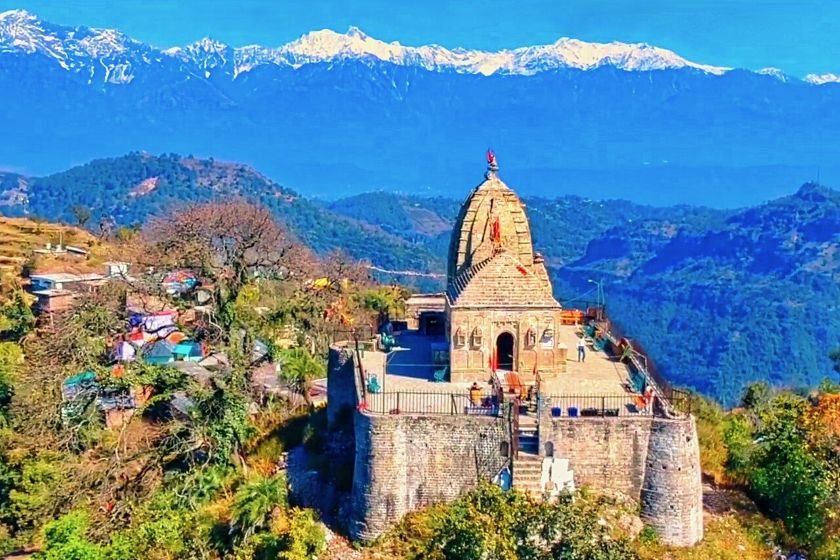
Ashapuri Mata Temple sits on high ground in Kangra district, Himachal Pradesh, near Nagavan and Panchrukhi according to government and Archaeological Survey of India sources, while the temple’s own website locates it in the Maharaj Nagar area near Palampur — a discrepancy likely reflecting the fact that this hilltop sits at a crossing point between several nearby administrative areas rather than two genuinely different temples. From the hilltop, the temple offers sweeping views of the snow-covered Dhauladhar range and the green valley below.
Google Maps: Get Directions
The final approach to the temple involves a walk or short drive uphill, and the access road has reportedly been in poor condition in places, so it’s worth allowing extra time.
- By road: Estimates vary noticeably by source — roughly 40 km from Kangra town and 50 km from Dharamshala according to government tourism listings, though other sources place it considerably farther from Kangra town (over 60 km); the discrepancy likely comes down to which route is being measured. The temple is generally reached via the Gaggal–Nagrota Surian road.
- By rail: Kangra Mandir station is cited as the nearest, at roughly 35 km, with Pathankot Junction further out at around 90 km.
- By air: Kangra (Gaggal) Airport is the nearest, though reported distances to it also vary across sources.
Given how much the distance figures disagree with each other, this is a temple where it’s genuinely worth confirming your route with a local or a live map before setting out, rather than trusting any single number.
🌸 Best Time to Visit
October to March brings the clearest views of the snow-covered Dhauladhars and the most comfortable climbing weather; the hilltop setting means summer heat and monsoon slickness are both worth planning around. A monthly Sunderkand Path is held on the last Tuesday of every month, drawing a steady stream of devotees beyond the major festival dates, and Navratri is, as at most Shakti temples in the region, a particularly significant time to visit.
🕉️ The Legend: A Warning Written in Wasps
Ashapuri’s central and most consistently told legend isn’t really about the temple’s founding — it’s about what the goddess is believed to have done to protect it. According to an account given by the present head of the Kangra royal family and reported in regional press, the temple served for generations as a hidden repository for treasures belonging to the Kangra rulers, and Goddess Ashapuri as their protector. When one Islamic invasion moved to threaten the site, the invading force is said to have been driven back not by soldiers, but by a sudden, overwhelming swarm of red wasps — an attack attributed directly to the goddess’s intervention. It’s a striking, specific image, though like many such protective legends attached to treasure-guarding deities across Rajasthan and Himachal, it should be read as a devotional tradition rather than a documented historical event; no independent military or chronicled record of the incident could be found for this piece.
A second, quite different origin story ties the temple to the Mahabharata. In this telling, the Pandavas sheltered nearby, in caves known as Malli, during their period of exile, and the warrior Karna — sent to track them down on Duryodhana’s orders — instead discovered a natural stone form (a pindi) of the goddess and, overwhelmed, laid the foundation of a temple in her honour rather than exposing the brothers he’d been sent to find. This version connects Ashapuri to the wider Vaishno Devi tradition, framing her pindi form as a direct manifestation of that goddess. It’s a compelling story, but it comes from a narrower set of sources than the wasp-invasion legend and should be treated as a secondary, less corroborated tradition rather than the primary account.
On the question of who actually built the standing structure, sources genuinely disagree rather than simply retelling the same fact differently. Government tourism listings, an Archaeological Survey of India assessment, and independent press coverage converge on a 17th-century construction date, crediting Vijay Ram, son of King Chandrabhana of Kangra. At least one other source instead attributes the temple to a 16th-century King Man Singh of the Katoch line, and a Tribune report on the temple’s neglect describes it, in passing, as roughly 600 years old — which would push its origin earlier still. Rather than force these into a false certainty, it’s fairest to say the temple is unambiguously old and ASI-protected, with the 17th-century, Vijay Ram attribution carrying the strongest and most independently corroborated support.
🙏 What Ashapuri Devi Is Known For
Ashapuri — “Asha” (hope/wish) plus “Puri” (abode) — is worshipped chiefly as a wish-fulfilling form of Shakti, variously described across sources as linked to Durga, Kali, or Vaishno Devi depending on which local tradition you follow. What sets the devotional focus here apart from many other regional Devi shrines is its specificity: people come to Ashapuri less for general protection and more with a particular hope in mind, trusting that a sincerely made wish, offered with a clear heart, will be heard.
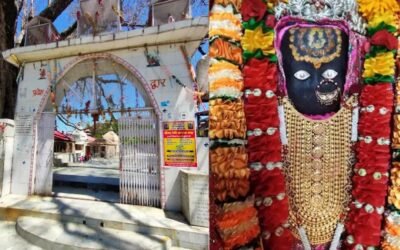
The idol itself, housed in the sanctum in pindi (natural stone) form according to several accounts, is described as having seven pairs of eyes — fourteen in total — a detail repeated across multiple sources and generally interpreted as a symbol of the goddess’s all-seeing, all-knowing grace. Devotees make offerings of flowers, incense, red cloth, and sweets, and it’s common practice to tie threads or small pieces of cloth (chunris) onto the trees near the shrine as a visible, lasting marker of a prayer made. The temple also functions as a kuldevi (family deity) shrine for some local families, adding a layer of generational, household-specific devotion on top of its broader pilgrimage role.
🏛️ The Temple Itself
Architecturally, Ashapuri is a fairly rare survival in this part of Himachal: a stone temple built in Nagara style, with a square-plan sanctum, a prominent pyramidal shikhara rising above it, and a mandapa (pillared hall) preceding the main shrine, along with an antarala (vestibule) connecting the two. The whole structure is built from sandstone, carved with the kind of detailing that earned it recognition from the ASI as a good example of the “structural versatility” of the later medieval period. Stone figures of a lion and a tiger stand guard outside, facing the sanctum, in what’s read locally as a symbol of protective strength flanking the goddess.
The temple’s real drama, though, comes from its setting rather than its scale. It sits at the highest point of its hillside, and the payoff for the climb is a clear, wide-open view of the Dhauladhar range’s snow line against the green folds of the valley below — the kind of view that makes the temple as much a lookout point as a place of worship. That prominence has come at a cost: local reporting has repeatedly flagged the site’s neglect, with crumbling access stairs and a narrow, accident-prone approach road that villagers and local politicians have periodically tried to get repaired, with mixed and incomplete success. Visiting Ashapuri today means encountering genuine antiquity, but also a monument that hasn’t received the sustained conservation attention some of Kangra’s other protected sites have.
📜 Kangra’s Katoch Legacy and the Wider Devi Landscape
Ashapuri sits within a Kangra Valley that has functioned as one of North India’s most significant centres of Shakti worship for centuries, alongside far larger and better-known shrines like Brajeshwari Devi and Chamunda Devi. Its construction is credited, per the strongest-supported account, to a member of the Katoch royal family — the same dynasty associated with Kangra Fort and its own Ambika Devi shrine — placing Ashapuri within a broader pattern of Katoch-era temple patronage across the district. Whether the temple predates that royal association by centuries, as the alternate Mahabharata-era and 16th-century accounts suggest, or was a genuinely 17th-century Katoch foundation, it belongs either way to a valley whose religious geography has been shaped continuously by Rajput hill dynasties, epic-era legend, and organic local devotion layered one on top of the other.
🎉 Festivals and Devotion
- Navratri: As at most regional Shakti shrines, a major period of heightened worship and visitation.
- Monthly Sunderkand Path: Held on the last Tuesday of every month, drawing regular devotees beyond the major festival calendar.
- Daily darshan: The temple remains open for regular worship year-round, with additional activities during festival periods.
🏞️ While You’re in the Area
- Malli Caves: Roughly 4 km away, tied to the Pandava-exile legend associated with the temple’s alternate origin story.
- Baijnath Temple: A 13th-century Jyotirlinga shrine to Shiva, one of the Beas valley’s major Shaivite pilgrimage sites.
- Maharana Pratap Sagar Lake and Pong Dam Wetland Sanctuary: A quieter, nature-focused contrast to the temple circuit, popular for birdwatching.
- Kangra Fort and Ambika Devi Temple: Further afield in Kangra district, worth combining on a longer Katoch-era heritage trail.
- Baglamukhi Temple: Another distinctive regional shrine, dedicated to one of the ten Mahavidyas, known for its tantric ritual tradition.
❓ Quick Questions Travellers Ask
Is the temple in good physical condition for visiting, given the reports of neglect? It’s an active, functioning shrine, but local reporting has noted deteriorating stairs and an access road that needs repair, so sturdy footwear and caution on the approach are worth planning for.
How far in advance should I plan around the monthly Sunderkand Path? It’s held on the last Tuesday of each month, so it’s easy to time a visit around it if that’s of interest, though the temple welcomes darshan on any day.
Is there an entry fee? No entry fee could be verified for this article; as an active community and ASI-linked temple rather than a ticketed monument, it’s likely free, but confirm locally.
Which origin story does the temple itself promote? Sources differ even on this — the temple’s own public materials lean toward the 17th-century Vijay Ram account, while other local and devotional retellings favor the older Mahabharata-era or 16th-century narratives; visitors will likely hear more than one version depending on who they ask.
Is this the same Ashapuri connected to Kangra’s former royal family? Yes — multiple sources, including the current head of the Kangra royal lineage, describe the temple as historically tied to the Katoch rulers and their protected treasures.
A Last Word
Fourteen watching eyes, a swarm of protective wasps, a warrior who came looking for exiled princes and left having built a temple instead — Ashapuri carries more competing stories than most shrines this size, and none of them fully agree on how old the place actually is. Maybe that’s fitting for a goddess whose entire reputation rests on listening rather than announcing herself. Climb the hill, look out at the Dhauladhars from that worn stone platform, and the exact century stops mattering quite as much as it does on paper — what’s left is a place where, by every account regardless of which legend you believe, people have been arriving with their quietest hopes for a very long time.
Fact-check note: The temple’s dedication to Ashapuri Devi as a wish-fulfilling form of Shakti, its Nagara-style stone architecture, its ASI-protected status, and its association with the Katoch royal family and the wasp-invasion legend are reasonably well corroborated across independent government, journalistic, and cataloguing sources. Genuinely unsettled and flagged above rather than resolved with false precision: the exact construction date and builder (17th-century Vijay Ram vs. a 16th-century or older attribution), the temple’s precise administrative location (Panchrukhi/Nagavan vs. Palampur/Maharaj Nagar), and road distances from nearby towns, which vary significantly between sources. No independently verified GPS coordinates or entry fee could be confirmed; use the map link above and check current details with the temple directly where possible.