High inside the largest fort in the Himalayas sits a small stone shrine that a royal dynasty still calls, quite literally, its mother.
Some temples exist because a king wanted to be remembered. Others exist because a story needed somewhere to live — and the story, in this case, is about how an entire ruling family came into being. Perched within the ramparts of Kangra Fort, above the confluence of two rivers and beneath the shadow of the Dhauladhar range, the Ambika Mata Temple doesn’t look like the origin point of a dynasty. It’s modest, weathered, and easy to walk past if you’re more focused on the fort’s towering gates and battle-scarred walls. But according to a legend the Katoch royal family still tells about itself, this is where their bloodline began — born, according to the story, from a single drop of the goddess’s sweat during a battle against a demon who could not be killed by ordinary means. Whether you take that literally or as a foundation myth doing what foundation myths do, it’s rare to stand this close to a story a living family still claims as their own.
🌄 Location & How to Reach It
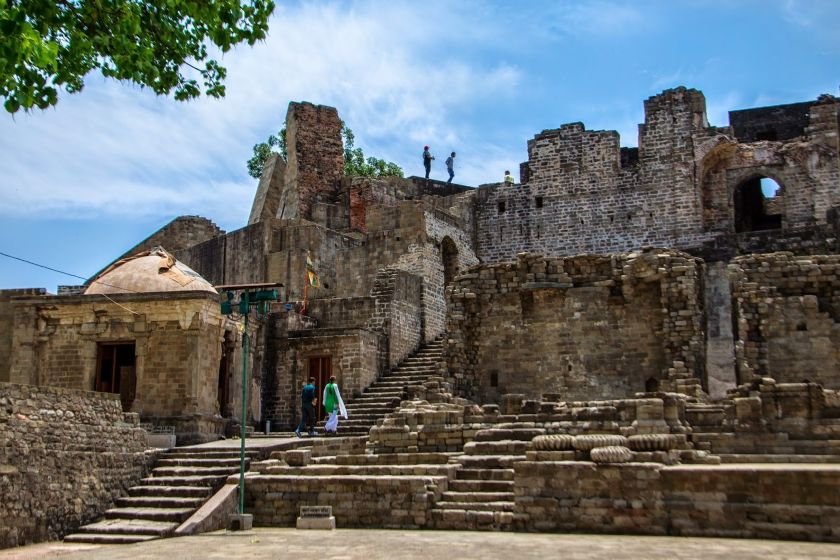
The Ambika Mata Temple sits inside Kangra Fort, in Old Kangra (Purana Kangra), roughly 3 km from Kangra town in Himachal Pradesh’s Kangra district. The fort itself occupies a hillock at the meeting point of the Banganga and Manjhi rivers, and the temple stands in a courtyard partway up the fort complex, alongside the ruined Lakshmi Narayan and Shitla Mata shrines.
Google Maps: Get Directions
The fort sits on a hillock, and reaching the temple itself means climbing a fair number of stone steps and steep, sometimes narrow passages after you enter — comfortable footwear matters more here than at a flat, ground-level temple.
- By road: About 20 km from Dharamshala and roughly 3 km from Kangra town; regular buses and taxis run from both. The final stretch inside the fort is on foot.
- By rail: Kangra Mandir, a narrow-gauge station, is the closest at around 2 km; for broad-gauge connections, Pathankot Railway Station (roughly 85–90 km away) is the more practical option.
- By air: Gaggal Airport, about 12–15 km away, is the nearest, with flights to Delhi and other major cities.
Compared to remote hill temples elsewhere in Himachal, this one is refreshingly easy — it’s inside a well-signed, ASI-managed monument with a proper entrance, ticket counter, and marked paths, so the challenge here is the climb, not the journey.
🌸 Best Time to Visit
Kangra Fort and its temples are usually open daily from around 9 a.m. to somewhere between 5 and 5:30 p.m., though exact hours can shift slightly with the season, so it’s worth confirming locally rather than cutting it close. October to March brings the most comfortable weather for the climb; the monsoon months (July–September) can leave the old stone steps slick and best avoided.
If you can align a visit with Navratri — observed here in both its spring and autumn forms — you’ll catch the temple in full devotional swing, with processions, aartis, and offerings that reflect its status as the Katoch family’s ancestral deity, not just another stop on the fort circuit.
🕉️ The Legend: A Drop of Sweat, a Dynasty Born
The story most consistently told about this temple isn’t really about the shrine’s construction — it’s about where the Katoch dynasty itself came from, and it centers on a battle described in the Markandeya Purana.
According to the legend, the goddess Ambika fought a fearsome demon named Raktbeej, whose blood carried a strange curse: every drop that touched the ground sprang up as a fresh demon, multiplying his army with every wound he took. In the heat of that impossible battle, a drop of Ambika’s own sweat fell to the earth — and from it emerged Bhumi Chand (also recorded as Rajanaka Bhumi Chand), the first of the Katoch line. He is said to have fought alongside the goddess and helped her finally overcome Raktbeej. In gratitude, Ambika granted him dominion over Trigarta — “the land of the three rivers” — the ancient name for the region that includes present-day Kangra. From that moment, the story goes, the Katoch kings considered Ambika their kuldevi, their family goddess, and built her a shrine at the very heart of their fortress.
This account is remarkably consistent across independent histories of the fort and the Katoch dynasty, which lends it real weight as the temple’s core legend. A second, far less corroborated story does circulate — one version credits a king named Raja Bhuri Singh with building the temple after a military victory over a rival ruler, Raja Sansar Chand. That story is worth treating with real caution: Bhuri Singh and Sansar Chand are figures from different Himachal princely states and different eras in most historical records, and the tale appears in only a single source consulted for this piece, without the same cross-referencing that supports the Raktbeej legend. It reads more like a garbled or conflated local retelling than an independently verifiable event, so it’s included here only as a flagged curiosity, not as history.
What’s on far firmer ground is the fort’s own age — its earliest surviving temples date to roughly the 9th–10th century CE, and the fort has documented history stretching back to Mahmud of Ghazni’s siege in 1009 CE, long before any of Kangra’s later, better-documented rulers were born.
🙏 What Ambika Devi Is Known For
Ambika, worshipped here as a form of Durga and Parvati, is honoured above all as the source and protector of the Katoch line — devotees don’t come to Kangra Fort seeking generic blessings so much as connecting to a very specific, very old claim of lineage and protection. For the Katoch descendants themselves, this temple isn’t a tourist stop; it remains an active site of family worship, and it’s said that royal descendants still visit to pay respects to the deity understood as their divine ancestor’s protector.
For the wider public, the temple functions more as a layered historical and spiritual site than a mass pilgrimage destination — nowhere near the scale of Kangra’s own Brajeshwari Devi Temple in town, one of the established Shakti Peeths, but significant precisely because of its narrow, specific role: this is the goddess a dynasty, not a whole region, calls its own. Regular worship includes morning and evening aarti, the lighting of ghee lamps, and recitation of the Durga Saptashati, continuing a devotional rhythm that has outlasted the fort’s many conquerors.
🏛️ The Temple Itself
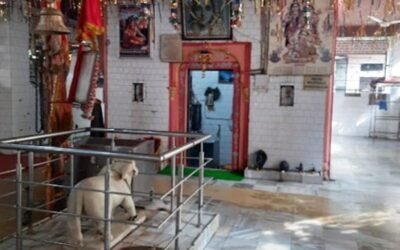
Don’t expect grandeur on the scale of the fort’s massive gateways — the Ambika Devi shrine is a small, stone-carved structure, and time, earthquakes, and centuries of sieges have not been kind to it. It sits in a courtyard reached through the Darsani Darwaza, once flanked by carved (now defaced) images of the river goddesses Ganga and Yamuna, alongside the similarly weathered remains of the Lakshmi Narayan and Shitla Mata temples.
What survives is enough to suggest what once stood here: worn stone walls, the outline of a sanctum that has clearly been rebuilt and repaired more than once, and an atmosphere that owes as much to its setting as to its architecture. Stand in that courtyard and you’re surrounded by the fort’s grey stone ramparts, with narrow defensive passages leading off in different directions and, if you climb further, sweeping views over the Banganga and Manjhi rivers toward the Dhauladhar peaks. There’s a hush here that’s different from the noise of the fort’s more photographed gates — incense smoke drifting in the stone-cooled air, the murmur of a priest’s prayers, birds somewhere up in the ramparts. The 1905 earthquake that devastated much of the fort left its mark on this courtyard too, and what you’re looking at today is as much a story of survival and repair as of original construction.
📜 The Katoch Dynasty and Trigarta’s Deep History
The Ambika Devi Temple can’t really be separated from the fort around it, and the fort can’t be separated from the Katoch dynasty’s claim to be one of continuously ruling India’s oldest royal lines. Kangra — ancient Trigarta — appears in the Mahabharata, where Raja Susharma Chandra of Trigarta is described fighting on the Kaurava side at Kurukshetra; genealogies trace the Katoch line back further still, to the mythic Bhumi Chand of the Ambika legend. Successive centuries brought invasions by Mahmud of Ghazni in 1009, Muhammad bin Tughluq in the 14th century, Sher Shah Suri’s general in 1540, and finally Mughal annexation under Jahangir in 1620 — each conqueror leaving a gate or scar behind, several of which still stand near the temple courtyard today.
Within the wider Kangra Valley, the fort’s temples sit alongside other major sites from overlapping eras — the 8th-century rock-cut Masroor Temples, sometimes called the “Ellora of Himachal,” and the Brajeshwari Devi Temple in Kangra town, one of India’s recognised Shakti Peeths. Together they paint a picture of Kangra as a genuinely major centre of temple-building and pilgrimage over more than a millennium, not just a fort with a shrine attached.
🎉 Festivals and Devotion
- Navratri (Spring and Autumn): The temple’s main festival period, marked by devotional processions, aartis, and offerings tied to its role as the Katoch family deity.
- Durga Ashtami: Observed with special pujas and community feasts.
- Daily worship: Morning and evening aarti, lighting of ghee lamps, and chanting of the Durga Saptashati.
🏞️ While You’re in the Area
- Maharaja Sansar Chand Museum — Just outside the fort entrance, with Kangra miniature paintings and artefacts that add real context before you start the climb.
- Brajeshwari Devi Temple — In Kangra town itself, one of the established Shakti Peeths and a natural pairing with the fort visit.
- Masroor Rock Cut Temples — Roughly 40 km away, an 8th-century complex carved from a single rock outcrop, often billed as the “Ellora of Himachal.”
- Jayanti Mata Temple — A small hilltop shrine near the fort, built by a Gorkha general, easily combined with a fort visit.
- Dharamshala and McLeod Ganj — About 20 km away, worth the drive if you want to extend the day into the Dalai Lama’s temple complex and the Tibetan quarter.
❓ Quick Questions Travellers Ask
Is the Ambika Devi Temple included in the regular Kangra Fort ticket, or is there a separate fee? It sits inside the main fort complex, so the standard fort entry ticket covers it — you won’t need a separate ticket for the temple itself. Reported entry fees vary noticeably between sources (from roughly ₹20 up to ₹150 for Indian visitors depending on whether an audio guide is bundled in), so it’s worth checking the current rate at the counter rather than relying on any one figure online.
How much walking or climbing is involved in reaching the temple? A fair amount — the temple sits partway up the fort on stone steps and narrow passages, so it’s not a flat, easy walk, and can be tough for elderly visitors or small children in hot weather.
Can I take photographs inside the temple courtyard? General photography is generally fine, though a separate video camera fee has been reported by some visitors; carrying a valid ID is also advisable, as it’s sometimes requested at entry.
Is the temple still actively used for worship, or is it purely a historical site? Both — it functions as a protected ASI monument and a living shrine, with regular aarti still performed and Katoch family descendants said to visit for devotional purposes.
What’s the best time of day to visit for photography or a quieter experience? Morning, shortly after opening, tends to be cooler and less crowded, with better light for the stone carvings than the harsher midday sun.
A Last Word
There’s something quietly striking about a family that still calls a single drop of a goddess’s sweat the reason it exists — and stranger still that the shrine marking that claim is this understated, tucked into a courtyard that most visitors pass on their way to somewhere more photogenic. Kangra Fort has survived Ghazni, the Tughluqs, the Mughals, an earthquake, and centuries of shifting rulers, and through all of it, the Ambika Devi Temple has remained exactly what the Katoch dynasty first built it to be: not a monument to power, but a quiet acknowledgment of where they believe that power came from. Stand in that worn stone courtyard, with the ramparts rising around you and the valley falling away below, and it’s easy enough to believe a dynasty really could begin with something as small and human as a drop of sweat.
Fact-check note: The fort’s 9th–10th century temple remains, its role as the Katoch dynasty’s ancestral shrine, and the Ambika–Raktbeej–Bhumi Chand foundation legend are well corroborated across multiple independent historical sources. Less certain: precise GPS coordinates (sources vary slightly and aren’t independently verified here), exact opening hours and entry fees (reported figures differ noticeably across sources, likely reflecting recent changes), and the secondary Raja Bhuri Singh/Raja Sansar Chand construction story, which appears in only one consulted source and conflicts with more established historical timelines — it’s presented above only as a flagged, unverified curiosity.