Facing the old Chougan grounds of Sujanpur Tira stands a Krishna temple built by a king in memory of his mother — and at its heart, an idol whose flute is said to point the “wrong” way, because one night, according to local memory, the god simply turned it himself
There’s a particular kind of temple story that survives centuries not because it’s dramatic, but because it’s checkable — you can walk up to the idol today and see the detail the whole legend hinges on. At Murli Manohar Temple, that detail is the flute. Look at Krishna’s idol here and the murli sits reversed from how you’d expect to see it in virtually every other Krishna shrine in India. Local memory says that reversal wasn’t a sculptor’s choice. It was Krishna’s own answer to a king who dared to question the way he’d been carved.
🌄 Location & How to Reach It
- Location: Opposite the Chougan grounds, Sujanpur Tira, Hamirpur district, on the banks of the Beas River
- Distance: Roughly 22–25 km from Hamirpur town; about 64 km from Kangra; around 85 km from Una
- Google Maps: Get Directions
- By road: Direct buses run from Delhi to Sujanpur; the town is also easily reached from Hamirpur, Nadaun, and Kangra
- By rail: Una is the nearest railhead, about 85 km away
- By air: Gaggal Airport (Kangra) is the nearest, roughly 65 km away, with taxis and buses onward to Sujanpur
Once in Sujanpur Tira, the temple sits right at the old royal heart of the town — a short, flat walk from the fort and the Chougan, no climbing involved.
🌸 Best Time to Visit
Any season works for an ordinary visit, but two dates transform the place completely: Janmashtami, when the temple becomes the centre of midnight aartis and community feasting, and Holi in March, when Sujanpur Tira hosts one of the oldest continuously celebrated Holi festivals in India, inaugurated here at this very temple with gulal applied to Krishna and Radha before the wider town erupts into color.
🕉️ The Legend: A King’s Doubt, A God’s Answer
The story is told with small variations depending on who’s telling it, but the core of it holds steady across every version. When the idol of Krishna was being installed in the newly built temple, Maharaja Sansar Chand — the same Katoch ruler responsible for so much of Sujanpur Tira’s temple architecture — looked closely at the murli in Krishna’s hands and objected. The flute, he said, had been positioned incorrectly. In the sterner retellings, he gave the priests an ultimatum: produce a satisfactory explanation by morning, or face his wrath.
The priests spent the night in prayer, unable to offer the king anything but faith. By dawn, the flute had turned — now facing the opposite direction from where it had been the evening before, exactly as it still stands today. Whatever doubt the king carried into that night was, by all accounts, gone by the time the sun rose. The temple’s chief priesthood, a lineage that has continued to serve here for generations, still points to this as the defining miracle of the shrine — and, by most local claims, the only known Krishna idol in the world depicted with the flute reversed in this particular way.
It’s worth holding that last claim loosely — “only one in the world” is the kind of thing devotional retellings tend to assert with more confidence than any survey of India’s countless Krishna temples could realistically confirm. What’s harder to dispute is the idol itself: the flute really is reversed, the story really has been told this way for generations, and that combination is enough to make this one of the more genuinely distinctive Krishna shrines in the region.
🙏 What the Temple Is Known For
The sanctum houses a Krishna idol carved from a single piece of Shaligram — a black fossil stone regarded in Hindu tradition as a direct manifestation of Vishnu — alongside an idol of Radha. That Radha idol is, notably, not original: the 1905 Kangra earthquake destroyed the temple’s original consort image, which some accounts describe as Rukmini rather than Radha, and what stands beside Krishna today is a later replacement. The temple’s outer niches carry stone images of assorted deities, along with what several sources describe as sculptures of Kartikeya and Brihaspati.
Devotees come here for the reversed-flute legend as much as for Krishna himself, and the temple’s reputation for answering sincere prayer is treated locally as directly tied to that founding miracle — faith rewarded once, the thinking goes, tends to keep being rewarded.
🏛️ The Temple Itself
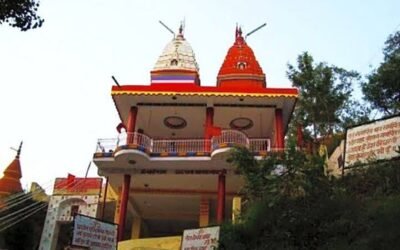
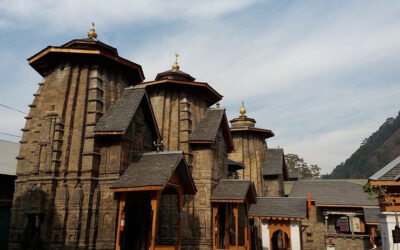
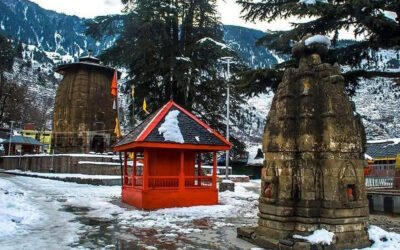
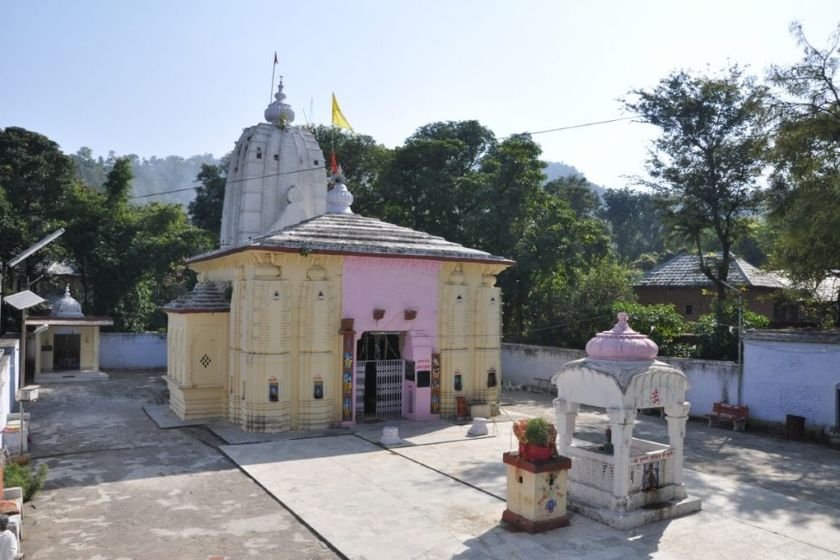
Built from stone and finished in soft yellow, pink, and white, the temple stands in a large open courtyard directly across from the Chougan — the historic training ground and public square that has anchored Sujanpur Tira’s civic life since the Katoch era. Its outer walls carry sculpted images in niches rather than the painted murals found at nearby Narvadeshwar, giving it a slightly different visual character from its sister temple across town, even though both were built under the same dynasty within a few decades of each other. A sacred tank near the complex adds to the sense of a temple built for ritual completeness, not just a single sanctum.
📜 Regional Context
Murli Manohar sits inside the same Katoch-era building boom that produced Narvadeshwar and Chamunda Devi nearby — all commissioned within a relatively tight window under Raja Sansar Chand’s patronage, when Sujanpur Tira functioned as the dynasty’s cultural and political capital. Sources differ meaningfully on exactly when this particular temple went up: some place it as early as 1785, others at 1790, others closer to 1794–96, and some simply describe it as “nearly 400 years old” — a figure that doesn’t align cleanly with Sansar Chand’s own reign (1775–1824) and is best read as a rounded, popularly repeated figure rather than a precise date. What’s consistent across every account is the motive: Sansar Chand built this temple in memory of his mother, making it, among Sujanpur’s royal temples, the one most directly tied to personal grief and devotion rather than purely dynastic or religious ambition.
🎉 Festivals and Devotion
- Holi (March): A national-level fair, inaugurated at this temple with color applied to Krishna and Radha before spreading through the town — a tradition the Katoch kings are credited with starting, continued today with an inaugural visit from the Chief Minister.
- Janmashtami: Midnight aarti, dance dramas, and community feasting mark Krishna’s birthday here with particular intensity.
- Daily worship: Local musicians are often found filling the courtyard with devotional songs even outside festival season.
🏞️ While You’re in the Area
- Sujanpur Fort: Built in 1758 by Raja Abhay Chand, a short walk away, with its own murals and a small museum of Katoch-era artifacts.
- Narvadeshwar Temple: The Shiva shrine built by a Katoch queen, famous for its Bhitti-style murals, easily combined with a Murli Manohar visit on the same walk.
- Chamunda Devi Temple: A fierce Shakti shrine roughly 5 km away, offering a quieter counterpoint after the busier royal temples in town.
- The Beas riverfront: A short, pleasant walk from the temple, especially rewarding in early morning or late afternoon light.
❓ Quick Questions Travellers Ask
Is the reversed flute something a visitor can actually see, or is it a subtle detail? It’s genuinely visible — this isn’t a legend you have to take entirely on faith once you’re standing in front of the idol.
How old is the temple, exactly? Sources disagree meaningfully — estimates range from the late 1780s to the mid-1790s, with some popular accounts rounding up to “400 years,” which doesn’t match Sansar Chand’s known reign; treat the exact date as unsettled rather than precise.
Is Holi here worth planning a trip around? Very much so — this is one of the oldest continuously held Holi celebrations in India, and the festival’s inaugural rituals happen at this exact temple before spreading to the rest of town.
Is the current Radha idol the original one? No — the original consort idol was destroyed in the 1905 Kangra earthquake and later replaced.
Can this be combined easily with Narvadeshwar Temple in one visit? Yes — the two are a short walk apart and are almost always visited together as part of the same Sujanpur Tira temple circuit.
A Last Word
Some temples ask you to believe in something invisible. Murli Manohar hands you the evidence directly — a flute that, in one telling or another, everyone agrees is pointing the “wrong” way, and has been for as long as anyone can trace. Stand in that courtyard opposite the old Chougan, with the Beas moving quietly nearby and the temple’s yellow-and-pink walls catching the afternoon light, and it’s not hard to understand why a king’s overnight doubt, resolved by morning, became the story this whole town still tells first.
Fact-check notes: The reversed-flute legend, the temple’s construction under Raja Sansar Chand’s patronage, and its location opposite the Sujanpur Tira Chougan are corroborated across multiple independent sources. The exact founding date varies significantly across accounts (1785, 1790, 1794–96, or a rounded “400 years”), and this discrepancy is flagged rather than resolved with false precision. Details about the Shaligram idol, the post-1905-earthquake Radha replacement, and the outer sculptures are drawn from fewer, more specific sources and presented with that in mind. The claim that this is the “only” Krishna idol worldwide with a reversed flute is a popular local assertion that could not be independently verified and should be read as devotional tradition rather than a confirmed fact. Exact GPS coordinates were not independently verified — please confirm via the map link above before travelling.