On a bluff above the Beas River, with the Dhauladhar range standing guard in the distance, a Katoch queen once had an entire epic painted across the walls of a Shiva temple — and two centuries, an earthquake, and a great deal of monsoon weather later, enough of it still survives to stop you in your tracks
Most temples ask you to close your eyes and pray. Narvadeshwar asks you to open them wider. Walk into the sanctum here and the first thing that competes for your attention isn’t the Shivling at the centre — it’s the walls around it, still carrying traces of a mural tradition that once turned this entire shrine into something closer to an illuminated manuscript than a conventional place of worship.
🌄 Location & How to Reach It
- Location: Sujanpur Tira, on a bluff above the Beas River, Hamirpur district
- Distance: Roughly 22 km from Hamirpur town; a short walk from Sujanpur Fort and the Chougan grounds
- Google Maps: Get Directions
- By road: Sujanpur Tira is well connected by taxi, auto, and bus from Hamirpur town; narrow lanes from the main bazaar lead directly to the temple
- By rail: Una Railway Station is the nearest major railhead
- By air: Gaggal Airport (Kangra) is the nearest, with Dharamshala roughly 90 km further on for onward connections
Once you’re in Sujanpur Tira itself, this is an easy, flat walk from the fort — no climbing required, just a wander through the old bazaar lanes toward the riverside bluff.
🌸 Best Time to Visit
Summer through early autumn — May to July and September to October — is generally considered the most comfortable window, with daytime temperatures in the low-to-mid 20s°C. Winters here turn genuinely cold, with fog and occasional snowfall, so pack accordingly if you’re visiting between December and February. If you can time a visit around Holi, Sujanpur Tira’s four-day celebration — among the oldest continuously held Holi festivals in India — turns the whole town, temple included, into a real spectacle.
🕉️ The Story: A Queen’s Temple, Painted Like a Manuscript
Unlike many of Hamirpur’s older shrines, Narvadeshwar doesn’t come wrapped in a miracle legend about a stolen idol or a bleeding stone. Its story is more historical than mythic, and no less compelling for it.
The temple was built in the early 19th century — most sources place it at 1802, though at least one account gives 1823 — commissioned by a queen of the Katoch dynasty. Which queen exactly depends on which record you trust: most accounts name Rani Prasanni Devi, wife of Maharaja Sansar Chand, though at least one source attributes it instead to Rani Suketan, another of Sansar Chand’s wives. Either way, the patron was a woman of the same royal household that had already turned Sujanpur Tira into one of the great centres of Kangra-school painting, and she seems to have wanted her temple to reflect that inheritance directly onto its walls.
What she commissioned was Bhitti-style construction — literally “wall” architecture — where the temple’s surfaces became the canvas for court artists to recreate entire passages from the Ramayana, the Mahabharata, and the Bhagavad Gita, alongside studies of wild animals and birds rendered in the same miniature tradition the region was already famous for. The result wasn’t simply a shrine with decoration added on; it was closer to a devotional library painted onto stone, meant to be read as much as worshipped in.
The 1905 Kangra earthquake, which devastated much of this region, took its toll here too — a good deal of the original mural work has faded or been lost in the century-plus since. What remains is still enough to convey the ambition of the original commission, even in its incomplete state.
🙏 What the Temple Is Known For
Narvadeshwar is dedicated to Lord Shiva, worshipped here as Shri Narvadeshwar alongside Parvati, with a Shivling enshrined in the main sanctum. But its real distinction within the wider landscape of Hamirpur’s temples is less about the deity and more about the manner of devotion — this is a temple built explicitly as a work of art, not merely decorated as an afterthought.
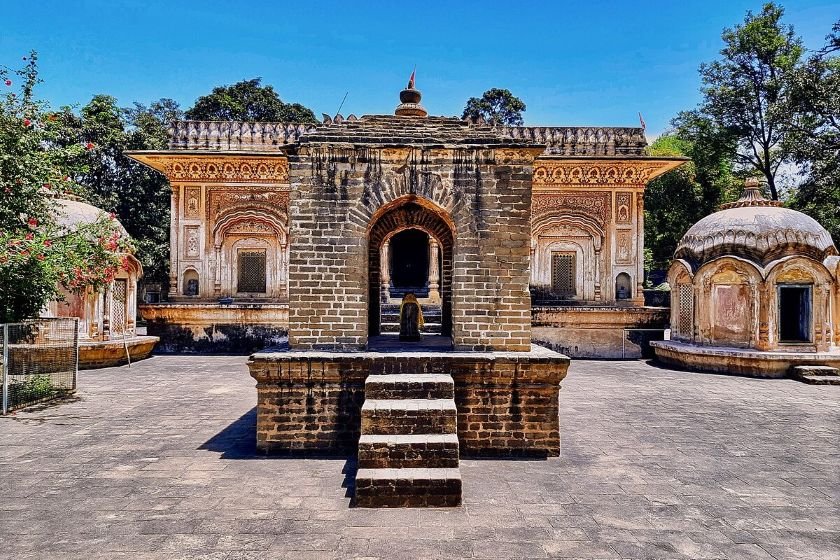
Clustered around the main shrine are several smaller temples, dedicated to Surya, Durga, Ganesha, Lakshmi-Narayan, and Mahishasura Mardini — a small constellation of deities gathered around the central Shiva shrine, reflecting the more inclusive, Panchayatan style of temple layout common in royal commissions of this era.
🏛️ The Temple Itself
Built on open ground on a bluff above the Beas, with the Dhauladhar range forming a distant backdrop, Narvadeshwar’s setting does as much work as its architecture. The Bhitti style blends elements that are recognizably Rajput with a Mughal sensibility in its palace-like proportions — a combination that shows up across Sujanpur Tira’s royal-era buildings more broadly, since the Katoch rulers who built this town were navigating exactly that cultural crossroads in the 18th and early 19th centuries.
Inside, faded as some of it now is, the mural work rewards a slow, patient look rather than a quick pass-through. Panels of Ramayana and Mahabharata scenes sit alongside studies of birds and animals, all rendered in the same rich, saturated palette that made Kangra miniature painting famous well beyond this valley.
📜 Regional Context
Narvadeshwar sits inside Sujanpur Tira, founded in the 18th century by the Katoch dynasty and built up as a fully-fledged royal seat — Raja Abhay Chand constructed the town’s fort in 1758, and Maharaja Sansar Chand later shifted his capital here from Kangra, renaming the town Sujanpur Tira in the process. Alongside Narvadeshwar, Sansar Chand’s reign produced the Murli Manohar temple (dedicated to Krishna) and the Chamunda Devi temple (a fierce Shakti shrine) — together forming a small but genuinely significant cluster of royal temple architecture, all built within a few decades of each other, all bearing the same Kangra-school artistic imprint.
🎉 Festivals and Devotion
- Holi (four days, March): One of India’s oldest continuously observed Holi celebrations, said to have been started by the Katoch royals themselves — the whole town, including the Chougan grounds near the temple, becomes the centre of festivities.
- Maha Shivratri: Observed with additional rituals at the main Shivling, in keeping with any Shiva temple of this stature.
- Daily worship: Routine puja continues at the sanctum, largely unchanged in form despite the surrounding building’s greater fame as an art site.
🏞️ While You’re in the Area
- Sujanpur Fort: Built in 1758 by Raja Abhay Chand, a short walk from the temple, with its own murals, courtyards, and a small museum of Katoch-era artifacts.
- Murli Manohar Temple: A Krishna-Radha shrine built by Sansar Chand, worth pairing with Narvadeshwar as part of the same royal temple circuit.
- Chamunda Devi Temple: A fierce Shakti shrine roughly 5 km away, offering a quieter, hill-view counterpoint to the temple architecture in town.
- The Beas riverfront: A pleasant, unhurried walk along the river, especially in early morning or late afternoon light.
❓ Quick Questions Travellers Ask
Is the temple still actively used for worship, or is it mainly a heritage site? Both — daily puja continues at the Shivling even as the building draws visitors primarily for its murals and history.
How much of the original mural work has survived? A meaningful portion, though the 1905 earthquake and general age have faded and damaged parts of it — enough remains to appreciate the scope of the original commission.
Is there a dress code for visiting? Modest, conservative dress is generally expected, as at any active temple in the region — avoid shorts, sleeveless tops, or similarly casual clothing.
Can this be combined easily with Sujanpur Fort in one visit? Very easily — the two sit within a short walk of each other and are usually visited together.
Is Holi in Sujanpur Tira worth planning a trip around? If you can manage the timing, yes — it’s a genuinely historic, four-day celebration rather than a single-day event, and the temple sits right in the middle of the festivities.
A Last Word
There’s a particular kind of devotion at work in a temple built to be looked at as closely as it’s prayed in — where a queen didn’t just endow a shrine but asked her court’s finest painters to fill it with an entire visual scripture. Narvadeshwar has lost some of that original brilliance to a century of earthquakes and monsoons, but what survives still does exactly what it was built to do: turn a quiet riverside bluff into a place where devotion and art were never meant to be separated in the first place.
Fact-check notes: The temple’s founding date (given as either 1802 or 1823 across sources) and its royal patron (named as either Rani Prasanni Devi or Rani Suketan, both wives of Sansar Chand, depending on the source) show genuine discrepancies across independent accounts and are presented here with that uncertainty flagged rather than resolved artificially. The Bhitti-style construction, the mural subject matter, the surrounding smaller shrines, and the 1905 earthquake damage are corroborated across multiple sources. Exact GPS coordinates were not independently verified — please confirm via the map link above before travelling.