Ten kilometres from Hamirpur town, on a hillside above the Sarlin road, stands an 88-foot Hanuman keeping watch over a shrine to the planet most people pray to avoid — not because the god is unkind, but because he’s said to give exactly what you’ve earned
Not every significant temple in Hamirpur comes wrapped in a centuries-old miracle. Shani Dev Temple, Lambloo, is barely thirty years old, built by local effort rather than royal decree, and it doesn’t pretend otherwise. What draws people here isn’t an ancient legend — it’s the particular, slightly uneasy relationship Hindu tradition has with Shani, the planet-god associated with karma, delay, and hard-earned justice, and a very modern local belief that this stretch of road quieted down considerably once his temple went up.
🌄 Location & How to Reach It
- Location: Near Sarlin village, Lambloo, Hamirpur district, Himachal Pradesh
- Distance: Roughly 10 km from Hamirpur town
- Google Maps: Get Directions
- By road: Regular buses and taxis run from Hamirpur bus stand; an alternate route goes via Bhota to Jhanikar, then on to Lambloo
- By rail: Una Railway Station is the nearest major railhead
- By air: Gaggal Airport (Kangra) is the nearest, roughly 85–90 km away
The temple sits on a hillside directly beside the main road, so unlike some of Hamirpur’s older hilltop shrines, there’s no real climb involved — parking is available along the roadside, and the approach is straightforward.
🌸 Best Time to Visit
Saturdays are, without question, the day to come — Shani’s day of the week draws the temple’s biggest crowds, along with a community langar held every week. Beyond that, Shani Amavasya (falling in the Hindu month of Jyeshtha) and Shani Jayanti bring larger, more ritual-heavy gatherings, with devotees arriving after an early morning bath specifically to perform Shani puja.
🕉️ A Modern Temple, an Old Kind of Unease
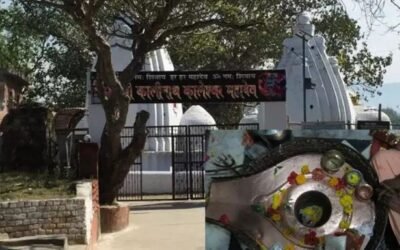
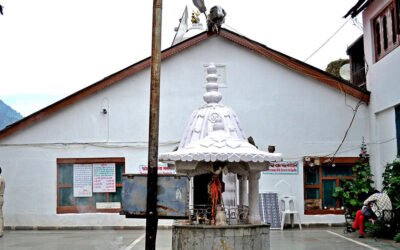
There’s no medieval founding myth here, and the temple doesn’t try to manufacture one. It was established in 1996, built with local community support, and now falls under the management of the Himachal Pradesh government — a straightforward, recent history compared to the centuries-old legends attached to many of Hamirpur’s other shrines.
What has grown up around it instead is a very local, very current belief: residents in the area say that before the temple was built, this stretch of road saw a troubling frequency of traffic accidents, and that since its establishment, that pattern has eased considerably. It’s the kind of claim that would be impossible to verify statistically, and no source treats it as anything more than a locally held conviction — but it fits naturally with what Shani represents in the first place. He’s the planet associated with consequence, with things catching up to you eventually, and a shrine that people credit with calming a dangerous road sits comfortably within that same logic.
The idol itself carries its own quiet detail worth noting if you visit: Shani Dev is traditionally depicted with eyes closed or turned away, never looking directly at a devotee — a visual departure from most Hindu deity idols, and one devotees here point to specifically, since a direct gaze from Shani is, in astrological tradition, not something to invite carelessly.
🙏 What the Temple Is Known For
Shani Dev is one of the Navagraha, the nine celestial bodies whose positions are believed in Hindu astrology to shape the course of a person’s life — and of the nine, Shani is the one people approach with the most caution, associated with the long, difficult transits of Sade Sati and Dhaiya. Devotees come here specifically to ease those planetary difficulties, performing yajnas, Tula Daan (a ritual weighing and donation), and Navgrah Shanti ceremonies aimed at restoring balance and reducing hardship.
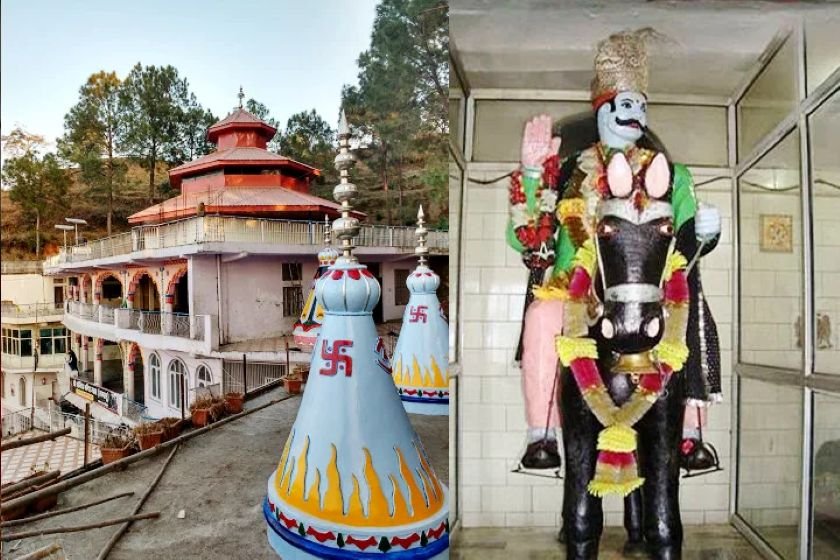
Alongside the main Shani idol, the temple complex includes two striking additions: an 88-foot Panchmukhi (five-faced) idol of Hanuman and a 31-foot idol of Bhairav Dev — both large enough to be visible well before you reach the temple itself, and both drawing their own share of devotion independent of the Shani shrine at the centre.
🏛️ The Temple Itself
This is a temple built for scale and visibility rather than antique architecture — its defining feature, quite literally, is size. The 88-foot Hanuman idol dominates the site’s skyline from the road below, and the complex as a whole is laid out with pilgrims in mind: accessible parking, room for the large Saturday crowds, and a straightforward hillside setting that doesn’t require any real trekking to reach. It’s a working, actively growing pilgrimage site rather than a preserved heritage structure, and it reads that way — practical, well maintained, and clearly built around the rhythms of weekly worship rather than a single historic moment.
📜 Regional Context
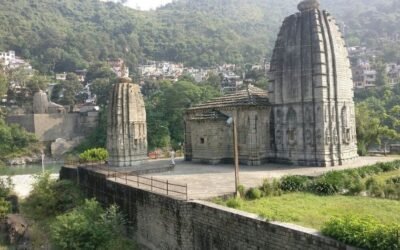
Shani Dev Temple’s rise says something about how Hamirpur’s religious landscape has continued evolving well past the Katoch-era temple-building boom that produced shrines like Narvadeshwar and Murli Manohar in Sujanpur Tira. Where those temples were royal commissions from the 18th and early 19th centuries, Lambloo’s Shani Dev shrine is a product of contemporary community devotion and government stewardship — proof that Hamirpur’s temple culture isn’t a closed historical chapter but something still actively being built.
🎉 Festivals and Devotion
- Every Saturday: The temple’s busiest and most significant day, drawing large crowds along with a weekly community langar.
- Shani Amavasya (Jyeshtha month): A major worship day specifically dedicated to easing Shani’s astrological influence.
- Shani Jayanti: Celebrated with special rituals marking Shani’s own observance day.
- Makar Sankranti and other Navagraha-linked occasions: Observed with additional pujas by devotees seeking planetary balance.
🏞️ While You’re in the Area
- Gasota Mahadev Temple: An older Shiva shrine on the Hamirpur–Jahu road, with its own cattle fair tradition.
- Sujanpur Tira: A heritage town with a cluster of Katoch-era temples, well worth combining into a longer day trip.
- Nadaun: A quiet riverside town with its own Gurudwara and temple connections, roughly 20 km from Sujanpur.
- Hamirpur town itself: A natural base for exploring this and several of the district’s other temples in a single, easy loop.
❓ Quick Questions Travellers Ask
Is this an ancient temple like Hamirpur’s other shrines? No — it was established in 1996, and it doesn’t claim otherwise; its significance comes from active, ongoing devotion rather than historical age.
What should I bring or prepare for a Shani Dev visit? Devotees traditionally bring oil, black til (sesame), and offerings associated with Shani specifically; if you’re here for Tula Daan or Navgrah Shanti rituals, it’s worth checking with temple staff in advance about what’s needed.
Is Saturday really necessary, or can I visit any day? You can visit any day, but Saturday is genuinely the temple’s focal day — expect a much livelier atmosphere, plus the weekly langar.
Is the road up to the temple difficult? No — it sits directly beside the main road with roadside parking, making it one of the more accessible temples in the district.
Can this be combined with Sujanpur Tira or other Hamirpur temples in one day? Yes — its position roughly 10 km from Hamirpur town makes it easy to fold into a broader day covering Gasota, Sujanpur Tira, and other nearby shrines.
A Last Word
Shani Dev Temple, Lambloo doesn’t ask you to believe in a centuries-old miracle to understand why it matters. It asks something more immediate: that consequence catches up with everyone eventually, and that a little humility in the face of that fact is worth the trip. Stand beneath that towering Hanuman idol on a Saturday afternoon, langar being served nearby, and the temple’s appeal stops needing any ancient legend to explain it — it’s simply doing, in real time, what people have always come to temples for.
Fact-check notes: The temple’s 1996 establishment, its management under the Himachal Pradesh government, the 88-foot Hanuman and 31-foot Bhairav Dev idols, and the Tula Daan/Navgrah Shanti rituals are corroborated across multiple independent sources. The local belief connecting the temple’s construction to a reduction in road accidents is repeated in visitor accounts but is a folk claim, not a verified statistic, and is presented here as such. Exact GPS coordinates were not independently verified — please confirm via the map link above before travelling.