High on the highest ridge in Mandi district, a stone goddess sits under open sky, and every roof ever raised over her has come down again.
There’s a certain kind of temple that exists not to shelter a story but to prove one — a shrine built around a single stubborn fact that no engineer, king, or chief minister has managed to argue away. Shikari Devi’s temple is that kind of place. Long before it was a tourist stop or a trekking destination, it was simply the spot where hunters climbed to ask a goddess for a clean kill and safe passage home, and where, centuries later, people are still trying and failing to give her a ceiling. What draws visitors up nearly 600 stone steps today isn’t grandeur — the shrine itself is a modest stone platform — it’s the sense of standing somewhere that has quietly refused to be finished for as long as anyone can remember.
🌄 Location & How to Reach It
Shikari Devi Temple sits atop Shikari Peak, the highest point in Mandi district, in the Seraj region of Himachal Pradesh — roughly midway between the Janjheli and Karsog valleys, with the Shikari Devi Wildlife Sanctuary spread around it. It’s about 18 kilometres from Janjheli on one side and a similar distance from Sanarli in the Karsog valley on the other, both reached by a forest road that winds through oak and pine before running out about a kilometre short of the shrine itself. From there, a long flight of stone steps — locals count it anywhere between 550 and 700, depending on who’s doing the counting and how tired they are by the top — carries you the rest of the way. Mandi town, the nearest major hub, lies roughly 90 kilometres off.
Google Maps: Get Directions
GPS Coordinates: 31.4787°N, 77.1656°E
Elevation: around 3,330 metres (roughly 10,930 feet) — high enough that the tree line thins noticeably in the final stretch and the wind carries a real bite even in summer.
- By road: Motorable forest road from Janjheli or from Sanarli/Karsog, followed by the final steep climb on foot
- By rail: Jogindernagar railway station, around 56 km away
- By air: Bhuntar Airport near Kullu, roughly 200 km away
Compared to most of Himachal’s hilltop shrines, this one asks more of you — it’s less a stroll and more a proper trek, with a real chance of altitude fatigue and unpredictable weather on the last leg, so it rewards people who come prepared rather than those hoping to tick it off quickly.
🌸 Best Time to Visit
The window that actually works for most visitors runs from around mid-April through the end of September, when the forest road is clear, the meadows below the peak are green, and the final climb is merely hard rather than dangerous. Late spring brings out wildflowers along the ridge; by October the slopes start turning gold before the first snow arrives. Winter is a different story altogether — the region can pile up several feet of snow, and the local administration in Thunag has, in recent years, issued outright bans on trekking toward the peak once the season turns, citing frostbite and whiteout risk on the exposed final stretch. If you’re drawn to seeing the temple genuinely snowbound, treat that as a photographer’s fantasy rather than a plan, and check locally before attempting it. The two Navratri periods — one in spring, one in autumn — are when the temple is busiest and most alive, with a steady stream of pilgrims making the climb specifically to coincide with the fair.
🕉️ The Legend: A Warning Ignored, A Goddess Unearthed
The story people tell most often here doesn’t start on the mountain at all — it starts at a dice game. According to local tradition, long before the Pandavas ever set foot in these hills, the goddess who would become Shikari Devi appeared before them as an unremarkable woman while they gambled away their kingdom to Duryodhana. She warned them plainly: stop now, or lose everything and end up begging in the streets. The brothers, seeing only an ordinary villager standing where a king’s game was being played, brushed her off and told her to leave. She did — and the game went on to cost them their kingdom and thirteen years of exile.
The story picks up again deep into that exile, somewhere in these same forests. Out hunting one day, the Pandavas spotted a deer unlike any they’d seen — sleek, unnaturally calm, always just out of range. They chased it for hours through the pines until it slipped away entirely, vanishing rather than simply outrunning them. That night, a woman’s voice rose out of the darkness on the hilltop, identifying herself as the same figure who’d tried to warn them at the dice game. If they wanted their kingdom back, she told them, they needed to dig at a particular spot and recover her image, then raise a shrine to her — one open to the sky, with no roof between her and the mountain. They dug, they found the stone image she’d described, and they built exactly what she’d asked for. In time, the kingdom was restored, and the goddess who had first appeared in disguise came to be known by a new name: Shikari Devi, the huntress who had guided the hunters.
Alongside this account, a second, older-sounding tradition holds that the sage Markandeya spent years in meditation on this same peak, and that the goddess revealed herself to him here in her fierce Mahishasura-slaying form — a story that also places the site in the Markandeya Purana, giving it a scriptural anchor separate from the Pandava tale. Whether both stories describe the same original event, or represent two separate strands of memory that later fused around one mountain, isn’t something anyone can say with certainty, and honestly, it probably shouldn’t be flattened into a single tidy timeline.
As for the temple’s most famous claim — that no roof has ever managed to stay up over it, and that snow refuses to settle inside even when the surrounding slopes vanish under ten feet of it — it’s worth saying plainly that this is exactly the kind of detail that travels faster than verification. It’s repeated with total conviction by locals, pilgrims, and every guidebook covering the region, and multiple independent visitors over the decades describe seeing it firsthand. But “no one has ever managed it” is a hard claim to fact-check across centuries, and it deserves to be told as the powerful local belief it is, not as settled physics.
🙏 What the Deity Is Known For
Shikari Devi is worshipped as a fierce form of Durga — some accounts identify her directly with Kali — but her specific identity as “Hunter Goddess” sets her apart from the grander Shakti shrines found lower in the valleys. She isn’t approached primarily for wealth or marriage the way some of the bigger pilgrimage temples are; her older, more specific role was protection during the hunt itself — safety from wild animals, luck in the chase, a clean outcome rather than a wounded animal and a dangerous pursuit. That hunting-era identity has broadened over generations into something closer to general problem-solving: devotees today climb up with health worries, family disputes, and financial troubles as often as anything else, and the belief that she “removes whatever is asked” runs deep locally.
Offerings here are simple and largely unchanged by tourism — ghee lamps, coconuts, small cash offerings, ceremonial flags called dhvajas, occasionally an umbrella left as a token gift. Animal sacrifice, tied to the temple’s origins among hunting communities, has historically been part of worship here, and it’s honest to say it still happens in some form, even as it’s increasingly viewed with discomfort by newer generations of visitors and by many pilgrims themselves. It’s not something the temple advertises, and it’s not something worth sanitizing either — it’s simply part of what this particular shrine’s history looks like up close.
🏛️ The Temple Itself
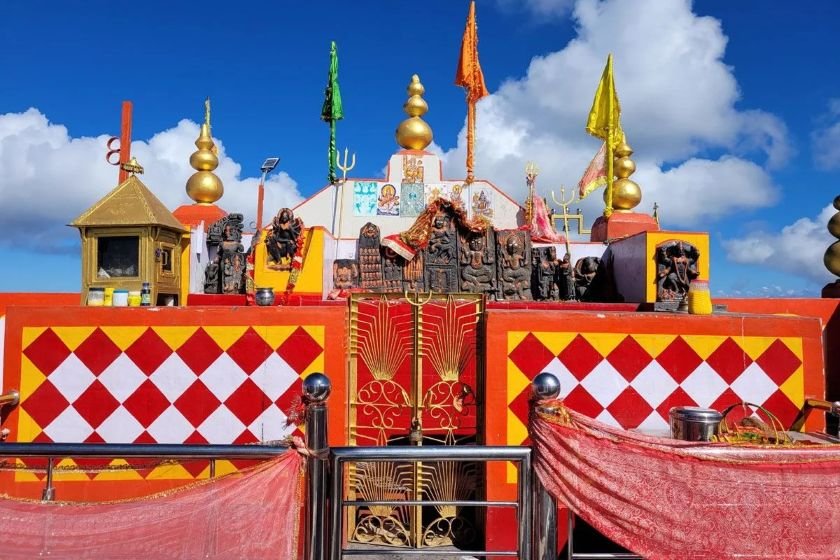
There’s no soaring gopuram here, no carved sandstone facade — the shrine is a plain, flat, cemented square platform with low stone walls on most sides and the goddess represented by a weathered black stone image at its center. What strikes most visitors isn’t craftsmanship, it’s the absence of a ceiling: you stand in what is unmistakably a temple, walled and clearly sacred, and look straight up at open sky. On a clear day the silence up here has its own texture — wind moving through the surrounding oak and blue pine, the occasional call of a monal pheasant, and very little else, since the site sits well above where most daily village life happens. On a cloudy day, mist rolls across the platform in slow waves, and the black stone idol seems to appear and disappear with it. The view outward is arguably as much a part of the experience as the shrine — on a genuinely clear day, the vista reportedly stretches toward the Dhauladhar range, Shrikhand Mahadev, and even distant peaks over in Uttarakhand, though how much of that you actually see depends entirely on the weather cooperating.
📜 The Seraj Valley and Its Layered Past
Shikari Devi’s peak sits inside the wider Seraj region of Mandi district, a belt of high valleys — Janjheli, Karsog, Bagsaid — that has long stayed slightly apart from the main Mandi-Kullu traffic corridor. Janjheli itself carries its own quiet colonial footnote: British officials reportedly wanted to develop the valley into a hill retreat in the way Shimla or Kasauli were built up, but the Raja of Mandi declined to let that happen, and the area kept its village character rather than becoming a resort town. That decision, whether deliberate policy or simple royal preference, is a large part of why this whole belt still feels unhurried compared to more built-up parts of the state.
The wider district carries plenty of other sacred sites from roughly the same devotional world — most notably Kamrunag, a lakeside shrine on the ridge route below Shikari Devi where pilgrims for generations have immersed gold and silver offerings directly into the water rather than handing them to a priest. Together, sites like these form a loose network of hill-deity worship across Mandi that predates, and sits somewhat outside of, the temple-town tourism built around places like Rewalsar in the same district.
🎉 Festivals and Devotion
- Navratri (spring, Chaitra) — the temple’s busiest fair, drawing pilgrims up from both the Janjheli and Karsog sides
- Navratri (autumn, Sharad) — a second major fair period, coinciding with clearer, more trek-friendly weather
- Daily/informal worship — smaller groups and solo pilgrims visit through the accessible months, especially those making a specific request or fulfilling a vow
- Offerings — ghee lamps, coconuts, dhvajas, small cash gifts, occasionally umbrellas, left according to what a visiting pandit at the site suggests
🏞️ While You’re in the Area
- Kamrunag Lake and Temple — a ridge-top trek away, this wooden lakeside shrine holds its own major fair each June and is easily combined with a Shikari Devi visit for anyone doing a multi-day trek through the range
- Janjheli Valley — apple orchards, modest homestays, and old wooden village temples make it a good base before or after the climb
- Bhulah Meadows — a stretch of open highland grassland on the road from Janjheli, worth a stop for the views alone
- Karsog Town — the valley’s other access point, with its own cluster of older temples worth a look if you’re approaching from that side
- Rewalsar — visible in the distance from the peak on clear days, and worth the detour separately for its unusual mix of Hindu, Buddhist, and Sikh pilgrimage sites around one small lake
❓ Quick Questions Travellers Ask
Is the temple open and accessible in winter? Not reliably. Snowfall can bury the region under several feet, and local authorities have issued seasonal bans on trekking toward the peak once winter sets in, for safety reasons. Plan for the mid-April to September window instead.
How many steps is the final climb? Sources vary — figures anywhere from around 550 to 700 steps are quoted — but expect the last kilometre or so from the parking area to be entirely on foot, uphill, at altitude.
Can I drive all the way to the temple? No. A jeepable forest road gets you to within roughly a kilometre of the shrine from either the Janjheli or Karsog side; from that point it’s on foot.
Is there anywhere to stay near the temple itself? Not really at the summit. Most people base themselves in Janjheli or Karsog, where homestays and small guesthouses are available, and make the climb as a day trip or an overnight trek with camping en route.
Is it a demanding trek, or manageable for most fitness levels? It’s rated as a moderate climb rather than a technical one, but the combination of altitude, distance, and the final stone staircase makes it noticeably harder than a typical roadside hill shrine — reasonably fit visitors manage it without special gear, but it’s not a casual stroll.
A Last Word
It would be easy to visit Shikari Devi expecting a grand monument and leave a little underwhelmed by a plain stone platform under open sky. But that emptiness overhead is the entire point — a goddess who, according to the story that gave her this mountain, asked specifically not to be enclosed, and who a Chief Minister himself apparently couldn’t override. Standing there with the wind moving through the pines and the black stone idol catching whatever light gets through the clouds, it’s not hard to understand why nobody up here seems in a hurry to try building that roof again.
Fact-check note: The core details in this piece — the temple’s location on Shikari Peak, its status as the highest point in Mandi district, the roofless architecture, the recurring claim that the interior stays snow-free during heavy regional snowfall, and the Pandava/Markandeya legend traditions — are corroborated consistently across Wikipedia, Himachal Pradesh government tourism pages, and multiple independent travel accounts. GPS coordinates (31.4787°N, 77.1656°E) and elevation (~3,330 m) are drawn from Wikipedia’s cited infobox data. The seasonal trekking ban described here was confirmed via a 2023 Tribune India report; such restrictions appear to be reissued each winter rather than being a single permanent rule, so current-year status should be checked locally before travel. One source dates the structure to the 7th century AD, which sits uneasily alongside the Mahabharata-era origin story told everywhere else — this piece has not tried to reconcile that discrepancy, since no verified founding date exists. No independently verified priest contact number or entrance fee information was found, and none has been invented.