Not to be confused with the more famous Shringa Rishi Temple in Kullu’s Banjar Valley — this is a different, much quieter site altogether, where the sage himself is said to have once meditated inside the mountain rather than beside it
A quick clarification before anything else, since the names genuinely overlap: this isn’t the well-known Shringa Rishi Temple at Baggi village in Kullu’s Banjar Valley, with its rebuilt pagoda-style shrine and its yearly May fair. That temple honours Rishi Shringi as the ruling deity of an entire valley. This is something much more intimate — a set of natural caves near the village of Singi in Sirmaur district, where local tradition holds that the sage Shringi himself once retreated to perform yagna, deep inside rock rather than beneath a constructed roof.
If Banjar’s temple represents how a whole valley chose to honour this sage publicly, these caves feel like the opposite: the quiet, unbuilt place where the man himself is said to have actually sat.
🌄 Location & How to Reach It
- Location: Singi village, near Sarahan, Sirmaur District, Himachal Pradesh – 173001
- GPS Coordinates: 30.7092° N, 77.2790° E
- Google Maps: Get Directions
- Distance: Roughly 30 km from Sarahan (Sirmaur), within reach of Nahan as well
Worth being careful here too: there’s more than one place called Sarahan in Himachal Pradesh — this one is in Sirmaur district, distinct from the far more famous Sarahan near Shimla, home to the Bhimakali Temple. The caves sit near Singi village, reached via local roads from Sarahan or Nahan, with a short climb up a set of steps leading to the cave’s narrow entrance. Local visitor accounts describe the site as genuinely a little tricky to locate without local knowledge, so asking directions in Singi or Sarahan itself is a sensible part of the plan rather than relying purely on GPS.
Getting to the wider area: Nahan, the district headquarters of Sirmaur, is the most practical base, with onward local transport or taxis needed to reach Singi village itself. This remains a genuinely off-the-beaten-path destination — expect modest local infrastructure rather than a well-signposted tourist route.
🌸 Best Time to Visit
March to June and September to November offer the most comfortable conditions for reaching this fairly remote site, avoiding both monsoon slipperiness on the approach steps and any winter cold at the higher elevations nearby. Since the caves are a natural formation rather than a temple with festival-driven crowds, there’s no particular seasonal rush — this is a place better suited to a quiet, unhurried visit than a scheduled pilgrimage.
Timings: No formal opening hours exist for this natural site — it’s accessible during daylight hours, and visitors should plan to arrive with enough daylight left for a careful walk back down afterward.
🕉️ Inside the Cave
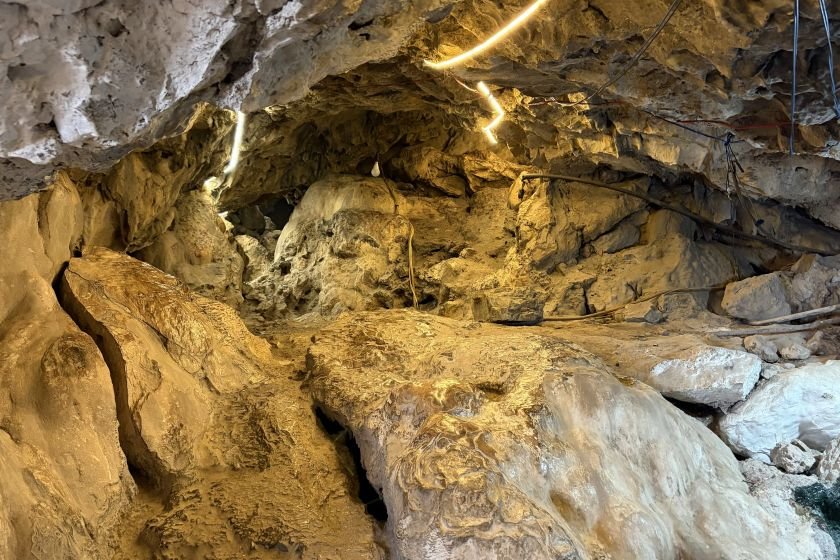
Step through the narrow entrance, past a short stretch of stone steps, and the cave opens into a series of naturally formed rock chambers, worn remarkably smooth in places by centuries of water movement. Several visitors specifically mention water still dripping steadily from the rock even today, collected by some devotees to offer directly to the naturally formed Shivalinga said to lie deep within the cave — a detail that gives the whole site a quietly self-sustaining sense of ritual, water sourced and offered within the very same sacred space, without any human intervention required.
Local tradition holds that this is where Rishi Shringi — the same sage credited elsewhere with presiding over King Dashratha’s Putrakameshti Yagna, the ritual said to have led to the birth of Lord Rama — once withdrew to perform his own yagna and meditation, seeking the isolation and stillness that a natural cave offers in a way no built structure quite can. Whether or not this specific cave was the exact site of that particular yagna, or simply became associated with his broader ascetic practice over time, local memory treats it as a genuine extension of the sage’s presence in the region — a companion site to the more publicly venerated temple in Banjar, rather than a competing claim to his legacy.
Visitors consistently describe the atmosphere inside as unusually still and conducive to quiet reflection — several specifically use words like “peaceful” and mention feeling “detached from the outer world” while inside, a fairly unusual thing for casual tourists to volunteer about a site, and a good indication of how genuinely contemplative this place remains for those who make the journey.
🏛️ A Site Defined by Stone, Not Structure
There’s very little built architecture to describe here, and that’s really the point. Unlike the carved wooden temples found across much of Himachal Pradesh, this is a site whose sanctity rests entirely in a natural rock formation — smooth stone surfaces shaped by water over a very long time, a narrow entrance that requires a small amount of careful climbing, and a deep interior where light fades and the sense of separation from the outside world becomes genuinely pronounced. It’s a reminder that not every sacred site in this region announces itself with carved pillars or a painted roofline — some remain exactly as geology originally left them, venerated precisely because nothing has been added.
📜 How This Connects to the Wider Shringi Rishi Tradition
Rishi Shringi’s story runs deep through this whole corner of the Himalaya, well beyond either this cave or the Kullu temple. Son of the sage Vibhandaka, he’s remembered above all for presiding over the yagna that led to Rama’s birth — a story recounted across the Ramayana tradition and taken seriously enough locally that an entire valley in Kullu chose him as its ruling deity. His descendants are traditionally associated with the Sikhwal (or Shringi) Brahmin community, still found today across parts of Rajasthan and beyond.
What makes Sirmaur’s connection to him distinct is precisely this cave-based tradition — a quieter, more ascetic thread of his story, focused on retreat and meditation rather than his more publicly celebrated role as a royal purohit. Local memory in this part of Himachal Pradesh preserves that thread specifically, offering a rare glimpse of the same figure in an entirely different devotional register from the one most visitors encounter at Banjar.
🎉 Local Devotion
Unlike a temple with a formal festival calendar, this cave doesn’t appear to host large scheduled celebrations of its own — its significance rests more in ongoing, quiet visitation than in an annual fair. Devotees who do make the trip typically come specifically to offer water to the Shivalinga within, drawn directly from the cave’s own dripping stone, and to sit for a period of quiet reflection in a setting that visitor accounts consistently describe as unusually conducive to exactly that.
🏞️ While You’re in the Area
- Nahan Town: Sirmaur district’s headquarters, with its own palace, lake, and colonial-era architecture.
- Renuka Ji Lake: One of Himachal Pradesh’s most significant pilgrimage sites, within reach of the wider Sirmaur area.
- Paudiwala Shiv Temple: Another regional Shiva site near Nahan, tied to its own distinct local legend involving Ravana.
- Suketi Fossil Park: India’s first fossil park, a notable regional attraction near Nahan.
🙏 Getting in Touch
There’s no formal contact number, booking arrangement, or managing body listed for this natural site — it’s a place of quiet local devotion rather than a managed tourist attraction. If you’re planning a visit, asking locally in Sarahan, Singi, or Nahan for current directions and conditions is genuinely more useful than seeking any official point of contact, particularly given how easy several visitors say it is to miss the entrance without local guidance.
❓ Quick Questions Travellers Ask
Is this the same as the Shringa Rishi Temple in Kullu? No — this is an important distinction. This is a natural cave site near Singi village in Sirmaur district, associated with Rishi Shringi’s meditation and yagna practice. The more widely known Shringa Rishi Temple, with its pagoda-style shrine and annual May fair, is a separate site at Baggi village in Kullu’s Banjar Valley.
Is the cave difficult to reach? It involves a short climb up stone steps to a narrow entrance, and several visitors mention the site being genuinely tricky to locate without local knowledge. It’s not a demanding trek, but it does require some care and, ideally, local directions.
Is there an entry fee? No, there’s no charge to visit — it functions as an open natural and devotional site rather than a ticketed attraction.
What should I bring? Sturdy footwear for the steps and narrow entrance, a torch or phone light for the darker interior sections, and a reasonable degree of caution given the natural, unmodified rock surfaces underfoot.
Is it suitable for a family visit? The narrow entrance and natural, sometimes slippery rock interior make this better suited to reasonably able-bodied visitors rather than young children or those with mobility concerns.
A Last Word
There’s a particular kind of quiet that only exists in places built by water and time rather than by human hands, and this cave holds exactly that. No carved doorway announces its significance, no festival crowd fills its narrow entrance most days of the year — just cool stone, the steady sound of water finding its way through rock, and the enduring local memory that a sage once chose this exact darkness to sit still in. Whatever you make of that memory, the stillness itself is real, and it’s not hard to understand why it’s kept people coming back.
Fact-check notes: This site is genuinely distinct from the well-documented Shringa Rishi Temple at Baggi village, Banjar, Kullu district (already covered separately), and this article has been written to keep the two clearly apart, since their similar names invite confusion. Information here draws on a Hindi-language regional tourism source describing the cave’s physical characteristics, a broader academic reference on Rishi Shringi’s mythology, and verified GPS coordinates pulled from live location data. Given how little English-language documentation exists for this specific site, details here are more limited than for better-documented temples on this list — no formal historical dating, festival calendar, or contact information could be independently verified, and none has been invented.
Shringi Rishi Caves, Sirmaur – The Cave Where a Sage’s Penance Still Drips Through Stone
Not to be confused with the more famous Shringa Rishi Temple in Kullu’s Banjar Valley — this is a different, much quieter site altogether, where the sage himself is said to have once meditated inside the mountain rather than beside it
A quick clarification before anything else, since the names genuinely overlap: this isn’t the well-known Shringa Rishi Temple at Baggi village in Kullu’s Banjar Valley, with its rebuilt pagoda-style shrine and its yearly May fair. That temple honours Rishi Shringi as the ruling deity of an entire valley. This is something much more intimate — a set of natural caves near the village of Singi in Sirmaur district, where local tradition holds that the sage Shringi himself once retreated to perform yagna, deep inside rock rather than beneath a constructed roof.
If Banjar’s temple represents how a whole valley chose to honour this sage publicly, these caves feel like the opposite: the quiet, unbuilt place where the man himself is said to have actually sat.
🌄 Location & How to Reach It
- Location: Singi village, near Sarahan, Sirmaur District, Himachal Pradesh – 173001
- GPS Coordinates: 30.7092° N, 77.2790° E
- Google Maps: Get Directions
- Distance: Roughly 30 km from Sarahan (Sirmaur), within reach of Nahan as well
Worth being careful here too: there’s more than one place called Sarahan in Himachal Pradesh — this one is in Sirmaur district, distinct from the far more famous Sarahan near Shimla, home to the Bhimakali Temple. The caves sit near Singi village, reached via local roads from Sarahan or Nahan, with a short climb up a set of steps leading to the cave’s narrow entrance. Local visitor accounts describe the site as genuinely a little tricky to locate without local knowledge, so asking directions in Singi or Sarahan itself is a sensible part of the plan rather than relying purely on GPS.
Getting to the wider area: Nahan, the district headquarters of Sirmaur, is the most practical base, with onward local transport or taxis needed to reach Singi village itself. This remains a genuinely off-the-beaten-path destination — expect modest local infrastructure rather than a well-signposted tourist route.
🌸 Best Time to Visit
March to June and September to November offer the most comfortable conditions for reaching this fairly remote site, avoiding both monsoon slipperiness on the approach steps and any winter cold at the higher elevations nearby. Since the caves are a natural formation rather than a temple with festival-driven crowds, there’s no particular seasonal rush — this is a place better suited to a quiet, unhurried visit than a scheduled pilgrimage.
Timings: No formal opening hours exist for this natural site — it’s accessible during daylight hours, and visitors should plan to arrive with enough daylight left for a careful walk back down afterward.
🕉️ Inside the Cave
Step through the narrow entrance, past a short stretch of stone steps, and the cave opens into a series of naturally formed rock chambers, worn remarkably smooth in places by centuries of water movement. Several visitors specifically mention water still dripping steadily from the rock even today, collected by some devotees to offer directly to the naturally formed Shivalinga said to lie deep within the cave — a detail that gives the whole site a quietly self-sustaining sense of ritual, water sourced and offered within the very same sacred space, without any human intervention required.
Local tradition holds that this is where Rishi Shringi — the same sage credited elsewhere with presiding over King Dashratha’s Putrakameshti Yagna, the ritual said to have led to the birth of Lord Rama — once withdrew to perform his own yagna and meditation, seeking the isolation and stillness that a natural cave offers in a way no built structure quite can. Whether or not this specific cave was the exact site of that particular yagna, or simply became associated with his broader ascetic practice over time, local memory treats it as a genuine extension of the sage’s presence in the region — a companion site to the more publicly venerated temple in Banjar, rather than a competing claim to his legacy.
Visitors consistently describe the atmosphere inside as unusually still and conducive to quiet reflection — several specifically use words like “peaceful” and mention feeling “detached from the outer world” while inside, a fairly unusual thing for casual tourists to volunteer about a site, and a good indication of how genuinely contemplative this place remains for those who make the journey.
🏛️ A Site Defined by Stone, Not Structure
There’s very little built architecture to describe here, and that’s really the point. Unlike the carved wooden temples found across much of Himachal Pradesh, this is a site whose sanctity rests entirely in a natural rock formation — smooth stone surfaces shaped by water over a very long time, a narrow entrance that requires a small amount of careful climbing, and a deep interior where light fades and the sense of separation from the outside world becomes genuinely pronounced. It’s a reminder that not every sacred site in this region announces itself with carved pillars or a painted roofline — some remain exactly as geology originally left them, venerated precisely because nothing has been added.
📜 How This Connects to the Wider Shringi Rishi Tradition
Rishi Shringi’s story runs deep through this whole corner of the Himalaya, well beyond either this cave or the Kullu temple. Son of the sage Vibhandaka, he’s remembered above all for presiding over the yagna that led to Rama’s birth — a story recounted across the Ramayana tradition and taken seriously enough locally that an entire valley in Kullu chose him as its ruling deity. His descendants are traditionally associated with the Sikhwal (or Shringi) Brahmin community, still found today across parts of Rajasthan and beyond.
What makes Sirmaur’s connection to him distinct is precisely this cave-based tradition — a quieter, more ascetic thread of his story, focused on retreat and meditation rather than his more publicly celebrated role as a royal purohit. Local memory in this part of Himachal Pradesh preserves that thread specifically, offering a rare glimpse of the same figure in an entirely different devotional register from the one most visitors encounter at Banjar.
🎉 Local Devotion
Unlike a temple with a formal festival calendar, this cave doesn’t appear to host large scheduled celebrations of its own — its significance rests more in ongoing, quiet visitation than in an annual fair. Devotees who do make the trip typically come specifically to offer water to the Shivalinga within, drawn directly from the cave’s own dripping stone, and to sit for a period of quiet reflection in a setting that visitor accounts consistently describe as unusually conducive to exactly that.
🏞️ While You’re in the Area
- Nahan Town: Sirmaur district’s headquarters, with its own palace, lake, and colonial-era architecture.
- Renuka Ji Lake: One of Himachal Pradesh’s most significant pilgrimage sites, within reach of the wider Sirmaur area.
- Paudiwala Shiv Temple: Another regional Shiva site near Nahan, tied to its own distinct local legend involving Ravana.
- Suketi Fossil Park: India’s first fossil park, a notable regional attraction near Nahan.
🙏 Getting in Touch
There’s no formal contact number, booking arrangement, or managing body listed for this natural site — it’s a place of quiet local devotion rather than a managed tourist attraction. If you’re planning a visit, asking locally in Sarahan, Singi, or Nahan for current directions and conditions is genuinely more useful than seeking any official point of contact, particularly given how easy several visitors say it is to miss the entrance without local guidance.
❓ Quick Questions Travellers Ask
Is this the same as the Shringa Rishi Temple in Kullu? No — this is an important distinction. This is a natural cave site near Singi village in Sirmaur district, associated with Rishi Shringi’s meditation and yagna practice. The more widely known Shringa Rishi Temple, with its pagoda-style shrine and annual May fair, is a separate site at Baggi village in Kullu’s Banjar Valley.
Is the cave difficult to reach? It involves a short climb up stone steps to a narrow entrance, and several visitors mention the site being genuinely tricky to locate without local knowledge. It’s not a demanding trek, but it does require some care and, ideally, local directions.
Is there an entry fee? No, there’s no charge to visit — it functions as an open natural and devotional site rather than a ticketed attraction.
What should I bring? Sturdy footwear for the steps and narrow entrance, a torch or phone light for the darker interior sections, and a reasonable degree of caution given the natural, unmodified rock surfaces underfoot.
Is it suitable for a family visit? The narrow entrance and natural, sometimes slippery rock interior make this better suited to reasonably able-bodied visitors rather than young children or those with mobility concerns.
A Last Word
There’s a particular kind of quiet that only exists in places built by water and time rather than by human hands, and this cave holds exactly that. No carved doorway announces its significance, no festival crowd fills its narrow entrance most days of the year — just cool stone, the steady sound of water finding its way through rock, and the enduring local memory that a sage once chose this exact darkness to sit still in. Whatever you make of that memory, the stillness itself is real, and it’s not hard to understand why it’s kept people coming back.
Fact-check notes: This site is genuinely distinct from the well-documented Shringa Rishi Temple at Baggi village, Banjar, Kullu district (already covered separately), and this article has been written to keep the two clearly apart, since their similar names invite confusion. Information here draws on a Hindi-language regional tourism source describing the cave’s physical characteristics, a broader academic reference on Rishi Shringi’s mythology, and verified GPS coordinates pulled from live location data. Given how little English-language documentation exists for this specific site, details here are more limited than for better-documented temples on this list — no formal historical dating, festival calendar, or contact information could be independently verified, and none has been invented.