Just outside McLeod Ganj, a spring-fed pool and a small Shiva shrine carry a legend so specific that it dictates something as precise as word order — a defeated king’s name placed before a serpent god’s, by the serpent god’s own agreement.
Most temple legends in this region end with a shrine being built and a place being named. Bhagsu Nag Temple’s story goes one step further: it explains not just why the place exists, but why it’s called what it’s called, in exactly that order. A thief, a bottomless lake, a furious serpent god, and a dying wish that turned a punishment into an act of grace — that’s the story sitting behind one of Dharamshala’s most visited, and most misunderstood, temples.
🌄 Location & How to Reach It
- Location: Bhagsu village, near McLeod Ganj, Dharamshala, Kangra district, Himachal Pradesh
- Distance: Roughly 8–11 km from Dharamshala town (about 20–40 minutes by taxi or local bus); a short, easy auto-rickshaw or walking distance from McLeod Ganj itself
- Google Maps: Get Directions
- GPS Coordinates: Not independently verified for this piece — use the map link above, or search “Bhagsu Nag Temple, McLeod Ganj” directly on Google Maps for a precise pin before travelling
- Elevation/terrain: Set in the lush, forested foothills below the Dhauladhar range, at a noticeably gentler elevation than the high-altitude trekking destinations further up the same mountains
- By road: Easily reached by taxi, local bus, or short auto-rickshaw ride from McLeod Ganj; the temple sits right at the edge of the village
- By rail: Kangra’s narrow-gauge station is the closer regional option at roughly 20 km; Pathankot Junction, the nearest broad-gauge station, is around 85–90 km away
- By air: Gaggal Airport (Kangra) is the nearest, roughly 15–18 km away
This is one of the most accessible temples in this series — no real climb, no rough track, just a short ride from one of Himachal’s busiest tourist hubs, which is part of why it draws such a mixed crowd of pilgrims, backpackers, and day-trippers alike.
🌸 Best Time to Visit
March through June brings Dharamshala’s most pleasant weather and its best scenery for a visit here. The temple’s main annual festival, dedicated to Lord Shiva, is generally held around Shravan (the monsoon month) or in September, depending on the source — accounts aren’t fully consistent on the exact timing, so it’s worth confirming locally, but either way it’s described as a vibrant occasion with processions, music, dance, and feasting, drawing crowds to the temple, Dal Lake, Kotwali Bazaar, and Bhagsu Falls all at once. The temple is generally open from around 5:00 AM to 10:00 PM.
🕉️ The Legend: A Stolen Lake, A Dying Wish
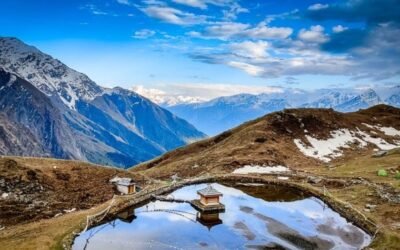
The story, told with striking consistency across sources, is set at Nag Dal — a high-altitude lake in the Dhauladhar range, described in legend as bottomless and spanning roughly two miles across, home to Nag Devta, the serpent deity. A king (in some versions a powerful sorcerer-king, in others described more as an asura, a demon-king) named Bhagsu ruled a kingdom suffering severe drought. Desperate, and skilled in sorcery himself, he journeyed to Nag Dal, found the lake full, and used his powers to capture its water in his kamandal — a ritual water pot — intending to carry it home to save his people.
He didn’t get far. Nag Devta, returning from an evening stroll to find his lake emptied, followed Bhagsu’s tracks and confronted him where he’d stopped to rest for the night. A fierce battle followed, and Bhagsu was defeated — killed, in most tellings, with the lake’s water spilling back to refill Nag Dal in the struggle. But rather than dying in anger or humiliation, Bhagsu, in his final moments, expressed genuine respect and repentance toward the god who’d bested him. Moved by this, Nag Devta granted him a last wish. Bhagsu didn’t ask to be spared — he asked that water reach his kingdom regardless, so his people would be protected, and that he be honored alongside the serpent god’s own fame.
Nag Devta granted both requests. Water began flowing toward Bhagsu’s former kingdom, and the god declared that from then on, this place would carry both their names together — with Bhagsu’s placed first, ahead of Nag Devta’s own. That’s the detail every serious account of this legend agrees on: the very order of the words “Bhagsu Nag” is itself part of the myth, a small, permanent act of grace granted to a defeated king rather than an arbitrary naming convention.
A separate strand of the tradition adds a further layer: Nag Devta is said to have later appeared at this spot in the form of his own beloved deity, Shiva, manifesting as a self-formed (Swayambhu) lingam known as Bhageshwar. According to this account, Bhageshwar later revealed his presence here in a dream to a local ruler named King Dharamchand — and it’s from that king’s name that the nearby town of Dharamshala itself is said to take its own name, linking this small temple’s legend directly to the naming of the wider region’s principal town.
It’s worth being direct about the temple’s age and founding, since sources diverge sharply here: some describe it as dating to the Vedic era, as old as 3,000 BC; others place its construction under a historical Raja Bhagsu reigning between 1123 and 1153 AD; others still describe a 19th-century founding. Given how widely these claims vary and how little independent verification exists for any of them, the temple’s actual age is best treated as genuinely unresolved rather than settled by any single figure.
🙏 What the Deity Is Known For
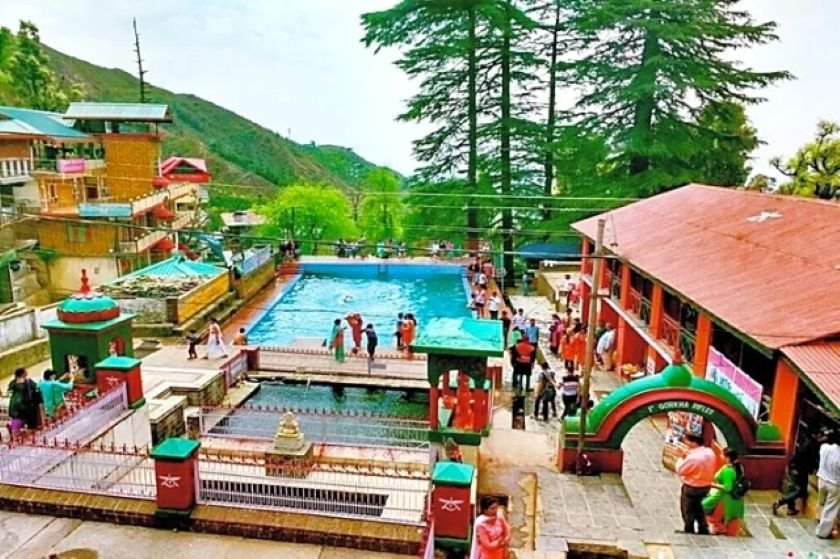
Bhagsu Nag Temple is dedicated jointly to Shiva, worshipped here as Bhageshwar, and to the serpent deity Bhagsu Nag himself — a dual devotional focus that mirrors the legend’s own reconciliation between a mortal king and a divine serpent. Devotees seek the standard range of blessings associated with Shiva worship, but the temple’s sacred pool carries its own specific reputation: fed by a perennial natural spring through three pipes, the kund’s cold water is widely believed to have healing or medicinal properties, and both devotees and casual visitors take a holy dip here, with separate bathing areas maintained for men and women.
The temple also carries a distinct living connection to Gorkha history in the region. Gorkha soldiers settled in this area in the early 18th century alongside the British, later forming the 1st Gorkha Rifles regiment in 1815, and generations of their descendants are still described as maintaining regular devotion to this temple, seeking its blessings for significant occasions to this day.
🏛️ The Temple Itself
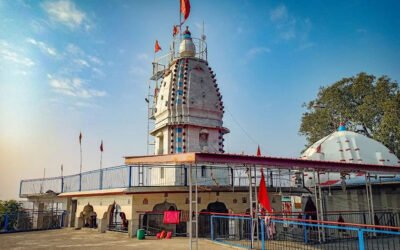
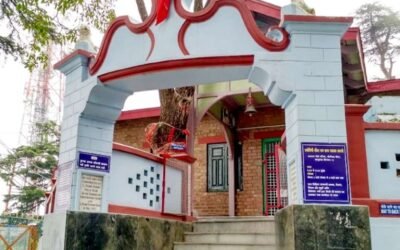
Bhagsu Nag Temple blends traditional Himachali architecture — whitewashed walls, a prominent white shikhara, wooden carvings, and sloping roofs — with a layout that includes three distinct sections: the Pradakshinam, a circumambulation path around the main shrine; the Garbha Griha, the inner sanctum; and the Sabha Mandapam, a communal assembly hall. Surrounding shrines within the same complex are dedicated to Ganesha, Parvati, Hanuman, and Kali Maa, giving the site a fuller pantheon than a single-deity shrine. Deodar trees frame the temple grounds, and the whole complex sits with clear views out toward the Dhauladhar mountains.
Directly in front of the main shrine, the spring-fed sacred pool is the site’s most active gathering point, drawing a steady stream of both religious bathers and curious visitors throughout the day. From the temple, a clear trail leads onward to Bhagsu Waterfall in roughly 15 to 30 minutes on foot — a cascade that some versions of the legend attribute directly to Bhagsu Nag himself, framing the waterfall as a physical extension of the same founding myth rather than a separate natural feature.
📜 Regional Context: From Gaddi Village to Global Backpacker Hub
Bhagsu’s own history traces a striking transformation. It began as a Gaddi tribal village, its people relying on farming and herding for generations, largely untouched by the wider currents of Kangra’s dynastic and pilgrimage history. That changed dramatically after 1959, when the Dalai Lama and the Tibetan community settled in nearby McLeod Ganj, turning the wider area into a major center of Tibetan Buddhist culture and, in the decades since, one of Himachal’s most visited backpacker and tourist destinations. Bhagsu itself has absorbed much of that transformation directly — its streets now lined with rooftop cafés serving Israeli, Tibetan, and Italian food alongside the traditional temple and spring, making it one of the more culturally layered sites in this entire series: an ancient Shiva-Nag legend sitting a few dozen meters from a trance-music café.
🎉 Festivals and Devotion
- Annual Bhagsu Nag festival (Shravan or September, depending on source): A major occasion with processions, music, dance, and feasting, drawing crowds across the wider Bhagsu-McLeod Ganj area.
- Shravan month observances: Special worship tied to the monsoon month, dedicated to Lord Shiva, according to several accounts.
- Ongoing Gorkha devotion: Regular, generational patronage from local Gorkha families for significant life occasions, distinct from the larger annual festival.
- Daily worship: Regular prayer and holy bathing at the sacred pool throughout the year.
🏞️ While You’re in the Area
- Bhagsu Waterfall: A short walk from the temple, the natural centerpiece the legend itself claims as Bhagsu Nag’s own creation.
- Nag Dal Lake trek: A considerably more demanding high-altitude trek leading to the lake at the center of the temple’s founding legend, for those wanting to follow the myth to its source.
- Dal Lake and Naddi Viewpoint: Popular scenic spots in the wider McLeod Ganj area, easily combined with a Bhagsu visit.
- Kotwali Bazaar: Dharamshala’s main market, useful for combining temple and waterfall visits with everyday shopping and food.
- Namgyal Monastery & Tsuglagkhang: The Dalai Lama’s residence and a major Tibetan Buddhist center, representing the area’s other major devotional tradition.
❓ Quick Questions Travellers Ask
Why does the demon king’s name come before the god’s in “Bhagsu Nag”? According to the temple’s core legend, this was Nag Devta’s own granted wish to the dying King Bhagsu — a deliberate act of honor rather than an accident of naming convention, and it’s the detail most consistently emphasized across retellings of the story.
How old is the temple, actually? Genuinely unclear — sources place its origins anywhere from the Vedic era (as old as 3,000 BC) to a 12th-century historical king’s reign to a 19th-century construction, with no single account verified as authoritative; treat any specific age claim with real skepticism.
Is the spring water actually safe or beneficial to bathe in? It’s widely believed locally to have healing properties and is cold, natural spring-fed water with separate bathing areas for men and women; as with any natural spring, use your own judgment about entering, particularly regarding water quality after heavy rain.
Is this connected to how Dharamshala town got its name? According to one strand of the temple’s legend, yes — the self-manifested Shiva lingam here is said to have revealed itself in a dream to a King Dharamchand, from whom the town of Dharamshala is said to take its name, though this detail appears in fewer sources than the core Bhagsu-and-Nag-Devta story.
Is Bhagsu worth visiting if I’m not particularly religious? Yes — between the waterfall, the cafés, the trekking routes, and the general atmosphere of the village, Bhagsu functions as much as a scenic and cultural stop as a pilgrimage site, and many visitors come primarily for the waterfall and village rather than the temple itself.
A Last Word
Bhagsu Nag Temple carries an unusually literal kind of legend — not just an explanation for why a shrine exists, but for the precise shape of its own name, granted as a dying wish and kept ever since. Between the spring-fed pool, the short walk to the waterfall, and the trance music drifting down from a café further up the trail, it’s a place where an old story about a repentant king and a forgiving god somehow still holds its own against a genuinely modern, cosmopolitan village that’s grown up right around it.
Fact-check note: The core legend — King Bhagsu stealing water from Nag Dal Lake, his defeat by Nag Devta, and the god granting both flowing water for Bhagsu’s kingdom and the honor of his name preceding Nag Devta’s own — is remarkably consistent across sources and is treated here as the temple’s well-established primary tradition. The connected claim that a self-manifested Shivling here revealed itself to a King Dharamchand, giving Dharamshala town its name, appears in fewer sources and is presented as a secondary, less-verified strand of the same broader legend. The temple’s founding date is genuinely unresolved — claims range from the Vedic era (c. 3000 BC) to a 12th-century king’s reign to 19th-century construction — and no single figure is presented as authoritative. The exact timing of the temple’s annual festival (Shravan vs. September) also varies by source and is presented as uncertain rather than resolved. No exact GPS coordinates or official contact details could be verified, and none are invented here.