A 16th- or 17th-century temple in the heart of Mandi has no roof over its main hall — and depending on who you ask, that’s either a profound theological statement, an unfinished Mahabharata-era construction race, or simply centuries of weather finally winning.
Most temples explain their own architecture in a single, agreed-upon way. Ardhnarishwar Temple in Mandi offers you a choice. Stand in its open-air mandapa, looking straight up at the sky where a roof should be, and you’ll hear at least three different reasons for why it isn’t there. One version tells you it was never meant to have one — that a temple dedicated to Shiva and Parvati fused into a single body deserves an open ceiling, so that masculine form can merge with feminine sky. Another traces it back to the Pandavas, racing to build eighty-one temples in a single night and running out of darkness before they could finish the eighty-first. A third, considerably less poetic explanation comes from the temple’s own official caretakers: the roof simply collapsed, and the building has sat in a state of disrepair ever since. All three stories are still in circulation. None of them has driven out the others.
🌄 Location & How to Reach It
Ardhnarishwar Temple stands on Samkhetar Road in Mandi town, Himachal Pradesh, on the banks of the Beas River, roughly 1.5 km from the Mandi bus stand and close to the well-known Bhootnath Temple.
Google Maps: Get Directions
Sitting right in the heart of Mandi town, this is one of the more effortlessly accessible temples in this series — no trek, no remote approach, just a short walk within the town itself.
- By road: Easily reached on foot or by auto from Mandi bus stand; Mandi town is well connected by bus and taxi from Shimla, Kullu, Manali, and Chandigarh.
- By rail: Reported at roughly 55 km from Joginder Nagar’s narrow-gauge terminus, the closest practical rail option, though Mandi itself has no station of its own.
- By air: The nearest airport is generally cited at around 56 km away near Kullu, with Chandigarh Airport as a longer-distance alternative.
Given its in-town location, this temple pairs naturally with the rest of Mandi’s dense cluster of old shrines — a short walk covers this, Bhootnath, and several others on the same afternoon.
🌸 Best Time to Visit
As an open-air, roofless structure, Ardhnarishwar is most comfortably visited outside the peak monsoon months, when rain falls directly into the mandapa. October through March offers the most pleasant conditions for lingering over its carvings. As with much of Mandi town, Shivratri — the town’s week-long international fair — is the most significant citywide occasion, drawing large crowds to temples across Mandi, this one included, even if it isn’t the single largest individual draw among them.
🕉️ The Legend: A Missing Roof, Three Ways
The temple’s most classical legend has nothing to do with Mandi specifically — it explains the Ardhanarishwara form itself, the composite half-Shiva, half-Parvati deity found in temples across India. According to this widely attested tradition, Brahma, tasked with the work of creation, found himself unable to proceed using only male beings; the process demanded both masculine and feminine principles working together. Shiva, recognising the problem, merged with Parvati into a single form — Shiva occupying the right half of the body, Parvati the left — making the union of Purusha (consciousness) and Prakriti (nature) literal rather than merely symbolic. This is the foundational myth behind every Ardhanarishwara shrine, not something specific to Mandi, and it’s well documented across classical Hindu textual tradition.
What is specific to this particular temple is the question of its missing roof, and here the sources genuinely diverge into three separate explanations rather than one agreed story.
The most devotionally satisfying version holds that the roofless mandapa is entirely intentional: since the deity enshrined here already embodies the union of two opposing principles in one body, the open ceiling is read as a further, architectural extension of the same idea — the temple’s masculine form left open to merge with the feminine energy of the sky above it. It’s a lovely piece of theological symmetry, and it’s the explanation most often repeated in devotional and tourism-oriented accounts of the temple.
A second, entirely different version ties the temple into Mandi’s larger civic identity as “Chhoti Kashi” — a nickname earned by the town’s claim to host 81 temples, matching or exceeding Varanasi’s own famous temple count. According to this tradition, the Pandavas were tasked with building all 81 temples in a single night, and very nearly succeeded — but dawn broke before the eighty-first and final temple could be completed. Ardhnarishwar, in this telling, is that unfinished eighty-first temple, its incomplete state a permanent record of a race against time that fell just short.
The third explanation is the least poetic and the most straightforwardly documented: architectural surveys of the site describe the roof over the maha-mandapa as having collapsed, and note the temple’s overall state of preservation as poor. Independent sources date the temple’s actual construction to either the 16th century, under Raja Ajbar Sen, or the 17th century, under Raja Sidh Sen — two different Mandi rulers credited in different accounts, a genuine discrepancy worth flagging rather than resolving in favour of either. Either way, this places the temple’s real origin firmly within Mandi’s documented Sen-dynasty history rather than the mythic Mahabharata past, which makes the more devotional and legendary explanations for its open roof feel less like literal history and more like meaning layered onto a structure that, in more prosaic terms, has simply weathered and partially collapsed over several centuries.
None of these three stories fully cancels out the others in local memory, and that’s arguably the most honest way to leave it: a genuinely uncertain construction date, a real structural collapse, and two different layers of myth built on top of it, all coexisting in how the temple is talked about today.
🙏 What Ardhnarishwar Is Known For
Devotees visiting the temple seek a range of blessings unusually broad for a single shrine — sources describe visitors coming for spiritual liberation, wealth, relief from illness, success in major purchases like vehicles, and the pursuit of knowledge, reflecting the composite deity’s symbolic association with wholeness and balance rather than any single, narrower devotional specialty.
One of the temple’s most distinctive features is something it doesn’t have: a Nandi, the bull mount conventionally placed facing the sanctum at nearly every Shiva temple in India. Local tradition explains the absence directly through the deity’s composite nature — since Ardhnarishwar already embodies both Shiva and Shakti within a single form, the customary placement of Nandi is considered unnecessary, making this a genuinely rare example among India’s Shiva shrines.
🏛️ The Temple Itself
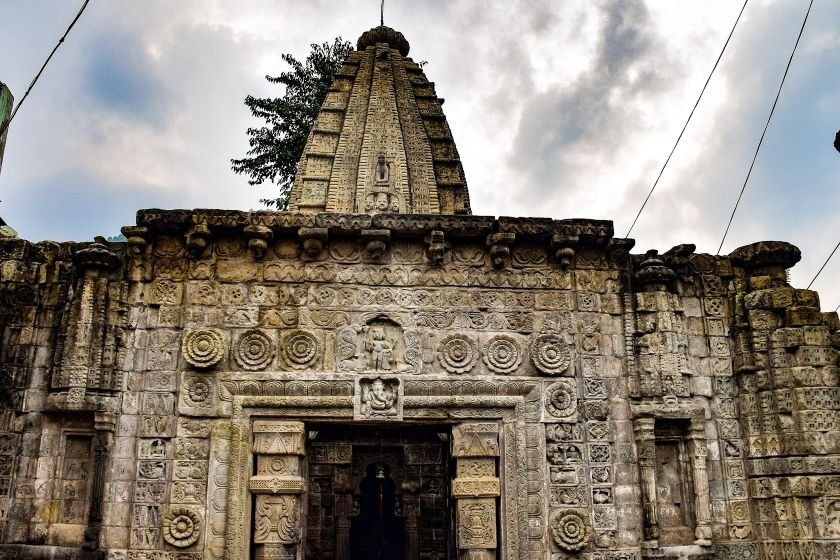
Architecturally, the temple follows a sanctum–antarala–maha-mandapa layout, with the sanctum built on a triratha (three-projection) plan. The mandapa, roofless as discussed above, is framed by four corner shrines and supported by four pillars whose capitals carry restrained, symmetrical geometric designs, giving the open hall what one description calls an almost ascetic character despite the density of carving elsewhere on the structure. The shikhara above the sanctum carries three carved faces of Shiva, while an image of Ganesha sits above the entrance gateway — a conventional but carefully executed piece of temple iconography. The garbhagriha’s entrance is worked with detailed geometric motifs, and the mandapa’s arched windows are decorated with floral carving.
The sanctum’s central image is the temple’s obvious centrepiece: a stone Ardhanarishwara idol with Shiva’s half — matted hair, a garland of skulls, a serpent — occupying the right side, and Parvati’s half, richly adorned with traditional jewellery, occupying the left. A carved slab beside the main image depicts the couple’s respective mounts, the bull and the lion, together on a single stone. Images of Bhairon and Hanuman are also present within the complex, and in the temple’s four corners, sculpted figures are traditionally kept dressed in silk cloth. The temple is a protected Monument of National Importance under the Archaeological Survey of India’s Shimla Circle — a designation that sits oddly alongside at least one online source describing it, seemingly incorrectly, as a “modern temple”; given its ASI protection and the historical construction dates attributed to it by multiple other sources, that particular description looks like an error rather than an accurate account of the temple’s age.
📜 Mandi’s “Chhoti Kashi” Identity
Ardhnarishwar Temple sits at the center of Mandi’s broader self-image as “Chhoti Kashi” — Little Varanasi — a nickname built on the town’s claim to 81 old temples packed into a relatively compact urban area, rivalling the sacred density of Varanasi itself. Whatever the truth of the specific “81st temple left unfinished overnight” legend, it’s a story that only makes sense in a town this genuinely saturated with old shrines — Bhootnath, Triloknath, Panchvaktra, Bhima Kali, and Shyamakali among them — where a temple standing slightly apart from the rest, roofless and architecturally unusual, invites exactly this kind of explanatory myth-making.
🎉 Festivals and Devotion
- International Shivratri Fair: Mandi’s week-long, town-wide festival, drawing large crowds to temples across the town, including this one.
- General darshan: The temple functions as an active, if modestly scaled, place of worship year-round, alongside its status as a protected ASI monument.
🏞️ While You’re in the Area
- Bhootnath Temple: Just nearby, built in 1527 and central to Mandi’s Mahashivratri celebrations.
- Bhima Kali Temple, Bhiuli: A riverside Shakti shrine elsewhere in Mandi town, on the banks of the same Beas River.
- Triloknath Temple: Another of Mandi’s old riverside temples, close to the main bus stand.
- Panchvaktra Mahadev Temple: Known for its five-faced Shiva idol, near the Beas–Suket Khad confluence.
- Parashar Lake and Temple: A high-altitude sage’s shrine with a mysterious floating island, further into Mandi district for those extending the trip.
❓ Quick Questions Travellers Ask
Is the roof ever going to be repaired? No confirmed restoration plans could be found for this article; given the temple’s protected status under the ASI, any future conservation work would likely go through that authority, but its current roofless state has persisted long enough to become part of how the temple is understood and explained locally.
Why doesn’t this Shiva temple have a Nandi statue? Local tradition attributes this directly to the deity’s composite Shiva-Shakti form, which is considered to make the conventional placement of Nandi unnecessary — a genuinely unusual feature among Indian Shiva temples.
How old is the temple, really? Sources disagree — one account credits 16th-century construction under Raja Ajbar Sen, another 17th-century construction under Raja Sidh Sen. Both place it within Mandi’s historical Sen dynasty rather than confirming any specific single date.
Is there an entry fee? No entry fee could be confirmed for this article; as an ASI-protected but actively worshipped town temple, general access is very likely free.
How does this temple fit into a wider Mandi sightseeing day? Very easily — it’s within easy walking distance of several of the town’s other major temples, making it a natural stop on any “Chhoti Kashi” temple walk.
A Last Word
There’s something quietly appropriate about a temple dedicated to the fusion of two opposites refusing to settle on a single story about itself. Ardhnarishwar doesn’t resolve the tension between its devotional symbolism, its epic-scale legend, and its documented structural decay — it just holds all three at once, the way its central idol holds Shiva and Parvati in a single unbroken body. Stand in that open mandapa long enough, sky overhead instead of a ceiling, and it stops mattering which explanation you came in believing. The temple simply is what centuries of weather, faith, and storytelling have left behind.
Fact-check note: The temple’s dedication to Ardhanarishwara (composite Shiva-Parvati), its location on Samkhetar Road in Mandi town, its roofless mandapa, its absence of a Nandi statue, and its status as an ASI-protected Monument of National Importance are well corroborated across independent sources, including Wikidata’s ASI-sourced records. Genuinely unsettled and flagged above rather than resolved with false precision: the temple’s construction date and patron (16th-century Raja Ajbar Sen vs. 17th-century Raja Sidh Sen), and the reason for its missing roof (intentional theological design vs. an unfinished Pandava-era legend vs. straightforward structural collapse, per architectural survey descriptions). At least one source describing the temple as “modern” appears inconsistent with its documented ASI-protected historical status and is not treated as reliable here. No entry fee could be confirmed.