High above Mandi, a nearly circular alpine lake with a mysteriously drifting island has not one but two competing origin stories — and they don’t agree on who actually made it, or why.
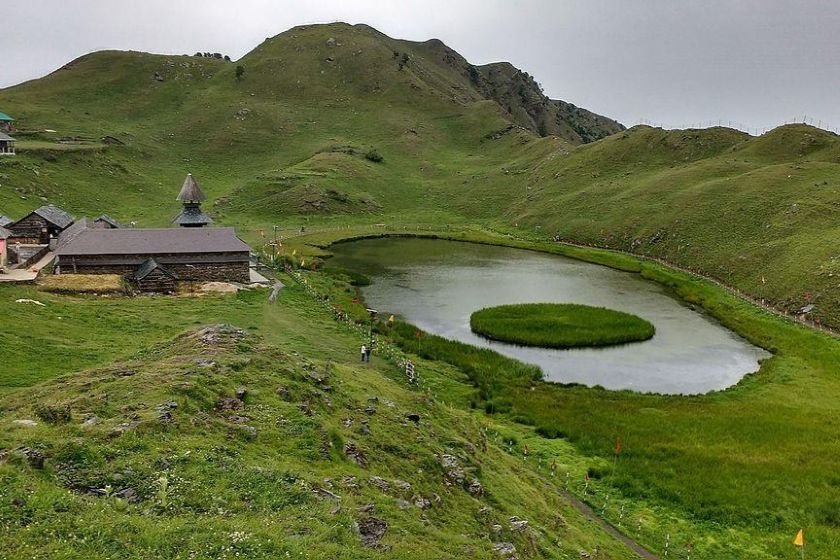
Some sacred lakes have a single, tidy creation myth. Parashar Lake has two, and they don’t fit neatly together. One tradition credits the sage Parashar himself, striking the ground with his rod and calling the water up from the earth to give himself a place for meditation. The other credits Bhima, mightiest of the Pandava brothers, ramming his elbow or mace into the mountainside after the Kurukshetra war — not for his own sake, but to give the rain-god Kamrunag a place to settle after falling in love with the view. Both stories are told here, often by the same guides in the same breath, and neither cancels the other out in local memory. What’s left, either way, is a genuinely strange, nearly circular lake at 2,730 metres, with a floating island that drifts across its surface for reasons nobody has fully explained, and a three-tiered wooden temple on its bank old enough to have watched centuries of visitors try to make sense of both stories at once.
🌄 Location & How to Reach It
Parashar Rishi Temple and its adjoining lake sit at an altitude of approximately 2,730 metres (8,960 feet), roughly 49 km from Mandi town in Himachal Pradesh, reached most commonly via Baggi village or Kataula.
Google Maps: Get Directions
- By road: Approximately 49 km from Mandi via Kataula or Bajaura, roughly a two-hour drive by taxi or private vehicle on mountain roads; a separate, more rugged route connects toward Panarsa near the Kullu-Manali highway, though that stretch is better suited to 4WD vehicles given its unpaved, rocky sections.
- By rail: Reported distances to Joginder Nagar’s narrow-gauge station vary considerably across sources, from around 80 km to well over 100 km, so this is best treated as a rough, distant option rather than a practical primary route.
- By air: Bhuntar Airport near Kullu is the nearest, generally cited at 65–70 km away.
- By trek: A popular alternative is the 7–8 km trek from Baggi village, climbing through alpine meadows and cedar forest — moderately challenging, and considered especially scenic in spring and autumn.
April through November offers the most reliable road access; conditions can deteriorate quickly in bad weather given the mountain terrain on every approach route.
🌸 Best Time to Visit
May through July and September through November are generally considered the most pleasant windows, avoiding both peak monsoon and the harshest winter cold. The temple’s main annual gathering is referred to across different sources as either the Saranauhali fair or the Parashar Mela, generally placed in June, with devta processions, folk music, and local cuisine; whether these names describe the same event or two related but distinct observances isn’t entirely clear from the sources available, so it’s worth treating them as likely overlapping rather than assuming they’re identical. Rishi Panchami, a festival specifically honouring sages, is also noted as being celebrated here separately.
🕉️ The Legend: Two Stories, One Crater
Parashar’s core mystery isn’t really about the sage at all — it’s about how the lake itself came to exist, and the sources genuinely disagree on the answer.
The first tradition, repeated by Himachal Pradesh’s own district tourism authority, credits the sage Parashar directly: meditating at this site, he is said to have struck the ground with his rod (gurj), and water rose up and took the shape of the lake that now bears his name. A related version of this same broad tradition has Parashar instead using his arrows to create three separate sacred ponds nearby — Amrit Kund, Hathi Kund, and Brahma Kund — each carrying its own claimed properties, layering the sage’s miraculous association across multiple features of the landscape rather than just the main lake.
The second tradition belongs to the Mahabharata rather than to Parashar personally, and ties the lake’s creation to Bhima and the rain-god Kamrunag. In this version, the Pandava brothers were travelling home after the eighteen-day war at Kurukshetra, accompanied by Kamrunag, who had grown so attached to the beauty of this particular stretch of mountains that he wished to remain there permanently. Bhima, strongest of the five brothers, is said to have struck the ground — with his elbow in some tellings, his mace in others — carving out the depression that filled with water to become the lake, specifically so that Kamrunag would have somewhere to settle.
It’s worth being honest about a real geographical wrinkle in that second story: Kamrunag’s own shrine, as it’s independently documented elsewhere, sits on Kamru Hill, a genuinely separate location reached by its own multi-hour trek from Rohanda, several hours’ walk from Parashar Lake rather than at it. If Kamrunag settled permanently at Parashar, it sits oddly alongside his own well-established temple existing as a distinct pilgrimage site elsewhere in the same district. Rather than try to resolve that inconsistency, it’s more honest to treat both places as sharing a common thread of Mahabharata-era legend involving Bhima and Kamrunag’s post-war journey through this region, without insisting the two stories describe a single, internally consistent itinerary.
Separately, it’s worth noting that the historical sage Parashara — traditionally credited as the author of the Vishnu Purana and the father of Ved Vyasa, the sage said to have compiled the Mahabharata itself — is a genuinely major figure in classical Hindu tradition, generally associated in the broader textual record with regions near the Yamuna and Ganga rather than specifically with this Himalayan lake. His association with this exact site in Mandi district reflects a strong and long-standing regional tradition rather than something drawn from the pan-Indian textual accounts of his life — a pattern common to many Himalayan sites that anchor major classical figures to a specific local landscape.
🙏 What Parashar Rishi Is Known For
Devotees visiting the temple come to honour Parashar as a figure of deep wisdom and meditative power, seeking blessings, spiritual insight, and a sense of connection to one of Hindu tradition’s foundational sage-lineages. The temple functions as a pilgrimage destination in its own right, but its identity is inseparable from the lake beside it — visitors describe the two as a single spiritual experience rather than a temple with an adjacent scenic feature, with prayer, quiet reflection, and the strange sight of the drifting island all folding into the same visit.
Ritual practice here follows familiar patterns — offerings of flowers, incense, and ghee lamps — while the site’s real distinctiveness lies less in any single elaborate ceremony and more in the sheer atmosphere of the place: a working pilgrimage site, a trekking destination, and a subject of ongoing local fascination and scientific curiosity all at once, in a way that’s fairly unusual even among Himachal’s already atmospheric high-altitude shrines.
🏛️ The Temple Itself
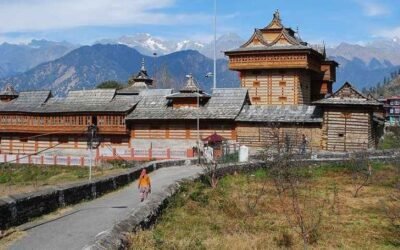
Parashar Rishi Temple is a three-tiered, pagoda-style wooden structure, generally dated to the 13th or 14th century and consistently credited to Raja Ban Sen of Mandi across nearly every source consulted — one of the more solidly corroborated attributions in this entire series. Built from deodar wood and stone in traditional Himachali style, the temple is densely carved with mythical creatures, floral motifs, serpents, and depictions of local deities, its tiered slate roof designed to blend into the alpine landscape around it rather than dominate it. The sanctum houses the sage in the form of a Pindi — a natural stone representation — described by at least one visitor account as distinctly black in colour.
At least two independent sources repeat a striking construction claim: that the entire temple was built from a single deodar tree, with one account adding that the process took twelve years to complete. This is the same kind of extraordinary craftsmanship claim that turns up at other wooden temples in this region — Magru Mahadev at Chhattri carries an almost identical story — and while it speaks to a genuine and impressive tradition of single-log timber construction in Himachali temple-building, it’s worth flagging as a claim repeated across a small number of sources rather than something independently architecturally verified.
The lake itself is, if anything, the more debated physical feature. Its size is reported wildly differently depending on the source — official tourism material describes a modest perimeter of around 300 metres, while at least one visitor account describes the lake as nearly a kilometre in diameter — a large enough discrepancy that it’s worth treating any specific figure with real caution rather than picking one to state as fact. What is consistently reported is the lake’s floating island: a patch of dense vegetation that shifts position across the water over the course of the year, for reasons that remain genuinely unexplained despite various scientific theories (trapped gas, root mats, seasonal wind patterns) circulating alongside the more devotional explanation that the sage’s own spirit guides its movement. The lake’s depth is also popularly described as unknown or bottomless — folklore rather than measured fact, but a detail repeated consistently enough to be a core part of how the site is understood locally.
📜 Mandi’s Ban Sen Legacy and the Wider Seraj Landscape
Parashar’s construction under Raja Ban Sen places it within Mandi’s broader dynastic temple-building history, alongside other Sen-era shrines across the district. Geographically and thematically, Parashar Lake belongs to the same high-altitude cluster of Mandi’s Mahabharata-linked sacred sites as Kamrunag and Shikari Devi — places where classical epic legend, older Yaksha and Naga folk tradition, and genuinely difficult, remote terrain combine to produce some of Himachal’s most atmospheric pilgrimage destinations. Together, these sites form a loose regional network of high-altitude shrines that trekkers and pilgrims alike often visit in combination, rather than as isolated, unconnected stops.
🎉 Festivals and Devotion
- Saranauhali fair / Parashar Mela (June, possibly extending into July): The temple’s main annual gathering, with devta processions, folk music, and local cuisine — reported under two overlapping names across different sources.
- Rishi Panchami: A festival specifically honouring sages, celebrated at the temple separately from the main summer fair.
- General darshan: The temple sees a steady flow of pilgrims, trekkers, and campers throughout its accessible season, given its dual identity as both a devotional and outdoor-recreation destination.
🏞️ While You’re in the Area
- Kamrunag Temple: A high-altitude rain-god shrine elsewhere in Mandi district, sharing overlapping Mahabharata-era legend with Parashar Lake.
- Baggi Village: The main starting point for the trek up to Parashar Lake, useful for arranging guides and supplies.
- Karsog Valley: Known for its own cluster of ancient temples and Pandava-linked legends.
- Mandi town (“Chhoti Kashi”): About 49 km away, with its own dense concentration of old temples, including Bhutnath and Triloknath.
- Shikari Devi Temple: A roofless Shakti shrine at the highest point in Mandi district, part of the same broader high-altitude pilgrimage network.
❓ Quick Questions Travellers Ask
Why does the lake have two different origin stories? Local tradition simply hasn’t settled on one — a sage-centred version credits Parashar’s own miraculous rod-strike, while a separate Mahabharata-era version credits Bhima creating the lake for Kamrunag. Both are commonly told, sometimes by the same guide in the same conversation.
How big is the floating island, and can I get close to it? Reports vary, and its position shifts throughout the year, so its accessibility depends entirely on when you visit; it’s best appreciated from the shore rather than approached directly.
Is the trek to Parashar suitable for beginners? The 7–8 km trek from Baggi is generally described as moderately challenging — manageable for a reasonably fit beginner, but a genuine hill trek rather than a casual walk.
Is there accommodation near the temple? Yes — a forest rest house, an HPPWD rest house, and accommodation run by the temple committee are all available for overnight stays, alongside popular camping options in the surrounding meadows.
Is there an entry fee? No entry fee could be confirmed for this article; as an actively used pilgrimage and trekking site, general access is very likely free, though camping or rest house stays may carry their own charges.
A Last Word
There’s something fitting about a lake that refuses to settle on a single story about its own beginning, sitting beside a temple dedicated to a sage famous for authoring some of Hinduism’s foundational texts. Whether it was Parashar’s rod or Bhima’s elbow that opened this particular crater in the mountainside, what’s left behind resists easy explanation on every level — an island that won’t stay put, a depth nobody has measured, and a temple that has quietly outlasted seven centuries of visitors arriving with the same unanswered question. Some places, it turns out, are more interesting for what they don’t resolve than for what they do.
Fact-check note: The temple’s 13th/14th-century construction under Raja Ban Sen of Mandi, its three-tiered pagoda-style wooden architecture, its dedication to Sage Parashar, and the lake’s floating island are well corroborated across independent sources, including Wikipedia and Himachal Pradesh’s own district tourism authority. Genuinely unsettled and flagged above rather than resolved with false precision: which of two competing legends (Parashar’s rod vs. Bhima/Kamrunag) explains the lake’s creation; the lake’s actual size (reported perimeter/diameter figures vary substantially); distances to Joginder Nagar railway station; and the claim that the temple was built from a single deodar tree, which appears in more than one source but isn’t independently architecturally verified. No entry fee could be confirmed.