For generations, devotees at this Karsog Valley shrine marked Navratri by sacrificing a buffalo — a ritual re-enacting the goddess’s own ancient victory. In recent years, a Himachal Pradesh court finally ordered it to stop, and the temple’s priests fought that order all the way to the bench.
Most of the temples in this series carry their conflicts safely in the past — a medieval invasion, a dynastic dispute, a legend nobody can fully verify anymore. Kamaksha Devi Temple in Kao village is different: its most defining tradition ran headfirst into a modern Indian courtroom within living memory. The temple’s founding legend holds that Goddess Durga, in her Kamaksha form, slew the buffalo-demon Mahishasura on this exact spot — and for as long as anyone could remember, devotees marked that victory each Navratri by sacrificing an actual buffalo at the site. When animal sacrifice came under legal challenge in Himachal Pradesh, the temple’s priest pushed back hard, citing ancient religious texts and taking the fight to the Deputy Commissioner of Mandi and eventually the High Court itself — which ultimately ruled the practice banned across the state. It’s a rare thing: a temple whose central ritual has a documented, dated legal ending, layered directly on top of a myth that supposedly stretches back to the Satya Yuga.
🌄 Location & How to Reach It
Kamaksha Devi Temple sits in Kao village, roughly 7 km from Karsog town, in the Karsog Valley of Mandi district, Himachal Pradesh — a bowl-shaped valley known for its apple orchards and deodar forest, roughly 90–100 km from both Mandi and Shimla.
Google Maps: Get Directions
The final stretch into Kao runs along a narrow village road, and more than one visitor account notes that it’s best travelled in daylight given the road’s condition.
- By road: Reachable via the Karsog–Mandi or Karsog–Shimla routes; Chindi, a small village roughly 19–20 km away, is a common overnight base for those exploring the wider Karsog Valley.
- By rail: The nearest practical railhead for this specific part of Mandi district is generally cited as Shimla, despite the considerable distance — a reflection of just how far into the interior of the district Karsog Valley sits.
- By air: Shimla’s airport is similarly cited as the nearest option, again underlining the valley’s genuine remoteness from any major transport hub.
Karsog Valley itself isn’t a heavily touristed part of Himachal, and getting to Kao specifically means committing to the valley as a destination rather than a quick stop along a bigger route.
🌸 Best Time to Visit
Navratri remains the temple’s most significant occasion, even with its most controversial historical ritual no longer part of the observance — the goddess’s core mythology is too tied to this specific festival for that to change. Spring through autumn offers the most comfortable travel conditions for reaching this interior valley; the apple orchards that define much of the local landscape are at their best in the warmer months. Visitors should be aware, before arriving, of two firmly enforced local customs: leather items of any kind — shoes, belts, watch straps, even camera straps — are not permitted inside the temple, and photography inside is generally not allowed.
🕉️ The Legend: A Demon in the Shape of a Buffalo
The temple’s founding legend is shared, in broad strokes, with virtually every Durga temple built around the Mahishasura myth: a demon king, cursed to take the form of a water buffalo, wreaking havoc until the goddess Durga confronted and killed him. What makes Kamaksha Devi’s version distinctive is its insistence that this exact spot in Kao village is where that battle actually happened — not a symbolic reenactment site, but the literal ground the myth is anchored to, with the goddess’s victory here understood as a specific historical event within the Satya Yuga rather than a story that happened somewhere unspecified in cosmic time.
A secondary tradition ties the wider Karsog Valley, and this temple within it, to the sage Parashurama, said to have meditated here before seeking the goddess’s blessing — a detail that connects Kamaksha Devi to the same broader Parashurama-and-Pandava layer of legend found across several other Karsog Valley shrines, including the nearby Mamleshwar Mahadev temple. Some researchers, according to local accounts, believe the temple’s actual origins may lie closer to the Parashurama or Pandava period than to the more mythologically distant Satya Yuga the core legend claims — a reasonable, if unverifiable, attempt to place the site within a somewhat less cosmically remote timeframe. A further, less corroborated claim holds that the temple’s original deity image is kept underground and isn’t shown to all visitors; this detail appears in only a single travel account and is worth treating as local color rather than confirmed practice.
The demon-as-buffalo legend led directly to the temple’s most consequential and most recently resolved tradition: for generations, devotees marked Navratri here by sacrificing an actual buffalo, understood as a ritual reenactment of the goddess’s original victory. That practice eventually collided with Himachal Pradesh’s broader legal moves against animal sacrifice. According to a detailed local account, when authorities moved to stop a scheduled sacrifice at the temple, the resident priest petitioned the Deputy Commissioner of Mandi to allow it to continue; when preparations resumed regardless, police intervened to halt the sacrifice on-site, and supporters of the practice took their case to the Himachal Pradesh High Court, arguing from ancient religious texts in its defence. The priest and his supporters ultimately lost: the High Court ruled against the practice, effectively ending buffalo sacrifice not just at this temple but as a banned practice across the state.
🙏 What Kamaksha Devi Is Known For
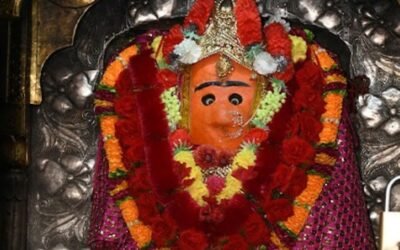
Kamaksha is worshipped here as a form of Durga — locally described by temple priests as “the goddess of goddesses” — and functions as the presiding deity of the wider Karsog area, drawing devotees whose relationship with her is bound up closely with local identity rather than a purely regional or national pilgrimage circuit. It’s worth noting a naming coincidence worth being careful about: this temple shares its name with two much better-known shrines elsewhere in India — the major Kamakhya Shakti Peeth in Assam, and Kamakshi Amman Temple in Kanchipuram, Tamil Nadu — and Kao’s temple is sometimes locally described as “the third” or “the only one in Himachal” bearing this name, a claim to distinctiveness rather than a suggestion of any direct historical link to those two much larger, independently ancient shrines.
A further complication worth flagging directly: a separate, independently documented Kamaksha temple exists at a place called Jaidevi in Mandi district, serving as the kuldevi (family deity) shrine of the former Suket royal family, with its own tradition that the goddess’s idol was originally brought from Assam by Suket’s kings. That Jaidevi shrine is a genuinely distinct temple with its own royal, dynastic history — quite different from Kao’s locally rooted Mahishasura legend — and the two shouldn’t be assumed to be the same site simply because they share a name and a district; readers researching this temple online should be aware that some general reference material (including at least one encyclopedia entry) actually describes the Jaidevi shrine rather than the one in Kao.
🏛️ The Temple Itself
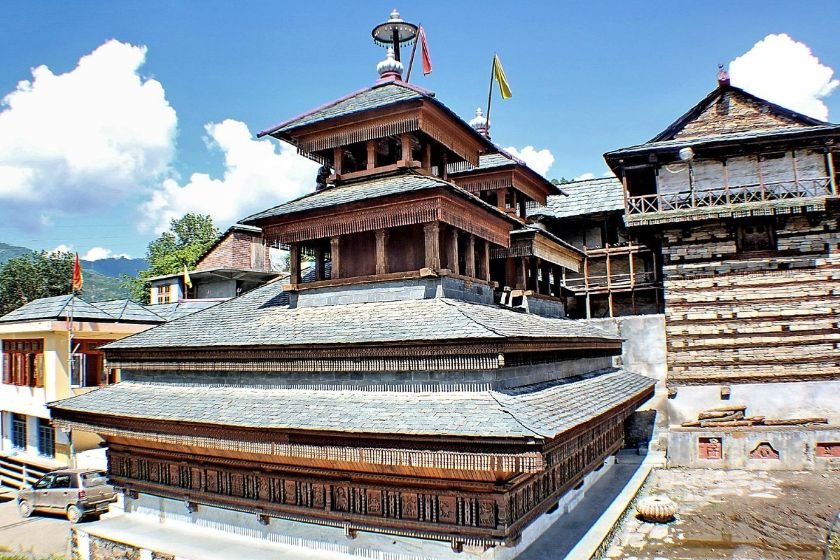
Kamaksha Devi’s temple is a striking example of traditional Himachali wooden pagoda-style architecture, built using a stone-and-timber grid construction technique without any concrete mortar — the same interlocking method that gives many of the region’s older hill temples their resilience. According to at least one detailed local account, the original structure was built primarily of stone, with its current, more elaborate wooden superstructure added roughly a decade and a half before that account was written — meaning the temple’s celebrated woodcarving, while genuinely old in tradition, may represent a more recent renovation layered onto an older stone base rather than original centuries-old timber.
Visitors consistently describe the woodcarving as exceptional even by the high standard of Himachal’s other wooden shrines, with detailed pagoda-style tiering and craftsmanship credited to local artisans rather than any single named royal patron. The temple sits on a hilltop with panoramic views across the Karsog Valley’s apple orchards and deodar forest, and several visitor accounts mention ancient artifacts around the site adding to its sense of age and mystery, alongside the more mundane charm of a resident temple cat that several reviewers single out as a highlight of their visit.
📜 Karsog Valley’s Layered Mythology
Kamaksha Devi Temple sits within a valley whose very name is said to carry the weight of its own legend: “Karsog” is popularly derived from “Kar Shok,” meaning mourning, tied to local belief that the Pandavas spent part of their exile grieving in this valley. That etymological legend sets the tone for a valley genuinely dense with epic-linked shrines — the Mamleshwar Mahadev temple in Karsog town, credited to Pandava construction and home to a temple drum said to have been played by Bhima himself; the Mahunag temple, dedicated to Karna; and the roofless, high-altitude Shikari Devi shrine, also tied to the Pandava exile tradition. Kamaksha Devi’s Mahishasura legend and its Parashurama connection place it comfortably within this same dense, overlapping web of Karsog Valley mythology, even though its specific ritual history — and that ritual’s recent, court-ordered end — makes it stand apart from its neighbours in a way none of the older legends alone could.
🎉 Festivals and Devotion
- Navratri: The temple’s most significant annual occasion, historically marked by the now-banned buffalo sacrifice tradition and still observed with other rituals honouring the goddess’s victory over Mahishasura.
- General darshan: The temple functions as an active local shrine year-round, serving as the presiding deity site for the surrounding Karsog community.
🏞️ While You’re in the Area
- Mamleshwar Mahadev, Karsog town: A Pandava-linked Shiva temple famous for its carved pillars and a giant temple drum attributed to Bhima.
- Shikari Devi Temple: A roofless Shakti shrine at the highest point in Mandi district, also tied to the Pandava exile legend.
- Mahunag Temple: Dedicated to Karna of the Mahabharata, reached via a partial trek roughly 25 km away.
- Bhim Rock: A rock formation resembling a snake’s hood, locally believed to be a snake turned to stone by Bhima.
- Pangna Killa: A historic fort-temple complex elsewhere in the Karsog Valley circuit.
❓ Quick Questions Travellers Ask
Is buffalo sacrifice still practiced at this temple? No — the Himachal Pradesh High Court ruled against the practice after a legal challenge, and animal sacrifice has since been banned across the state; the temple continues to observe Navratri through other rituals instead.
Is this the same Kamaksha temple mentioned on Wikipedia? Not necessarily — Wikipedia’s main “Kamaksha Temple” article actually describes a different shrine at Jaidevi in Mandi district, the kuldevi temple of the former Suket royal family, which has its own distinct history involving an idol reportedly brought from Assam. This article describes the separate, locally rooted temple in Kao village near Karsog.
What should I know before visiting, in terms of temple etiquette? Leather items of any kind — shoes, belts, watch straps, camera straps — aren’t permitted inside, and photography inside the temple is generally discouraged or restricted; it’s worth checking current rules with temple staff on arrival.
Is there an entry fee? No entry fee could be confirmed for this article; as an actively worshipped local shrine, general darshan is very likely free.
How does this fit into a broader Karsog Valley visit? Very naturally — it’s commonly visited alongside Mamleshwar Mahadev and other Karsog Valley temples as part of a single day’s exploration of the valley’s dense cluster of Pandava- and Parashurama-linked shrines.
A Last Word
There’s something genuinely rare about a temple whose myth and modern legal history sit this close together — a goddess who supposedly killed a buffalo-demon in the Satya Yuga, and a High Court, centuries or millennia later, ruling on whether her devotees could still sacrifice a real one in her honour. Kamaksha Devi Temple doesn’t resolve that tension by pretending the courtroom chapter didn’t happen; it simply carries both, the ancient victory and the modern ruling, side by side, the way Karsog Valley itself carries grief in its very name and orchards in its hillsides. Few temples in this series have had their defining ritual settled this recently, or this definitively.
Fact-check note: The temple’s location in Kao village near Karsog, its Mahishasura-slaying legend, its historic buffalo sacrifice tradition and the tradition’s cessation following a legal challenge, and its pagoda-style wooden architecture are corroborated across independent regional sources. A separate, independently documented Kamaksha temple at Jaidevi in Mandi district — the Suket royal family’s kuldevi shrine — is a genuinely distinct site from the one described here, and is the temple actually covered by Wikipedia’s main “Kamaksha Temple” article; this piece describes the Kao/Karsog shrine specifically. Unverified and flagged above rather than repeated as fact: the claim that the original deity image is kept underground, and the exact timing of the temple’s wood-superstructure renovation, both of which appear in only a single source. No entry fee could be confirmed.