In a small Kangra village painted almost entirely yellow, pilgrims come not to ask for blessings in the usual sense, but to ask a goddess to stop someone else in their tracks.
Most temples are built around hope — for health, for children, for rain, for a good harvest. The Baglamukhi Temple at Bankhandi is built around something narrower and stranger: the specific, unapologetic desire to see an opponent rendered powerless. Baglamukhi is one of the ten Mahavidyas, the great tantric wisdom-goddesses of Shakta tradition, and her particular gift is stambhan — the power to freeze, paralyze, or still whatever threatens you, whether that’s a rival in a lawsuit, an enemy in business, or simply an obstacle that won’t move. It’s an unusually blunt kind of devotion for a country full of gentler pilgrimage sites, and it’s drawn a correspondingly unusual crowd over the years, from ordinary petitioners with court dates to, by some accounts, politicians and public figures hoping the same stillness might settle in their favour.
🌄 Location & How to Reach It
The temple sits in Bankhandi village, near Dehra, in Kangra district, Himachal Pradesh, directly on the Chandigarh–Dharamshala Highway (NH503), roughly 30–40 km from Kangra town.
Google Maps: Get Directions
Sitting directly on a major highway, this is one of the more straightforwardly accessible pilgrimage sites in the region, without the steep climbs or narrow final approaches that mark many Himachal hill temples.
- By road: Regular buses and taxis run from Kangra, Dharamshala, and Pathankot, as well as longer-distance services from Delhi, Chandigarh, Amritsar, and Jalandhar; being on NH503 makes this an easy stop for anyone driving the Chandigarh–Dharamshala route.
- By rail: Reported distances vary — Kangra Mandir station is cited anywhere from roughly 35 to 48 km away depending on the source, with Pathankot Junction further out at around 90 km.
- By air: Gaggal (Kangra) Airport is the nearest, though again, reported distances differ noticeably between sources, ranging from around 11 km to 40 km — worth confirming with a live map rather than relying on any single figure.
Given its highway-side location, this is a temple that fits easily into a broader Kangra Valley road trip rather than requiring a dedicated, effort-heavy detour.
🌸 Best Time to Visit
The temple is generally open daily from around 5 a.m. to 9:30 p.m., with a short midday closure — reported consistently across sources as falling somewhere around noon to 12:30 p.m. Navratri, especially the autumn observance in September–October, is by far the most significant time to visit, when the temple takes on its fullest devotional intensity; Dussehra and Diwali are also marked with particular grandeur here.
🕉️ The Legend: A Storm the Gods Couldn’t Calm
The story most consistently told about Baglamukhi’s origin doesn’t begin at Bankhandi at all — it begins with a catastrophe. In the Satya Yuga, according to the legend, a storm of such violence swept across the earth that it threatened all creation. Vishnu, alarmed, went to Shiva for help; Shiva, in turn, told him that only Shakti herself could restore order. Vishnu performed austerities at the edge of Haridra Sarovar — the “lake of turmeric” — and his devotion was answered when the goddess rose directly from the lake’s yellow waters in the form of Baglamukhi. She stilled the storm, and in doing so revealed the power she would become known for ever after: not destruction, but stillness — the ability to stop a force, however overwhelming, in its tracks.
A second layer of the temple’s story moves the timeline forward to the Dwapara Yuga and the events of the Mahabharata: the Pandavas, during their period of hidden exile (Agyaatvas), are said to have built the temple at Bankhandi in a single night and performed a powerful havan here to secure the goddess’s blessing — an origin story echoed at several other Kangra-area shrines and worth reading as much as a marker of the site’s felt antiquity as a literal historical claim.
A further, more specifically epic-linked tradition — recounted in fewer independent sources than the storm and Pandava stories, and worth treating as a secondary tradition rather than the temple’s core legend — holds that Lord Rama, guided by Hanuman, worshipped Baglamukhi at this site to obtain the Brahmastra, the celestial weapon that proved decisive in his war against Ravana.
None of these are, of course, verifiable history in the ordinary sense, and it’s worth being upfront about that: like most Mahavidya shrines, Bankhandi’s mythic timeline reaches back to a cosmic and epic past that predates any documentary record. What’s more genuinely uncertain is a specific claim repeated in at least one source — that the temple’s stone idol is “over 800 years old.” That figure appears in only a single consulted source, without independent corroboration, and should be treated with real skepticism rather than repeated as settled fact.
🙏 What Baglamukhi Is Known For
Baglamukhi — from “Bagala” (bridle or restraint) and “Mukhi” (face) — is the eighth of the ten Mahavidyas in Shakta tantric tradition, also known as Pitambara or Peetambara for her signature colour. Where many Devi temples are approached with broad requests for protection or prosperity, Bankhandi’s devotees tend to arrive with sharper, more targeted concerns: an ongoing legal case, a business rivalry, a specific person or situation they feel powerless against. The goddess’s particular domain — stambhan shakti, the power to immobilize — makes this one of the more distinctively purpose-built pilgrimage sites in the Kangra Shakti belt, standing alongside but functioning quite differently from nearby shrines like Chamunda Devi and Jwalamukhi.
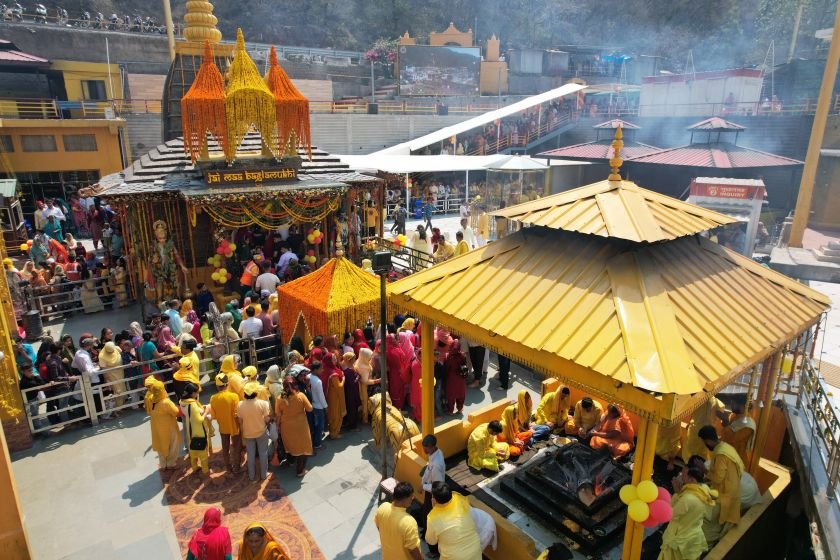
The temple is one of only three historically significant Bagalamukhi shrines in India, the other two being the Pitambara Peeth in Datia and a Bagalamukhi temple in Nalkheda, both in Madhya Pradesh — a genealogy that gives Bankhandi real standing within the wider Mahavidya tradition rather than positioning it as a purely local or regional shrine. Ritual practice here centers on daily aarti, turmeric and yellow-flower offerings, and — most distinctively — havan (fire sacrifice) performed with particular intensity at night, which devotees believe yields results within a specific window, commonly cited as 36 days. Navgraha Puja and Vaksiddhi Puja (rituals associated with speech and eloquence, relevant to legal and rhetorical contests) are also performed here.
🏛️ The Temple Itself
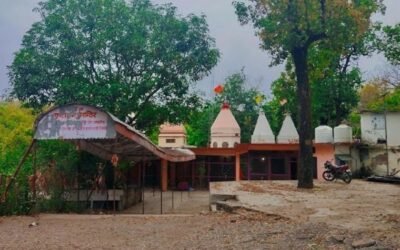
Yellow dominates everything here, inside and out — the temple’s domes, pillars, and entrance are all painted in the goddess’s favoured colour, and devotees typically dress in yellow and bring offerings of yellow sweets, most commonly besan ki laddoo, to match. The sanctum houses a seated idol of Baglamukhi in golden-yellow attire, described across sources as having a dark face, shimmering golden or three eyes, a crown, and a nose ring, with a mace or club resting at her side — the weapon associated with her power to subdue. Some accounts describe her flanked by Lakshmi and Saraswati as complementary aspects of the divine feminine, though this detail isn’t universally repeated across sources.
Descriptions of the architectural style itself don’t fully agree — most sources describe a traditional Pahari or Himachali style suited to heavy snowfall, with a curved or dome-shaped roof supported by open pillars, while at least one source instead describes a blend of Hindu and Buddhist architectural influences; this discrepancy is worth flagging rather than resolving, since it likely reflects differing impressions of a structure that combines several stylistic elements. A large octagonal havan platform, topped with a tiered, pagoda-style spire, dominates the temple grounds and is the visible center of the site’s fire-ritual tradition. Separate shrines to Bhairava and Hanuman stand before the main sanctum, and a Shiva lingam shrine sits nearby — devotees traditionally offer water to Shiva after completing their darshan of the goddess.
📜 Kangra’s Shakti Circuit
Bankhandi sits within what’s often called the Kangra Shakti belt — a dense cluster of Devi shrines across the district that includes Jwalamukhi’s eternal flame, the Shakti Peeth at Brajeshwari Devi, and Chamunda Devi on the Baner river, among others. Many pilgrims fold Bankhandi into a broader regional circuit sometimes referred to locally as the Nava Shaktipeeth Yatra. One government tourism source also places a Bagalamukhi shrine at the entrance to Kotla Fort near Kangra — a reference that doesn’t clearly match Bankhandi’s own location and may point to a separate, smaller shrine associated with the same goddess elsewhere in the district; this is noted here as an unresolved discrepancy rather than a confirmed second site. Either way, Bankhandi’s position within this wider network of Shakti worship, layered across the Dhauladhar foothills, reflects a region where goddess devotion has multiple, sometimes overlapping centers rather than a single dominant shrine.
🎉 Festivals and Devotion
- Navratri (Autumn, September–October, and Spring): The temple’s most significant festival period, celebrated with particular grandeur.
- Dussehra and Diwali: Also marked with major celebration and higher visitor numbers.
- Nightly havan: A distinctive, ongoing ritual practice rather than a once-a-year event, drawing devotees seeking specific, time-bound results.
- Daily aarti and worship: Conducted from early morning through the evening, with a short midday pause.
🏞️ While You’re in the Area
- Chamunda Devi Temple: About 20 km away, one of Himachal’s most revered Shakti Peeths, set against the Dhauladhar backdrop.
- Masroor Rock Cut Temples: Roughly 30 km away, an 8th-century complex of monolithic temples often called the “Ellora of Himachal.”
- Pong Dam Lake: Around 35 km away, a major wetland sanctuary popular with birdwatchers, especially in winter.
- Kangra Fort: Approximately 25 km away, one of the largest and oldest forts in India, with its own Ambika Devi shrine.
- Kareri Lake: A high-altitude freshwater lake in the Dhauladhar range, popular with trekkers looking to extend a Kangra visit into the mountains.
❓ Quick Questions Travellers Ask
Is this temple only for people dealing with legal disputes or conflicts? No — while it’s especially known for legal and competitive matters, devotees also visit for general protection, removal of obstacles, and broader spiritual purposes; the “enemy-paralyzing” reputation is its distinctive specialty, not its only function.
Can visitors participate in the night havans, or are they only for priests? Sources describe the night havans as a major draw for devotees seeking specific outcomes, though the more intensive tantric rituals associated with the site are generally understood to require experienced priests; check with temple staff about what’s open to general visitors versus what requires a booked, guided ritual.
Is there accommodation near the temple? Yes — the temple trust reportedly manages some pilgrim accommodation within the complex, and Bankhandi’s location on a major highway means additional lodging options are available nearby along the Chandigarh–Dharamshala route.
Why is everything at the temple yellow? Yellow is Baglamukhi’s signature colour, tied to her mythic emergence from a turmeric lake; devotees echo this by wearing yellow, offering yellow sweets, and the temple itself is painted yellow throughout.
Is there an entry fee? No entry fee could be verified for this article; as an active devotional site run by a temple trust rather than a ticketed monument, general darshan is very likely free, though specific ritual bookings (such as havans) may carry a cost — best confirmed directly with the temple.
A Last Word
There’s a certain honesty to a temple built around a request most people are reluctant to say out loud — not “help me flourish,” but “help me stop what’s working against me.” Baglamukhi’s mythology runs from a storm that threatened all creation to a war that decided an epic, and somewhere in the middle of all that, a small yellow temple beside a Himachal highway became one of only three places in India where that particular, unflinching form of the goddess is enshrined at scale. Whether you come seeking victory in something specific or simply curious about a shrine unlike most others in the valley, Bankhandi doesn’t ask you to soften the request. It just asks you to name it.
Fact-check note: The temple’s dedication to Baglamukhi as one of the ten Mahavidyas, her association with stambhan shakti and the colour yellow, its status as one of three major Bagalamukhi shrines in India, and its location on NH503 near Dehra are well corroborated across independent sources, including government tourism materials. Genuinely unsettled and flagged above rather than resolved with false precision: exact distances to the nearest airport and railway station (which vary significantly across sources), the precise architectural influences on the current structure (Pahari/Himachali vs. a claimed Hindu-Buddhist blend), the specific “800-year-old idol” claim (found in only one source), and a government reference placing a Bagalamukhi shrine at Kotla Fort that doesn’t clearly correspond to Bankhandi. No independently verified GPS coordinates or entry fee could be confirmed; check current details directly with the temple trust where possible.