Every October, while the rest of India sets fire to effigies of the demon king, one small Himalayan temple town quietly declines to join in.
Dussehra is about as universal a festival as India has — the defeat of Ravana, celebrated with towering effigies going up in flames from Delhi to Mysore. Baijnath doesn’t do that. In this one town, tucked against the Dhauladhar range on the banks of the Binwa River, Ravana isn’t the villain of the story; he’s the reason the temple exists at all. Local tradition holds that it was Ravana’s own devotion to Shiva, and the god’s decision to heal him and travel partway to Lanka in his company, that left a fragment of the divine behind on this exact spot — which is why, centuries later, burning his effigy here still feels to locals like an insult delivered at the wrong address. It’s a small, quietly defiant detail, and it sets the tone for a temple that turns out to be unusually well documented for its age, with actual named builders, a dated inscription, and a nine-century paper trail that most Indian temples of comparable antiquity simply don’t have.
🌄 Location & How to Reach It
Baijnath Temple stands in the town of Baijnath, Kangra district, Himachal Pradesh, on the banks of the Binwa River (a tributary of the Beas), at an altitude of around 1,050 metres, with the Dhauladhar range rising behind it. The town sits directly on National Highway 20, between Pathankot and Mandi, and was known in antiquity as Kiragrama before the temple’s fame gave the settlement its present name.
Google Maps: Get Directions
Baijnath is roughly 17 km from Palampur and about 24 km from Bir Billing, making it an easy stop for anyone already touring that part of the Kangra Valley.
- By road: Well connected via NH20; regular buses and taxis run from Dharamshala, Palampur, Bir-Billing, and other towns along the highway.
- By rail: Baijnath Paprola railway station sits right in town, on the narrow-gauge Kangra Valley line linking Pathankot, Kangra, Palampur, and Jogindernagar — genuinely convenient by Himachal standards.
- By air: Gaggal (Dharamshala/Kangra) Airport is the nearest, roughly 50–56 km away depending on the exact route.
Unlike many of Kangra’s hilltop or riverside shrines, Baijnath sits right in the middle of an accessible highway town, so this is one of the easier temple visits in the region — no long climbs, no unpaved final stretch.
🌸 Best Time to Visit
Winter (October–February) brings cool, clear weather in the 5–15°C range and snow-dusted Dhauladhar views that make the temple’s backdrop especially striking; summer (March–June) is milder and pairs well with side trips to Bir Billing and Palampur. Mondays, considered auspicious for Shiva worship generally, see noticeably higher footfall here. The town’s single biggest occasion is Maha Shivratri, marked as a five-day, state-level festival that draws tens of thousands of pilgrims from across Himachal Pradesh and beyond; a smaller, monthly Shivratri observance also brings devotees throughout the year.
🕉️ The Legend: A Lingam That Would Not Reach Lanka
The temple’s central story begins not with Shiva but with Ravana, the demon king of Lanka and, in this telling, one of Shiva’s most devoted worshippers. According to the legend, Ravana travelled to Kailash and performed severe penance there, seeking the invincibility that would let him challenge the gods themselves. When those prayers went seemingly unanswered, he pushed further, journeying to a site associated with present-day Manimahesh in Chamba district and escalating his austerity to a genuinely brutal extreme — offering his own heads, one by one, into a sacrificial fire. Alarmed at what Ravana might become if that penance succeeded, the Devas appealed to Shiva to intervene. Shiva appeared, restored Ravana’s severed heads, and in doing so earned the title Vaidyanath — “Lord of Physicians,” the healer.
Grateful and emboldened, Ravana asked for one more favour: that Shiva accompany him back to Lanka to be consecrated there. Shiva agreed, but on one condition — he would take the form of a linga for the journey, and Ravana must never set that linga down on the ground before reaching Lanka, or it would root itself permanently wherever it touched earth. The journey went smoothly until it reached the area of present-day Baijnath, where Ravana, needing to relieve himself, handed the linga to a shepherd for safekeeping — a shepherd who was, in most versions of the story, Vishnu in disguise, sent to ensure exactly this outcome. Unable to bear the weight, the shepherd set it down. The linga fixed itself to the spot instantly, splitting into two forms worshipped ever since as Vaidyanath and Chandrabhal. Ravana, the story goes, was left in Lanka without the very deity he’d hoped to install there.
It’s worth being honest about where legend and verified history actually meet here. The temple’s own inscriptions — carved into stone slabs inside the mandapa and independently confirmed by multiple sources — record that the current structure was built in Saka year 1126, corresponding to 1204 CE, by two merchant brothers named Ahuka and Manyuka, sons of a merchant called Siddha, under the regional overlordship of a king named Jayachandra. Crucially, those same inscriptions describe the brothers building a temple to house a Shiva linga that already existed on the site — meaning the Ravana legend and the sanctity of this particular spot predate the visible 13th-century structure by an unknown, unrecorded stretch of time. Some traditions push that earlier history further still, suggesting an even older shrine here was destroyed by natural calamity before Ahuka and Manyuka’s reconstruction, though this remains folklore rather than something the inscriptions themselves confirm.
Baijnath’s link to the Jyotirlinga tradition is genuinely, openly disputed rather than settled. Several sources describe it as one of the twelve Jyotirlingas of Shiva; others point out that the Adi Shankaracharya’s Dwadasha Jyotirlinga Stotra is generally understood to refer instead to the Vaidyanath temple in Deoghar, Jharkhand — with a third contender, the Vaidyanath temple at Parli in Maharashtra, also claiming the same identity in certain texts. All three temples are venerated locally as genuinely sacred sites regardless of which one the classical verses actually intended, and that’s really the most honest way to leave it: a live, long-running disagreement rather than a fact anyone can adjudicate from here.
🙏 What Vaidyanath Is Known For
Worshipped here specifically as Vaidyanath — the Lord of Physicians — Shiva’s healing aspect is what distinguishes Baijnath’s devotional character from most other Shiva shrines in the region. Devotees come seeking relief from illness and physical suffering as much as general blessings, and the water from the nearby stream is widely believed among worshippers to carry genuine medicinal value. This is also, notably, one of relatively few Indian temples where Ravana himself is treated with something closer to reverence than condemnation — a direct consequence of the linga’s origin story, and the reason behind the town’s singular refusal to burn his effigy at Dussehra, even as the rest of the country marks the same festival with exactly that ritual.
Daily worship follows an unbroken puja routine that, by most accounts, has continued without interruption for centuries, and Maha Shivratri remains by far the temple’s most significant collective devotional moment, transforming the town into a genuine pilgrimage hub for several days each year.
🏛️ The Temple Itself
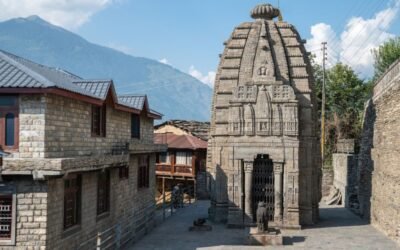
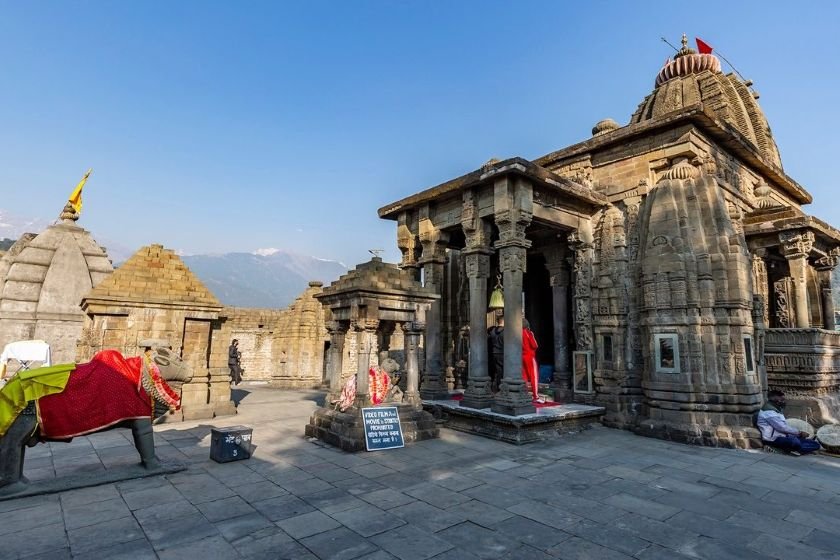
Architecturally, Baijnath is a well-preserved example of Nagara-style North Indian temple design, with a distinctive regional twist: several sources describe its detailing as blending Nagara forms with elements more typical of Orissan (Kalinga) temple architecture, a combination that isn’t especially common elsewhere in Himachal Pradesh. The temple has two entrances, north and south, opening into a spacious mandapa with balconies along its sides. A small four-columned porch precedes the mandapa, and it’s here that a Nandi (Shiva’s bull mount) sits facing the sanctum, as is traditional at Shaivite temples. Beyond the mandapa lies the garbhagriha (inner sanctum), where the linga itself rests behind walls carved with figures of gods, goddesses, and celestial beings, along with floral motifs typical of the medieval Nagara idiom. Above it all rises a curvilinear shikhara, restored and repaired at several points across the 20th century — including a full reinstallation of the tower’s original-style kalasa (pinnacle) around 1999–2000 — as part of an ongoing, carefully managed programme of ASI conservation that has included debris clearing and stonework grouting dating as far back as the 1920s.
Remarkably, the temple survived the catastrophic Kangra earthquake of April 1905 — a magnitude event that killed more than 20,000 people and levelled much of Dharamshala, McLeodGanj, and Kangra town — with comparatively minimal structural damage, a detail that speaks to both the quality of its original construction and no small amount of luck.
📜 A Rare Documented Chapter of Kangra’s Temple History
What sets Baijnath apart from most of the region’s ancient shrines isn’t its legend — plenty of Kangra temples have equally rich mythology — but the unusual clarity of its verified history. The founding inscription doesn’t just give a date; it names the builders, their father, their local ruler, and even records specific donations (land, shops, an oil mill) made to sustain the temple’s upkeep, placing it firmly within the broader Trigarta (Kangra) region’s political structure of the early 13th century rather than leaving it as an undated, anonymous shrine. The temple was substantially renovated in the 18th century under Sansar Chand II, the Katoch king whose patronage shaped several major religious sites across Kangra district during that period — tying Baijnath into the same royal building tradition responsible for work at Kangra Fort and elsewhere in the valley.
🎉 Festivals and Devotion
- Maha Shivratri: Baijnath’s major annual event, observed as a five-day, state-level festival drawing large numbers of pilgrims from across Himachal Pradesh and beyond.
- Monthly Shivratri: A smaller-scale but regular observance held throughout the year.
- Mondays: Considered especially auspicious for Shiva worship, with correspondingly higher visitor numbers.
- Dussehra (notably absent): Unlike almost anywhere else in India, Baijnath does not burn effigies of Ravana, out of respect for his devotion to Shiva and his association with the temple’s founding legend.
🏞️ While You’re in the Area
- Bir Billing: India’s paragliding capital, roughly 24 km away, a striking contrast to the temple’s quiet devotional pace.
- Palampur: Around 17 km away, known for its tea gardens and views of the Dhauladhar range.
- Masroor Rock Cut Temple: A monolithic 8th-century rock-cut complex elsewhere in the Kangra Valley, worth combining on a broader temple-focused itinerary.
- Chamunda Devi Temple and Kangra Fort: Further along the valley, both major stops on a wider Kangra heritage circuit.
- Dharamshala and McLeodGanj: Roughly 50 km away, offering a Tibetan-influenced hill-station contrast to Baijnath’s older Hindu pilgrimage character.
❓ Quick Questions Travellers Ask
Is it true this is one of the twelve Jyotirlingas? It’s genuinely disputed — some traditions list it among the twelve, while classical Sanskrit verses on the subject are generally understood to point to the Vaidyanath temple in Deoghar (or, in some texts, Parli) instead. Baijnath is venerated locally as deeply sacred regardless of how that specific classification is resolved.
Why doesn’t Baijnath celebrate Dussehra like the rest of India? Because local tradition treats Ravana as a devoted Shiva worshipper directly connected to the temple’s founding legend, burning his effigy here is considered disrespectful to that devotion — a distinctive local practice found in very few other places in India.
How old is the temple, really? The current structure is confidently dated to 1204 CE by its own inscriptions, naming its builders directly — but those same inscriptions describe an earlier Shiva linga already present at the site, meaning the spot’s sanctity predates the visible building by an unknown span of time.
Is the temple wheelchair- or elderly-accessible? Being located in town on relatively flat ground, Baijnath is considerably easier to access than many of Kangra’s hilltop shrines, though the sanctum interior and mandapa involve some uneven, older stone flooring.
Is there an entry fee? No entry fee could be confirmed for this article; as an active, ASI-protected place of worship rather than a purely ticketed monument, general darshan is very likely free, though it’s worth confirming locally.
A Last Word
There’s a certain grace in a town that has spent eight centuries quietly withholding judgment on the one figure the rest of the country agrees to condemn every autumn. Baijnath doesn’t ask you to take a side on Ravana — it just asks you to notice that devotion, even a demon king’s, isn’t always simple, and that a god willing to heal his most extreme devotee is a slightly different Shiva than the one enshrined elsewhere. Between the dated inscriptions naming two merchant brothers and a story about a linga too heavy for a disguised god to carry, Baijnath holds both its documented history and its living myth with equal seriousness — which, after so many temples where one has almost entirely swallowed the other, feels like its own kind of rare.
Fact-check note: The temple’s 1204 CE construction date, its builders Ahuka and Manyuka, its pre-existing Shiva linga, its 18th-century renovation under Sansar Chand II, and its survival of the 1905 Kangra earthquake are well corroborated across independent government, academic, and archaeological sources, including inscriptions on-site. The temple’s identification as one of the twelve Jyotirlingas is genuinely and openly disputed among sources rather than settled, and is presented above as such rather than resolved one way or the other. No independently verified entry fee could be confirmed; details on ASI conservation dates (1921–22, 1953–54, 1999–2000) come from a single detailed source and, while plausible and consistent with the temple’s known ASI-protected status, haven’t been cross-verified against a second independent source.