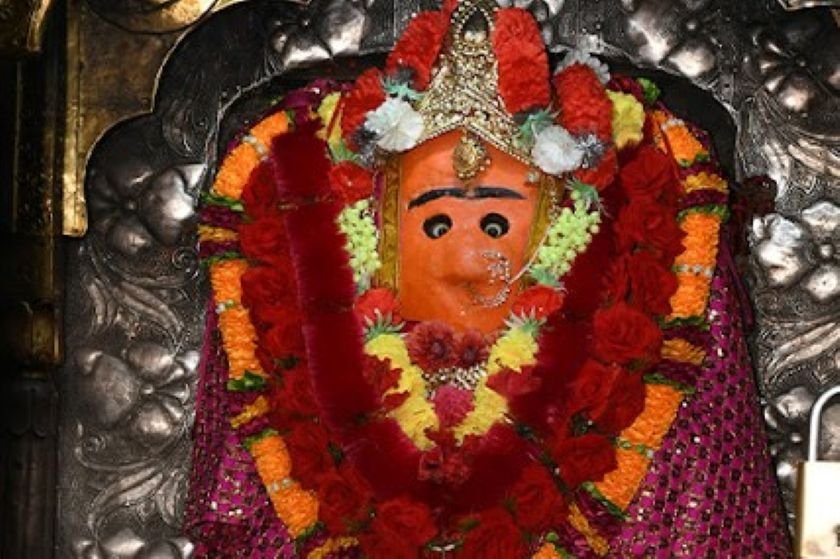
In a valley temple below the Dhauladhar peaks, the goddess enshrined at the altar is kept permanently wrapped in cloth — not for modesty, but because her devotees believe her true form is more than most people could safely see.
Some goddesses are approached with flowers and quiet requests. Chamunda is approached with something closer to respect for raw force. She’s the form Durga takes at her most unrestrained — born, according to scripture, specifically to hunt down and destroy two demons no gentler deity could handle — and the temple built in her honor on the banks of the Baner River reflects that intensity in small, telling details: an idol kept draped in red and black cloth rather than left bare, guardian figures at the door fierce enough to match her rather than soften her, and a cave around back where Shiva himself is worshipped not as a separate deity but as her essential counterpart. This is one of Himachal’s most visited Shakti shrines, and also one of its more layered — not just goddess worship, but a story about two forms of the divine, feminine and masculine, sharing a single home.
🌄 Location & How to Reach It
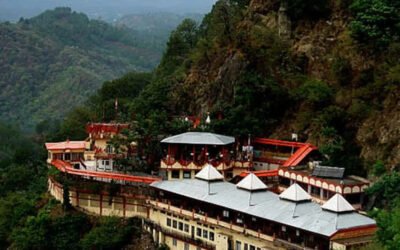
Chamunda Devi Temple — formally known as Shri Chamunda Nandikeshwar Dham — stands in the village of Padar (Dadh), Dharamshala tehsil, Kangra district, Himachal Pradesh, on the banks of the Baner River, roughly 15 km from Dharamshala.
Google Maps: Get Directions
Reported distances from nearby towns vary a little depending on the source and route — Palampur is cited anywhere from about 10 to 19 km away, and McLeodGanj around 24 km — so it’s worth checking a live map for your specific starting point.
- By road: Well connected by bus and taxi from Dharamshala, Palampur, and McLeodGanj; the temple sits in a scenic valley setting with clear views of the Dhauladhar range.
- By rail: Sources point to two different options depending on which line you’re on — Kangra railway station, around 14 km away on the Kangra Valley narrow-gauge network, or Moranda near Palampur, cited by other sources as the nearest narrow-gauge stop at roughly 30 km.
- By air: Kangra (Gaggal) Airport is the nearest, generally cited at around 25–28 km away, with daily flights to Delhi and Chandigarh.
This is one of the more accessible major Shakti shrines in the Kangra Valley — a valley-floor riverside site rather than a steep hilltop climb, which is itself part of the temple’s own founding story.
🌸 Best Time to Visit
Spring and autumn, coinciding with the two Navratri observances, offer the most pleasant weather alongside the temple’s fullest devotional energy; summer mornings are comfortable, while the monsoon brings heavy rainfall worth planning around. The temple is generally open daily from around 6 a.m. to somewhere between 7 and 8 p.m. Navratri — celebrated twice yearly, in March–April and September–October — is by far the busiest and most significant time to visit, along with an annual Chamunda Devi Fair held in April.
🕉️ The Legend: A Goddess Born From Fury, and a Shrine Moved by a Dream
Chamunda’s origin story comes directly from the Devi Mahatmya, one of Shaktism’s foundational texts, and it’s worth telling as the two-part story it actually is: how the goddess came to exist, and, separately, how she came to be worshipped at this particular spot.
In the scriptural account, during a fierce war between gods and demons, the goddess Kaushiki (an emanation of Parvati) drew a fierce warrior form, Chandika, out of her own contracted brow in response to an attack by two demon generals, Chanda and Munda. Chandika hunted the pair down and killed them in battle, and in recognition of that victory, Kaushiki granted her the name Chamunda — a fusion of her two slain adversaries’ names. It’s a origin built entirely around righteous, controlled fury, and it’s why Chamunda is traditionally depicted and approached as one of Durga’s fiercest, most intense forms rather than one of her gentler ones.
The temple’s presence at this specific riverside spot, however, is a separate and much more local story. According to tradition, the goddess’s original shrine sat atop a remote hill known as Aadi Himani Chamunda — a site so difficult to reach that, several hundred years ago, a local king and a Brahmin priest prayed to her for permission to relocate her worship somewhere more accessible. She is said to have appeared to the priest in a dream, directing him to a specific spot to dig and recover a sacred image. When the king’s men located it, they found they couldn’t lift it at all — not because of its weight, but, the goddess explained in a second dream, because they’d approached it as an ordinary stone rather than as her. Only when the priest himself bathed, dressed in fresh clothes, and returned in a properly devotional state was he able to lift the idol easily and install it where the temple now stands.
It’s worth flagging that sources genuinely disagree on when this happened and how old the resulting temple actually is — some describe the relocation as roughly 400 years ago (putting the current temple’s founding in the 16th century), others push the same event back to the 17th century, and at least one source describes the structure as closer to 700 years old. Rather than force these into a single confident number, it’s fairest to say the temple is old and long-established, with the exact century genuinely unsettled across the sources consulted. Separately, at least one source appears to describe a differently attributed, 18th-century Chamunda Devi temple associated with a Chamba ruler and a different river altogether — almost certainly a distinct shrine that shares the same name and goddess rather than the same building; the Kangra district temple on the Baner River, described throughout this piece, is the one most consistently documented by regional and government sources.
🙏 What Chamunda Is Known For
Chamunda is worshipped here as a fierce, direct form of Durga (and, in some traditions, Kali) — a goddess devotees approach less for gentle blessings and more for protection against genuinely serious threats, along with the fulfillment of sincerely made vows. It’s widely believed among pilgrims that a heartfelt promise made at this temple will be honoured, which draws visitors well beyond the immediate region.
The temple’s alternate name, Chamunda Nandikeshwar Dham, points to its distinctive dual character: this isn’t purely a Devi shrine, but one that explicitly houses Shiva alongside the goddess, in the form of Nandikeshwar. A marble staircase behind the main shrine descends to a natural cave-like recess where a self-manifested (swayambhu) Shivalinga is worshipped, framing the whole complex as a meeting point of Shakti and Shiva rather than a shrine to either one alone. Worth noting honestly: Chamunda Devi Temple is not counted among the 51 canonical Shakti Peethas of classical tradition, though it holds a firmly established place within Himachal’s broader network of major regional Shakti shrines, alongside Jwalamukhi, Brajeshwari Devi, and Baglamukhi.
Daily worship includes regular aarti, and the recitation of the Shat Chandi mantra — a devotional hymn cycle in praise of the goddess — is considered a particularly auspicious practice here, believed by devotees to intensify the effect of prayers offered at the temple.
🏛️ The Temple Itself
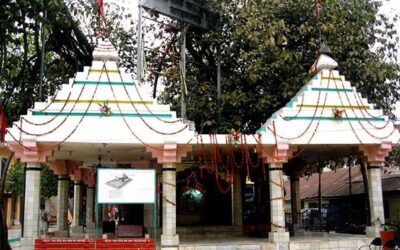
The main shrine follows traditional Himachali wooden architecture: sloping, gabled slate roofs, stone foundations, and richly carved wooden detailing throughout, rather than the stone-and-shikhara style seen at temples like Baijnath or Masroor. Inside the sanctum, the sanctum walls are decorated with carved silver sheets, and the goddess’s idol itself is kept wrapped in cloth — most commonly red and black — rather than displayed bare, a practice tied to the belief that her unclothed form carries an intensity better left veiled from casual view. Flanking the entrance to the inner sanctum stand large guardian images of Hanuman and Bhairav, both understood locally as her protectors. In one corner of the temple, small footprint marks on a stone are pointed out to visitors as the goddess’s own footsteps.
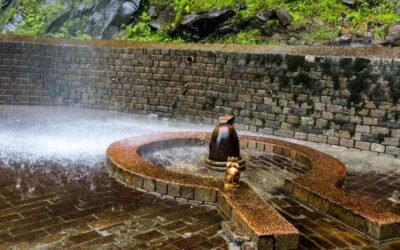
Behind the main shrine, the marble stairway down to the Nandikeshwar cave offers a genuinely different atmosphere from the main sanctum — cooler, closer, lit dimly enough that the self-manifested linga inside feels discovered rather than displayed. The complex’s sacred kund (pond), decorated with sculptures of various deities, gives pilgrims a place for ritual bathing before darshan, a practice many undertake as a first step in visiting the shrine properly. A handicrafts centre within the temple complex sells local Kangra Valley crafts — wood carvings, black pottery, Kangra tea, and the region’s well-known miniature-style paintings — alongside more conventional pilgrim facilities that include a guest house, an ayurvedic dispensary, a library, and a Sanskrit college.
📜 Kangra’s Shakti Network
Chamunda Devi Temple takes its place within a dense cluster of major goddess shrines across Kangra district — a valley whose sacred geography has been shaped by Shakti worship in layered, overlapping forms for centuries, from the eternal flame at Jwalamukhi to the Shakti Peeth at Brajeshwari Devi to the tantric focus of Baglamukhi at Bankhandi. Chamunda’s particular contribution to that landscape is its explicit pairing of goddess and Shiva worship under one roof, and its origin story of relocation from an inaccessible hilltop — a narrative pattern (moving worship from a remote original site to a more reachable one via divine instruction) that recurs at several other Himachal shrines and reflects a very practical, human history of pilgrimage sites adapting to their worshippers over time.
🎉 Festivals and Devotion
- Navratri (Spring, March–April, and Autumn, September–October): The temple’s most significant festival periods, marked by heightened ritual activity and large crowds.
- Chamunda Devi Fair (April): An additional annual fair drawing devotees specifically to the temple.
- Daily aarti and Shat Chandi recitation: Ongoing devotional practices conducted throughout the year.
🏞️ While You’re in the Area
- McLeodGanj and Dharamshala: Roughly 15–24 km away, offering the region’s Tibetan-influenced hill-station character as a contrast to the temple’s older Hindu pilgrimage tradition.
- Baijnath Temple: A 13th-century Shiva shrine elsewhere in the valley, with its own distinctive Ravana legend.
- Masroor Rock Cut Temple: A monolithic 8th-century rock-cut complex, part of a broader Kangra temple circuit.
- Palampur: Known for its tea gardens and Dhauladhar views, a relaxed stop en route.
- Baglamukhi Temple, Bankhandi: Another major Kangra Shakti shrine, with a very different, more tantric devotional focus.
❓ Quick Questions Travellers Ask
Why is the goddess’s idol kept wrapped in cloth? Devotees believe Chamunda’s true, unclothed form carries an intensity considered difficult or inappropriate to view directly, so the idol is traditionally kept draped rather than displayed bare.
Is this the same Chamunda Devi Temple people mention near Chamba? Likely not the same building — at least one source describes a similarly named, 18th-century Chamunda Devi shrine associated with a different river and a Chamba-area ruler, which appears to be a distinct temple that shares the goddess’s name rather than the same physical site as this Kangra district temple on the Baner River.
Can visitors bathe in the temple’s kund? Yes — the sacred pond within the complex is used by pilgrims for a ritual dip, traditionally undertaken before darshan.
Is there accommodation near the temple? Yes — the complex includes a temple guest house, and additional lodging is readily available in nearby Dharamshala and Palampur.
Is there an entry fee? No entry fee could be confirmed for this article; as an active community-run pilgrimage site, general darshan is very likely free, though it’s worth confirming locally.
A Last Word
There’s something quietly powerful about a temple that doesn’t try to soften its central deity to make her easier to approach. Chamunda isn’t presented here as gentle or comforting in the way some goddesses are — she’s wrapped in cloth, flanked by fierce guardians, and paired deliberately with Shiva’s own destructive aspect in the cave behind her shrine — and yet devotees still travel from across India trusting that a sincere vow made in front of her will hold. Maybe that’s the real lesson of a goddess born from someone else’s fury: power this direct doesn’t need to be diluted to be trusted. It just needs to be approached properly, the way that priest eventually learned to lift her.
Fact-check note: The temple’s dedication to Chamunda Devi alongside Nandikeshwar (Shiva), its location on the Baner River near Padar/Dadh village in Kangra district, its Devi Mahatmya origin story, and its dual Navratri festival calendar are well corroborated across independent government and regional sources. Genuinely unsettled and flagged above rather than resolved with false precision: the temple’s exact founding century (accounts range from roughly 400 to 700 years old), precise road distances to nearby towns, and the nearest practical railway station. A separate 18th-century Chamunda Devi temple associated with a Chamba-area ruler and a different river appears in at least one source and seems likely to be a distinct shrine conflated with this one due to the shared deity name — this article describes the Kangra district temple on the Baner River, which is the site most consistently and independently documented. No independently verified entry fee could be confirmed.